
I recently posted reviews of two particularly well-done nature documentaries. Both of these programs covered Mountain Lion ecology to one degree or another. Together, they painted a fascinating portrait of what these animals are capable of and how they survive in Texas and in other places around the country.
The first documentary–Willow: Diary of a Mountain Lion–was about an extraordinary female Mountain Lion living in Montana. This amazing Lion successfully raised six kittens to independence over the course of fifteen months–despite the odds being decidedly against her with this unusually large litter.
Mountain Lions typically produce litters of 2 to 3 kittens. Of those, only approximately 50% survive the 15 to 24 months required to become independent from their mothers.
The next documentary I reviewed was Deep in the Heart: A Texas Wildlife Story, narrated by Matthew McConaughey. This program covered a wide variety of species and ecologies, but one segment in particular was of special interest to me–the segment on Texas Mountain Lions.
Texas
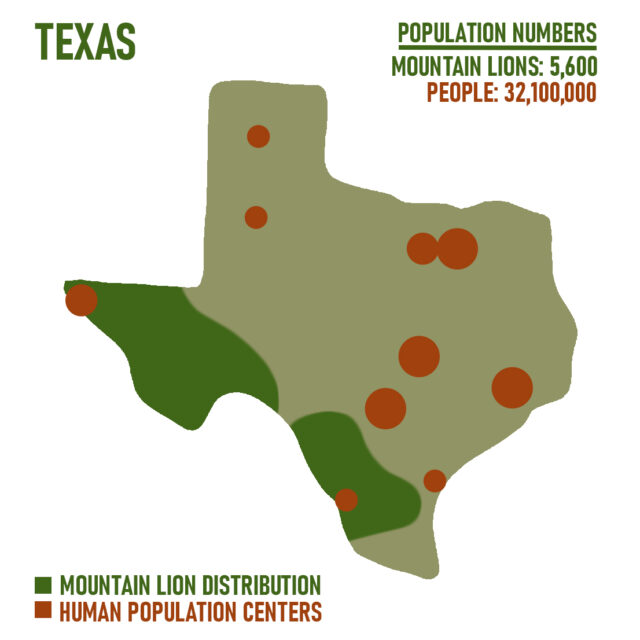
Texas is home to a large population of Mountain Lions. Historically, Mountain Lions ranged across the entire state, but that’s no longer the case. After decades of persecution, the big cats have effectively been restricted to remote regions in the far west and southwest parts of the state–well away from most major population centers.
These two areas of Texas are home to the state’s last remaining breeding populations of Mountain Lions, but transient Mountain Lions sometimes wander far afield of these places. Over the years, there have been rare Mountain Lion sightings in almost every other part of the state. Unfortunately, transient cats do not last long outside of their normal homeland. The journey of most of these wandering Mountain Lions ends abruptly when they run afoul of either a wayward hunter or an automobile.
Over the course of this website’s existence (some twenty years), we have had only a handful of transient Mountain Lions make their way through the Dallas/Fort Worth metroplex. In each case, the Mountain Lions ended their arduous journeys far from their home ranges when their luck ran out, and they were killed. In each instance, the cause of death was either a deer hunter’s rifle or an automobile collision–as is typical.
Texas is a large state–both in terms of land area and population. Public land is rare, though, with around 95% of the land area held as private property. Texas also has many large urban population centers, but most reside well outside expected Mountain Lion distributions. Mountain Lion-Human conflict is essentially nonexistent throughout most of the state.
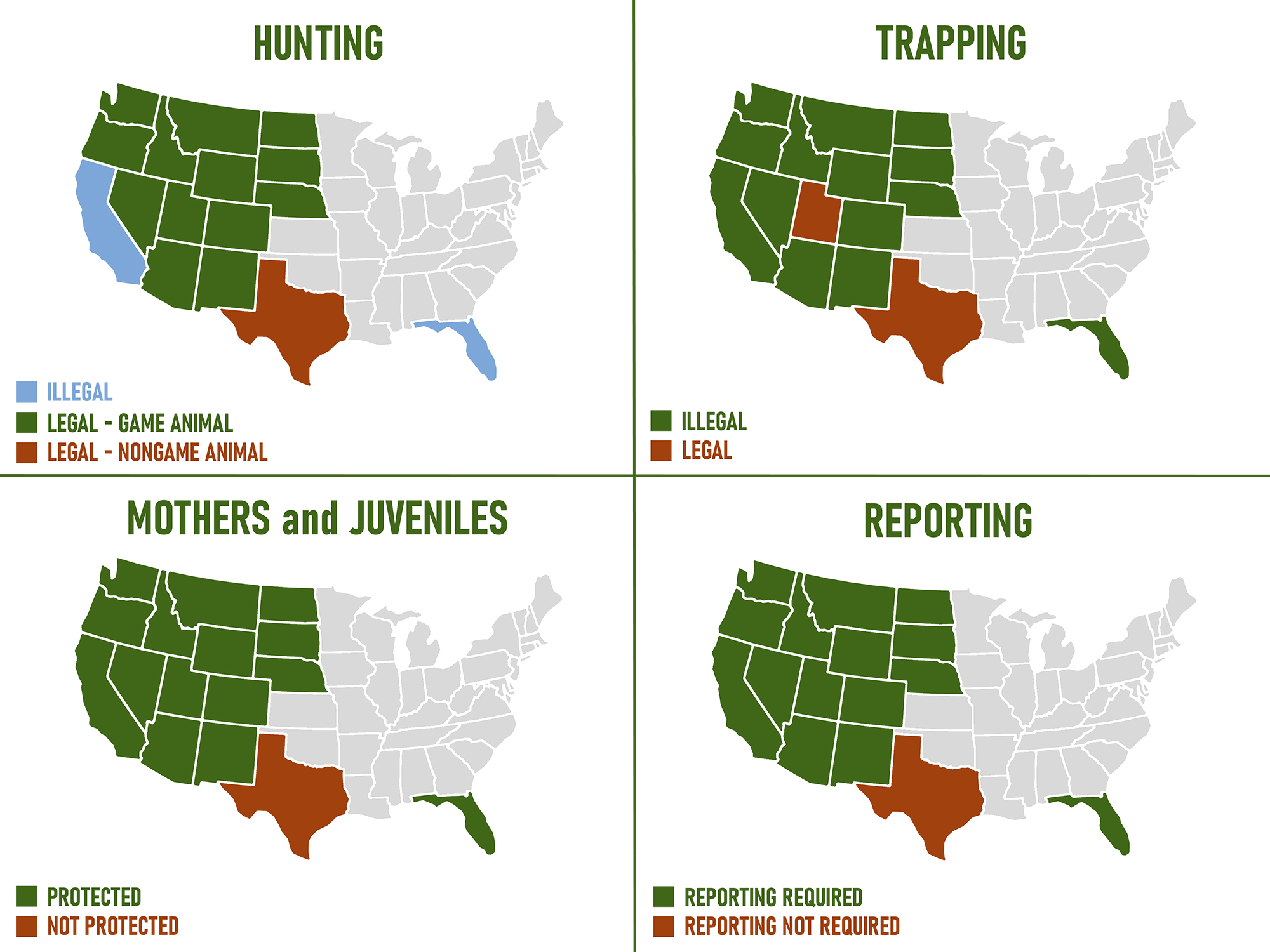
The State of Texas offers Mountain Lions almost no legal protections; reporting Mountain Lion mortalities is not required, and the population is not monitored or managed in a scientific way. Deep in the Heart addressed this situation in significant detail. In the documentary, McConaughey concludes the Mountain Lion segment by describing the official attitudes toward the big cats in Texas as being from a bygone era. I tend to agree with that assessment. It seems to me that we are long overdue for reconsidering how these animals can and should be managed in Texas.
REPORTING – The requirement to notify and involve state authorities when a Mountain Lion encounter or mortality has occurred.
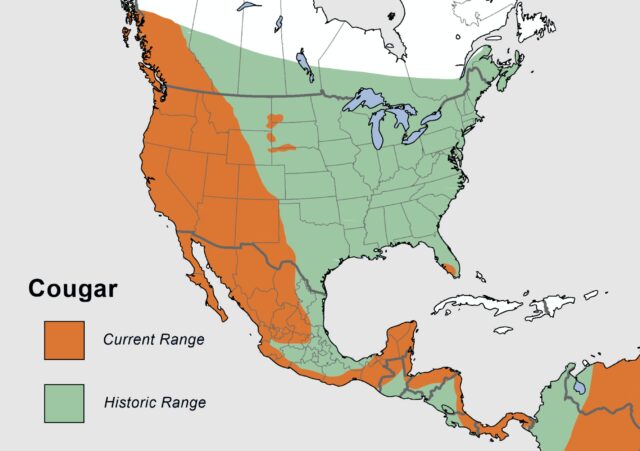
In addition to Texas, 15 other states have known resident and reproducing Mountain Lion populations: Arizona, California, Colorado, Florida, Idaho, Montana, Nebraska, Nevada, New Mexico, North Dakota, Oregon, South Dakota, Utah, Washington, and Wyoming. The status of Mountain Lions and how they are managed can vary significantly from state to state, and some of these states are better analogs for Texas than others–but none are perfect matches–as each state has a unique set of Mountain Lion circumstances to deal with.
Some of these states have healthy populations of the big cats, while others consider the Mountain Lion critically endangered. Several of these states have large human populations, making Mountain Lion encounters less uncommon–sometimes even in urbanized areas. Many other states have large tracts of wilderness combined with much smaller human populations, creating another unique dynamic. Livestock depredation is an issue in all states with sizeable Mountain Lion populations. Despite the varying situations, though, there is significant regulatory overlap between many of these states. There are some common threads that could be thought of as “best practices.”

The legal status of Mountain Lions in Texas is certainly a complex issue, and there is always significant friction generated whenever the suggestion of making changes comes up. I’m not sure I fully understand this resistance, but much of it may come down to simple tradition. Often the arguments for not granting Mountain Lions more legal protection in Texas do not hold up well when compared with what other states are able to accommodate.
I am generally receptive to the idea that wildlife should be protected wherever and whenever practical–and they should always be protected when a species is in serious peril. Further, state governments should not be in the business of promoting the eradication of any native species. But I also recognize that people and wildlife do sometimes come into conflict. In legitimate cases of problem wildlife, it is perfectly reasonable to address the issue in any way that is legal, ethical, and effective–even if that sometimes means killing the animal in question. I also understand that sport hunting is a popular activity that can and will continue within the framework of proper wildlife management.
I’m not going to use this article to suggest a way to manage Mountain Lions in Texas. I suspect, though, that the answer may begin with a compromise between the absence of any real protection offered in Texas today and the level of regulation found in the other states that have resident Mountain Lion populations.
With all of these thoughts in mind, I decided to put together this post, collecting the rules and regulations from Texas and presenting them alongside those from the fifteen other states that have native Mountain Lion populations, so the different ways of managing Mountain Lions can be compared and contrasted.
Starting with Texas, I’ve compiled my interpretation of each state’s Mountain Lion regulations into a tabular format. Each table attempts to present the same data in the same row for each state. This is a challenging way to organize that data because regulations can vary in purpose and scope from state to state. Where possible, I’ve tried to present the data as binary (essentially Yes/No), with a few specific rows added for elaborations.
The idea here is to facilitate the comparison of Texas Mountain Lion regulations to those of other states. And with that goal in mind, the tabular data presentation was created based on the regulations from Texas. To facilitate comparison, the data for other states will be shoehorned–where necessary–into that framework. Furthermore, Texas data will be duplicated and included in the specific table for each of the 15 other states, so that the similarities and differences are readily apparent.
I leaned pretty heavily on AI to help compile this data, and some nuanced errors may result. I will work to correct those as I become aware of them. But because of this, I cannot guarantee the absolute accuracy of the information provided. Some data may be out of date, and some may be incomplete or even wrong. The data is presented in good faith, but these tables are mostly designed to provide context for comparison purposes. Specific information should be researched independently and in depth to verify its veracity.
Common threads in the data are important to note. I’ll point out a few here so readers can keep an eye out for them…
Most states with resident Mountain Lion populations manage them as game animals, with strict regulations for licensing, bag and possession limits, seasons, and quotas. In a couple of states, Mountain Lions are protected to the degree that hunting them is completely illegal. In most states, trapping Mountain Lions is not permitted.
Most states also offer protection to immature Mountain Lions (spotted kittens) and their mothers. Some even offer the slightly more nuanced regulation of making it illegal to kill any Mountain Lion in the company of another–which would make hunting a mated pair illegal.
All states except Texas have Special Exceptions to their hunting laws that regulate how Mountain Lions can be killed or trapped for reasons other than sport. These special exceptions fall into three broad categories: Public Safety, Depredation, and Research.
PUBLIC SAFETY – Specific Mountain Lion actions that endanger humans (and pets in some states).
DEPREDATION – The killing of livestock or destruction of crops by wild animals and predators.
RESEARCH – The scientific study of Mountain Lions focusing on ecology, population, and behavior.
Further, all states–other than Texas–require the reporting of all Mountain Lion mortalities to wildlife authorities. Most also require the surrendering of some or all of the carcass when a big cat is killed for reasons other than sport. State officials use the information gathered from reporting to make better estimates concerning Mountain Lion populations and to help inform their management policy-making.
Hopefully, reviewing the data that follows will raise some important questions. A reader might come away wondering what are the reasons for hunting, trapping, and killing Mountain Lions. Are there good reasons to leave Mountain Lions unprotected? Or are there good reasons to manage and protect wild Mountain Lion populations? Is Texas a special case, or is it reasonable for there to be more regulatory overlap with other states? Can people and Mountain Lions coexist in close proximity? How serious a problem is Mountain Lion depredation? And so on…
Texas Mountain Lion Regulations
| State | Texas |
| Status | Nongame Animal |
| Sport Hunting | Legal with Valid Hunting License |
| Special Exceptions | None Needed |
| Special Exception – Public Safety | Sport Hunting Regulations apply. No special regulations. |
| Special Exception – Depredation | Sport Hunting Regulations apply. No special regulations. |
| Special Exception – Research | Sport Hunting Regulations apply. No special regulations. |
| Hunting Season | No Closed Season |
| Firearms | Legal with permitted equipment |
| Archery | Legal with permitted equipment |
| Dogs | Legal with permitted methods |
| Hunting Regulation Specifics | Mountain Lions may be hunted at any time by any lawful means or methods on private property. Public lands may have additional restrictions. It is unlawful to take any nongame species for commercial purposes (sale, offer for sale, barter, or exchange) from public lands or waters. No canned hunts. No person may hunt a Mountain Lion that is in captivity, or release a Mountain Lion from captivity for the purpose of being hunted or training dogs. Furthermore, no person may conduct, promote, assist, or advertise an activity prohibited under these rules. It is unlawful to hunt (capture, trap, take, collect, or kill) any wild animal or wild bird on a public road or the right-of-way of public roads. It is unlawful to take any nongame species for commercial purposes (sale, offer for sale, barter, or exchange) from public lands or waters. |
| Trapping | Legal with permitted methods |
| Trapping Season | No Closed Season |
| Spring Traps | Legal with permitted equipment |
| Wire Snares | Legal with permitted equipment |
| Cage Traps | Legal with permitted equipment |
| Trapping Regulation Specifics | A valid Texas hunting license is required to legally trap or hunt Mountain Lions in the state. Trapping is legal at any time by any lawful means or methods (heavy-duty footholds, cage/live traps, cable snares) on private property. Public lands may have additional restrictions. It is unlawful to allow a live Mountain Lion to be captured in a trap for more than 36 hours. It is unlawful to allow a live Mountain Lion to be captured in a snare for more than 36 hours unless the snare is incapable of producing a loop greater than 10 inches (ie accidentally caught in a small animal snare). |
| Bag Limit | No Bag Limit |
| Possession Limit | No Possession Limit |
| Mountain Lion Age and Gender Restrictions | No special restrictions. Mountain Lions of any gender or age can be taken. |
| Reporting | Not Required |
| Reporting Specifics | Reporting is encouraged but not required. |
| Population Monitoring | Informal and anecdotal |
Arizona
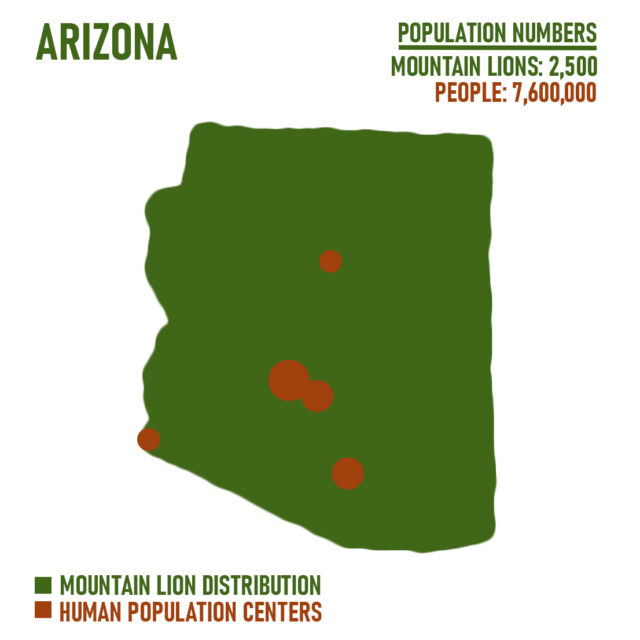
Arizona falls somewhere in the middle when it comes to both human and Mountain Lion population size. But Arizona is a relatively large state, and Mountain Lions range across its entirety–there is plenty of room for people and Mountain Lions to stay out of each other’s way.
Arizona classifies the Mountain Lion as a Big Game Animal and defines a specific Mountain Lion hunting season. Trapping Mountain Lions is illegal in the state. Juvenile Mountain Lions and their mothers are fully protected. Arizona maintains Special Exceptions to its hunting and trapping regulations for reasons of Public Safety, Depredation, and Research. Reporting of Mountain Lion mortalities is required in Arizona, and the population is scientifically monitored and managed.
Arizona-Texas Mountain Lion Regulations
| State | Arizona | Texas |
| Status | Big Game Animal | Nongame Animal |
| Sport Hunting | Legal with Valid Hunting License | Legal with Valid Hunting License |
| Special Exceptions | Public Safety Depredation Research | None Needed |
| Special Exception – Public Safety | Legal lethal methods as last resort Reporting required Carcass surrendered | Sport Hunting Regulations apply. No special regulations. |
| Special Exception – Depredation | Legal lethal methods Reporting Required Carcass surrendered | Sport Hunting Regulations apply. No special regulations. |
| Special Exception – Research | Special permit required Welfare of the Mountain Lion must be prioritized Reporting required | Sport Hunting Regulations apply. No special regulations. |
| Hunting Season | August 22 – May 31 | No Closed Season |
| Firearms | Legal with permitted equipment | Legal with permitted equipment |
| Archery | Legal with permitted equipment | Legal with permitted equipment |
| Dogs | Legal with permitted methods | Legal with permitted methods |
| Hunting Regulation Specifics | Requires a valid hunting license, an over-the-counter nonpermit-tag, and adherence to strict zone harvest limits. The bag limit is one lion per calendar year. Hunting is restricted to daylight hours from dawn till dusk. Management zones have specific harvest thresholds. Once a zone limit or female threshold is reached, that specific zone closes immediately. Hunters must check the Arizona Game and Fish Department status before hunting. It is illegal to kill any kitten (a lion with spots) or any adult lion accompanied by kittens. Canned hunts are illegal. Successful hunters must report a harvest online or by phone within 48 hours. The skull and hide (with proof of sex attached) must be presented to an AZGFD employee for inspection within 10 days of the kill. | Mountain Lions may be hunted at any time by any lawful means or methods on private property. Public lands may have additional restrictions. It is unlawful to take any nongame species for commercial purposes (sale, offer for sale, barter, or exchange) from public lands or waters. No canned hunts. No person may hunt a Mountain Lion that is in captivity, or release a Mountain Lion from captivity for the purpose of being hunted or training dogs. Furthermore, no person may conduct, promote, assist, or advertise an activity prohibited under these rules. It is unlawful to hunt (capture, trap, take, collect, or kill) any wild animal or wild bird on a public road or the right-of-way of public roads. It is unlawful to take any nongame species for commercial purposes (sale, offer for sale, barter, or exchange) from public lands or waters. |
| Trapping | Illegal with Special Exceptions | Legal with permitted methods |
| Trapping Season | No Open Season | No Closed Season |
| Spring Traps | Illegal with Special Exceptions | Legal with permitted equipment |
| Wire Snares | Illegal with Special Exceptions | Legal with permitted equipment |
| Cage Traps | Illegal with Special Exceptions | Legal with permitted equipment |
| Trapping Regulation Specifics | Recreational trapping of Mountain Lions is prohibited on public lands due to a 1994 ballot measure, meaning regular trappers cannot target them. Mountain Lions are classified as big game animals and are taken primarily via authorized hunting methods rather than commercial trapping, with specific exceptions strictly reserved for livestock protection. Public land rules ban leghold traps, body-gripping traps, and snares for catching large predators like Mountain Lions. Leg-hold traps without teeth (jaw spread 8.5 inches or less), leg snares, or legal firearms may be used for depredation control. All set traps must be inspected within 72 hours, non-target animals must be released, and target animals must be humanely dispatched immediately. Reporting required. | A valid Texas hunting license is required to legally trap or hunt Mountain Lions in the state. Trapping is legal at any time by any lawful means or methods (heavy-duty footholds, cage/live traps, cable snares) on private property. Public lands may have additional restrictions. It is unlawful to allow a live Mountain Lion to be captured in a trap for more than 36 hours. It is unlawful to allow a live Mountain Lion to be captured in a snare for more than 36 hours unless the snare is incapable of producing a loop greater than 10 inches (ie accidentally caught in a small animal snare). |
| Bag Limit | One per calendar year | No Bag Limit |
| Possession Limit | One per calendar year | No Possession Limit |
| Mountain Lion Age and Gender Restrictions | It is illegal to kill spotted kittens or any female Mountain Lion accompanied by spotted kittens. The Arizona Game and Fish Department limits female Mountain Lion harvests to a maximum of 50% of the total hunt limit per zone, and caps adult female mortality thresholds at 25% to protect the population. | No special restrictions. Mountain Lions of any gender or age can be taken. |
| Reporting | Required | Not Required |
| Reporting Specifics | Must be completed within 48 hours of taking the lion. Requires the hunter’s name, hunting license number, tag number, sex of the lion, and the game management unit where it was taken. Must present the Mountain Lion’s skull and hide (with attached proof of sex) to a designated Arizona Game and Fish Department employee within 10 days of the kill. | Reporting is encouraged but not required. |
| Population Monitoring | Active monitoring by the Arizona Game and Fish Department | Informal and anecdotal |
California
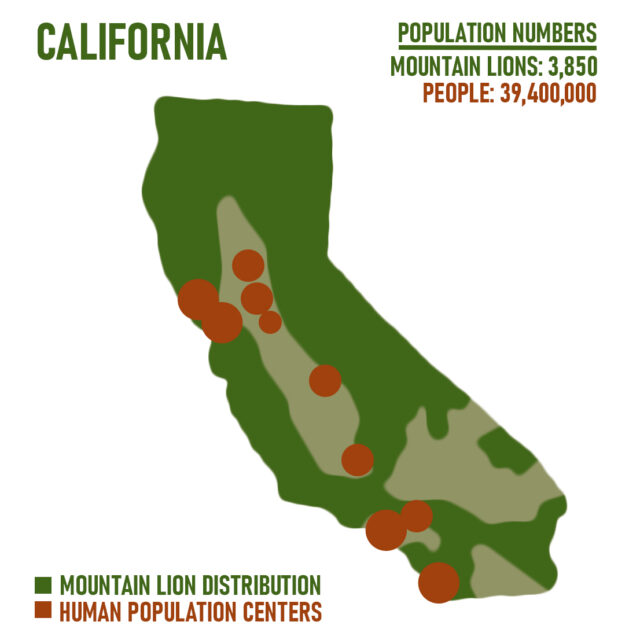
California is a large state in terms of both land area and human population. The state is home to several of the nation’s largest urban population centers.
With approximately 3,800 big cats, California also has a sizeable number of Mountain Lions–one of the largest populations in the country. In California, Mountain Lions maintain home ranges across much of the state, often coming into proximity with large cities. While conflict between people and Mountain Lions is still rare, California has the highest overall potential and frequency of these types of issues of any state in the nation.
California considers the Mountain Lion a Specially Protected Mammal and has made sport hunting and trapping of the animal illegal. Juvenile Mountain Lions and their mothers are fully protected. California has special exceptions in place to cover cases of Public Safety, Depredation, and Research. Reporting of Mountain Lion mortalities is required in California, and the population is scientifically monitored and managed.
California-Texas Mountain Lion Regulations
| State | California | Texas |
| Status | Specially Protected Mammal | Nongame Animal |
| Sport Hunting | Illegal | Legal with Valid Hunting License |
| Special Exceptions | Public Safety Depredation Research | None Needed |
| Special Exception – Public Safety | Legal lethal methods as last resort Reporting required Carcass surrendered | Sport Hunting Regulations apply. No special regulations. |
| Special Exception – Depredation | Legal lethal methods with immediate threat Special permit required with non-immediate threat Reporting Required Carcass surrendered | Sport Hunting Regulations apply. No special regulations. |
| Special Exception – Research | Special permit required Welfare of the Mountain Lion must be prioritized Reporting required | Sport Hunting Regulations apply. No special regulations. |
| Hunting Season | No Open Season | No Closed Season |
| Firearms | Illegal with Special Exceptions | Legal with permitted equipment |
| Archery | Illegal with Special Exceptions | Legal with permitted equipment |
| Dogs | Illegal with Special Exceptions | Legal with permitted methods |
| Hunting Regulation Specifics | Hunting is Not Permitted | Mountain Lions may be hunted at any time by any lawful means or methods on private property. Public lands may have additional restrictions. It is unlawful to take any nongame species for commercial purposes (sale, offer for sale, barter, or exchange) from public lands or waters. No canned hunts. No person may hunt a Mountain Lion that is in captivity, or release a Mountain Lion from captivity for the purpose of being hunted or training dogs. Furthermore, no person may conduct, promote, assist, or advertise an activity prohibited under these rules. It is unlawful to hunt (capture, trap, take, collect, or kill) any wild animal or wild bird on a public road or the right-of-way of public roads. It is unlawful to take any nongame species for commercial purposes (sale, offer for sale, barter, or exchange) from public lands or waters. |
| Trapping | Illegal with Special Exceptions | Legal with permitted methods |
| Trapping Season | No Open Season | No Closed Season |
| Spring Traps | Illegal | Legal with permitted equipment |
| Wire Snares | Illegal | Legal with permitted equipment |
| Cage Traps | Illegal with Special Exceptions | Legal with permitted equipment |
| Trapping Regulation Specifics | Trapping or hunting Mountain Lions is generally illegal in California, except under strict state permits issued for public safety or when a lion is actively harming livestock or pets. Recreational and commercial trapping are completely banned. It is unlawful for private citizens to catch, trap, pursue, or kill Mountain Lions for sport or personal convenience. The California Department of Fish and Wildlife (CDFW) issues special permits if a Mountain Lion damages or kills livestock, domestic animals, or other property. Live Cage Traps only for depredation. Reporting required. | A valid Texas hunting license is required to legally trap or hunt Mountain Lions in the state. Trapping is legal at any time by any lawful means or methods (heavy-duty footholds, cage/live traps, cable snares) on private property. Public lands may have additional restrictions. It is unlawful to allow a live Mountain Lion to be captured in a trap for more than 36 hours. It is unlawful to allow a live Mountain Lion to be captured in a snare for more than 36 hours unless the snare is incapable of producing a loop greater than 10 inches (ie accidentally caught in a small animal snare). |
| Bag Limit | Hunting Illegal | No Bag Limit |
| Possession Limit | Hunting Illegal | No Possession Limit |
| Mountain Lion Age and Gender Restrictions | Hunting Illegal | No special restrictions. Mountain Lions of any gender or age can be taken. |
| Reporting | Required | Not Required |
| Reporting Specifics | Report by telephone within 24 hours of capturing, injuring, or killing the Mountain Lion to a CDFW office. If calling is not practical, submit a written report within 5 days. Tag the killed Mountain Lion immediately with the special carcass tag provided, and mail the duplicate tag to CDFW in Sacramento within 5 days. The carcass must be turned over to CDFW for necropsy. | Reporting is encouraged but not required. |
| Population Monitoring | Active monitoring by the California Department of Fish and Wildlife and National Park Service | Informal and anecdotal |
Colorado
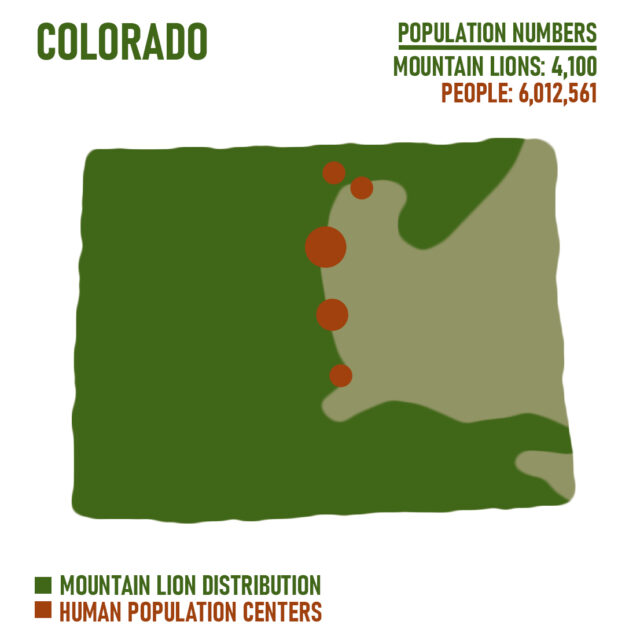
Colorado has both a sizeable human and Mountain Lion population. In Colorado, Mountain Lions can be found across much of the state, and the potential for and frequency of Human-Mountain Lion conflict remain relatively high compared to other states in the nation. The largest urban areas in the state–Denver and Colorado Springs–border known Mountain Lion distribution.
Colorado classifies the Mountain Lion as a Big Game Animal and defines a specific Mountain Lion hunting season. Trapping Mountain Lions is illegal in the state. Juvenile Mountain Lions and their mothers are fully protected. Colorado maintains Special Exceptions to its hunting and trapping regulations for reasons of Public Safety, Depredation, and Research. Reporting of Mountain Lion mortalities is required by law in Colorado, and the population is scientifically monitored and managed.
Colorado-Texas Mountain Lion Regulations
| State | Colorado | Texas |
| Status | Big Game Animal | Nongame Animal |
| Sport Hunting | Legal with Valid Hunting License, Stamp, and Exam | Legal with Valid Hunting License |
| Special Exceptions | Public Safety Depredation Research | None Needed |
| Special Exception – Public Safety | Legal lethal methods as last resort Pets and Property not protected Reporting required Carcass surrendered | Sport Hunting Regulations apply. No special regulations. |
| Special Exception – Depredation | Legal lethal methods Pets and Property not protected Reporting Required Carcass surrendered Depredation compensation | Sport Hunting Regulations apply. No special regulations. |
| Special Exception – Research | Special permit required Welfare of the Mountain Lion must be prioritized Reporting required | Sport Hunting Regulations apply. No special regulations. |
| Hunting Season | November 23 – March 31 | No Closed Season |
| Firearms | Legal with permitted equipment | Legal with permitted equipment |
| Archery | Legal with permitted equipment | Legal with permitted equipment |
| Dogs | Legal with permitted methods | Legal with permitted methods |
| Hunting Regulation Specifics | Mountain Lion hunting in Colorado requires a valid license. Must complete hunter education and pass the mandatory online Mountain Lion Education and Identification Course. Bag limit of one Mountain Lion of either sex per license year (April 1–March 31). Fall/winter season runs from November 23 through March 31 (and an April season in select units). There are 186 Game Management Units defined for Mountain Lions in Colorado. Each hunting unit has a strict total harvest limit. Hunters must check the open unit status daily before heading out; units close immediately when their harvest limit is reached. Colorado Parks and Wildlife must be contacted within 48 hours, and the hide and skull must be presented for mandatory inspection and sealing within 5 days. It is illegal to kill any kitten (a lion with spots) or any adult lion accompanied by kittens. Canned hunts are illegal. All edible portions of the Mountain Lion must be prepared for human consumption (excluding internal organs). Hound hunting is permitted with a maximum of 8 dogs per pack; hunters must stay active and present during the pursuit. Using artificial lights, electronic night devices, electronic calls, and bait is strictly illegal. | Mountain Lions may be hunted at any time by any lawful means or methods on private property. Public lands may have additional restrictions. It is unlawful to take any nongame species for commercial purposes (sale, offer for sale, barter, or exchange) from public lands or waters. No canned hunts. No person may hunt a Mountain Lion that is in captivity, or release a Mountain Lion from captivity for the purpose of being hunted or training dogs. Furthermore, no person may conduct, promote, assist, or advertise an activity prohibited under these rules. It is unlawful to hunt (capture, trap, take, collect, or kill) any wild animal or wild bird on a public road or the right-of-way of public roads. It is unlawful to take any nongame species for commercial purposes (sale, offer for sale, barter, or exchange) from public lands or waters. |
| Trapping | Illegal with Special Exceptions | Legal with permitted methods |
| Trapping Season | No Open Season | No Closed Season |
| Spring Traps | Illegal with Special Exceptions | Legal with permitted equipment |
| Wire Snares | Illegal with Special Exceptions | Legal with permitted equipment |
| Cage Traps | Illegal with Special Exceptions | Legal with permitted equipment |
| Trapping Regulation Specifics | Trapping Mountain Lions is generally illegal in Colorado. The state only allows lethal taking or removal when it is immediately necessary to protect human life, livestock, or real property, or when specifically authorized by Colorado Parks and Wildlife (CPW) officials. Recreational or commercial trapping of Mountain Lions is strictly prohibited by state law. Reporting required. | A valid Texas hunting license is required to legally trap or hunt Mountain Lions in the state. Trapping is legal at any time by any lawful means or methods (heavy-duty footholds, cage/live traps, cable snares) on private property. Public lands may have additional restrictions. It is unlawful to allow a live Mountain Lion to be captured in a trap for more than 36 hours. It is unlawful to allow a live Mountain Lion to be captured in a snare for more than 36 hours unless the snare is incapable of producing a loop greater than 10 inches (ie accidentally caught in a small animal snare). |
| Bag Limit | One per calendar year | No Bag Limit |
| Possession Limit | One per calendar year | No Possession Limit |
| Mountain Lion Age and Gender Restrictions | It is illegal to kill spotted kittens or any female Mountain Lion accompanied by spotted kittens. It is illegal to kill any Mountain Lion that is accompanied by one or more other lions. Specific management caps and quotas exist for adult females within regional game management units. | No special restrictions. Mountain Lions of any gender or age can be taken. |
| Reporting | Required | Not Required |
| Reporting Specifics | Call a Colorado Parks and Wildlife office within 48 hours to provide your name, CID number, date of harvest, sex of the lion, and the Game Management Unit. Personally present the skull and hide (which must be unfrozen and thawed) to a CPW officer or office within 5 days for a mandatory physical check and official seal. Hunters must also harvest all edible meat, including the four quarters, tenderloins, and backstraps, just like with other big game species. | Reporting is encouraged but not required. |
| Population Monitoring | Active monitoring by Colorado Parks and Wildlife | Informal and anecdotal |
Florida
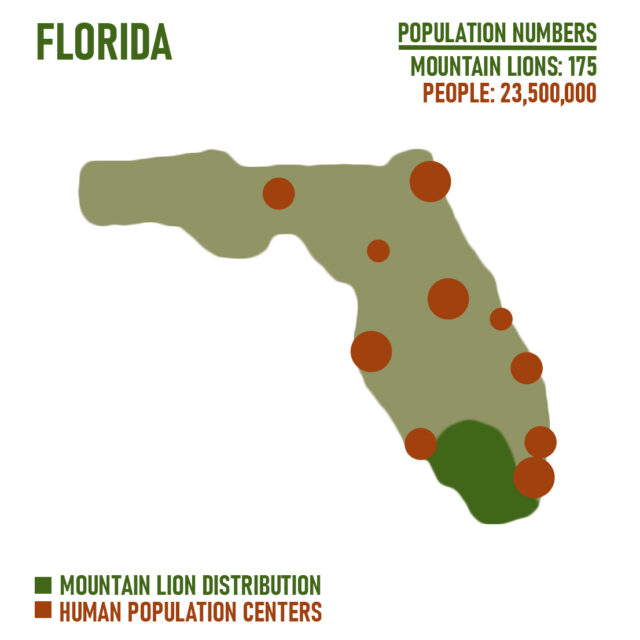
Florida has perhaps the most unique Mountain Lion situation of any state in the country. With no mountains to speak of in the state, Florida’s Mountain Lions instead reside in the most remote portions of the Everglades swampland, where they are more appropriately referred to as Cougars or Panthers.
Florida has only around 175 big cats, and the population is isolated and considered endangered. In 1995, state wildlife officials released 8 Texas Mountain Lions into South Florida in order to augment the genetic pool, as the native population was thought to be developing problems associated with inbreeding.
Florida has a sizeable human population and many large urban areas–some of which are close to the Panthers’ home range. Nonetheless, conflicts between people and Panthers remain very rare in Florida.
Florida classifies its Panthers as an Endangered Species and has made sport hunting and trapping of the animal absolutely illegal. Because Florida’s Panthers are so endangered, only very limited Special Exceptions exist for Research purposes. Reporting of Mountain Lion mortalities is required, and the population is scientifically monitored and managed.
Florida-Texas Mountain Lion Regulations
| State | Florida | Texas |
| Status | Endangered Species | Nongame Animal |
| Sport Hunting | Illegal | Legal with Valid Hunting License |
| Special Exceptions | Research | None Needed |
| Special Exception – Public Safety | Illegal Reporting required | Sport Hunting Regulations apply. No special regulations. |
| Special Exception – Depredation | Illegal Reporting required Depredation compensation | Sport Hunting Regulations apply. No special regulations. |
| Special Exception – Research | Special permit required Welfare of the Mountain Lion must be prioritized Reporting required | Sport Hunting Regulations apply. No special regulations. |
| Hunting Season | No Open Season | No Closed Season |
| Firearms | Illegal | Legal with permitted equipment |
| Archery | Illegal | Legal with permitted equipment |
| Dogs | Illegal | Legal with permitted methods |
| Hunting Regulation Specifics | Hunting is Not Permitted | Mountain Lions may be hunted at any time by any lawful means or methods on private property. Public lands may have additional restrictions. It is unlawful to take any nongame species for commercial purposes (sale, offer for sale, barter, or exchange) from public lands or waters. No canned hunts. No person may hunt a Mountain Lion that is in captivity, or release a Mountain Lion from captivity for the purpose of being hunted or training dogs. Furthermore, no person may conduct, promote, assist, or advertise an activity prohibited under these rules. It is unlawful to hunt (capture, trap, take, collect, or kill) any wild animal or wild bird on a public road or the right-of-way of public roads. It is unlawful to take any nongame species for commercial purposes (sale, offer for sale, barter, or exchange) from public lands or waters. |
| Trapping | Illegal with Special Exceptions | Legal with permitted methods |
| Trapping Season | No Open Season | No Closed Season |
| Spring Traps | Illegal | Legal with permitted equipment |
| Wire Snares | Illegal with Special Exceptions | Legal with permitted equipment |
| Cage Traps | Illegal with Special Exceptions | Legal with permitted equipment |
| Trapping Regulation Specifics | It is strictly illegal for private citizens to trap Mountain Lions in Florida. In Florida, Mountain Lions—locally known as the Florida panther (Puma concolor coryi)—are protected under both state law and the federal Endangered Species Act. There are no open seasons, licenses, or permits available to the public for hunting, capturing, or trapping Florida panthers. Under the federal Big Cat Public Safety Act, cougars (Mountain Lions/panthers) are classified as a prohibited wildlife species. It is a federal crime to privately possess, transport, or breed them. The only legal trapping or capturing of Mountain Lions in Florida is conducted by authorized state and federal biologists from the Florida Fish and Wildlife Conservation Commission (FWC) and the U.S. Fish and Wildlife Service operating under strict research protocols. Reporting required. | A valid Texas hunting license is required to legally trap or hunt Mountain Lions in the state. Trapping is legal at any time by any lawful means or methods (heavy-duty footholds, cage/live traps, cable snares) on private property. Public lands may have additional restrictions. It is unlawful to allow a live Mountain Lion to be captured in a trap for more than 36 hours. It is unlawful to allow a live Mountain Lion to be captured in a snare for more than 36 hours unless the snare is incapable of producing a loop greater than 10 inches (ie accidentally caught in a small animal snare). |
| Bag Limit | Hunting Illegal | No Bag Limit |
| Possession Limit | Hunting Illegal | No Possession Limit |
| Mountain Lion Age and Gender Restrictions | Hunting Illegal | No special restrictions. Mountain Lions of any gender or age can be taken. |
| Reporting | Required | Not Required |
| Reporting | If a hunter accidentally or in rare self-defense encounters a dead or injured panther, it must be reported right away to the FWC Panther Program. | Reporting is encouraged but not required. |
| Population Monitoring | Active monitoring by the Florida Fish and Wildlife Conservation Commission, US Fish and Wildlife Service, and National Park Service | Informal and anecdotal |
Idaho
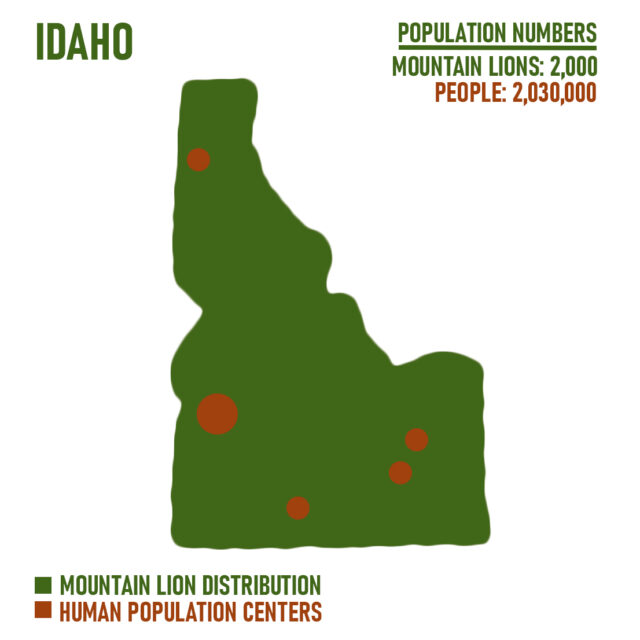
Idaho is a large state in terms of land area, but it is relatively small in terms of both human and Mountain Lion populations. Mountain Lions can be found throughout Idaho, and sightings occur with some frequency, but actual conflict with the big cats is rare.
Idaho classifies the Mountain Lion as a Big Game Animal and defines a specific Mountain Lion hunting season. Trapping Mountain Lions is illegal in the state. Juvenile Mountain Lions and their mothers are fully protected. Idaho maintains Special Exceptions to its hunting and trapping regulations for reasons of Public Safety, Depredation, and Research. Reporting of Mountain Lion mortalities is required in Idaho, and the population is scientifically monitored and managed.
Idaho-Texas Mountain Lion Regulations
| State | Idaho | Texas |
| Status | Big Game Animal | Nongame Animal |
| Sport Hunting | Legal with Valid Hunting License | Legal with Valid Hunting License |
| Special Exceptions | Public Safety Depredation Research | None Needed |
| Special Exception – Public Safety | Legal lethal methods as last resort Reporting required Carcass surrendered | Sport Hunting Regulations apply. No special regulations. |
| Special Exception – Depredation | Legal Reporting required Carcass surrendered Depredation compensation | Sport Hunting Regulations apply. No special regulations. |
| Special Exception – Research | Special permit required Welfare of the Mountain Lion must be prioritized Reporting required | Sport Hunting Regulations apply. No special regulations. |
| Hunting Season | July 1 – June 30 | No Closed Season |
| Firearms | Legal with permitted equipment | Legal with permitted equipment |
| Archery | Legal with permitted equipment | Legal with permitted equipment |
| Dogs | Legal with permitted methods | Legal with permitted methods |
| Hunting Regulation Specifics | Idaho is divided into 99 Game Management Units. Regulations may vary slightly from unit to unit. Mountain Lion hunting season generally runs from August 30 through March 31 or extended dates spanning July 1 through June 30, depending on the specific management zone. Most units prohibit hunting with dogs during October and November. Bag limit of one Mountain Lion per legal tag; multiple tags can be purchased and used in a single year across eligible units. Unfilled nonresident deer or elk tags can be used to harvest a Mountain Lion during an open season in units where the lion season is active. Taking spotted kittens or female Mountain Lions accompanied by spotted young is strictly prohibited. Canned hunts are illegal. External sex organs must remain naturally attached to the hide until mandatory checks are completed. Idaho Department of Fish and Game big game feeding site is illegal. | Mountain Lions may be hunted at any time by any lawful means or methods on private property. Public lands may have additional restrictions. It is unlawful to take any nongame species for commercial purposes (sale, offer for sale, barter, or exchange) from public lands or waters. No canned hunts. No person may hunt a Mountain Lion that is in captivity, or release a Mountain Lion from captivity for the purpose of being hunted or training dogs. Furthermore, no person may conduct, promote, assist, or advertise an activity prohibited under these rules. It is unlawful to hunt (capture, trap, take, collect, or kill) any wild animal or wild bird on a public road or the right-of-way of public roads. It is unlawful to take any nongame species for commercial purposes (sale, offer for sale, barter, or exchange) from public lands or waters. |
| Trapping | Illegal with Special Exceptions | Legal with permitted methods |
| Trapping Season | No Open Season | No Closed Season |
| Spring Traps | Illegal with Special Exceptions | Legal with permitted equipment |
| Wire Snares | Illegal with Special Exceptions | Legal with permitted equipment |
| Cage Traps | Illegal with Special Exceptions | Legal with permitted equipment |
| Trapping Regulation Specifics | In Idaho, it is illegal to trap, snare, or otherwise capture or hold any Mountain Lion. Mountain Lions may only be harvested through general or restricted hunting seasons using legal and approved methods. Capturing a Mountain Lion via traps or snares is strictly prohibited by the Idaho Department of Fish and Game. Inadvertent trapping must be reported, and the carcass surrendered to IDFG within 72 hours Research trapping is allowed with a Scientific Collecting Permit.. Reporting required. | A valid Texas hunting license is required to legally trap or hunt Mountain Lions in the state. Trapping is legal at any time by any lawful means or methods (heavy-duty footholds, cage/live traps, cable snares) on private property. Public lands may have additional restrictions. It is unlawful to allow a live Mountain Lion to be captured in a trap for more than 36 hours. It is unlawful to allow a live Mountain Lion to be captured in a snare for more than 36 hours unless the snare is incapable of producing a loop greater than 10 inches (ie accidentally caught in a small animal snare). |
| Bag Limit | One per legal tag. Up to two per Management Unit | No Bag Limit |
| Possession Limit | One per legal tag. Up to two per Management Unit | No Possession Limit |
| Mountain Lion Age and Gender Restrictions | It is illegal to kill spotted kittens or any female Mountain Lion accompanied by spotted kittens. Female Quotas in Some Management Units. | No special restrictions. Mountain Lions of any gender or age can be taken. |
| Reporting | Required | Not Required |
| Reporting Specifics | If legally harvested in a quota unit, it must reported to IDFG within 5 days of the kill. The skull and hide (with proof of sex attached) must be presented to the IDFG. For non-quota units, reporting must be completed in 10 days If the death was a non-hunting mortality the incident must be reported to the IDFG immediately. | Reporting is encouraged but not required. |
| Population Monitoring | Active monitoring by Idaho Department of Fish and Game | Informal and anecdotal |
Montana
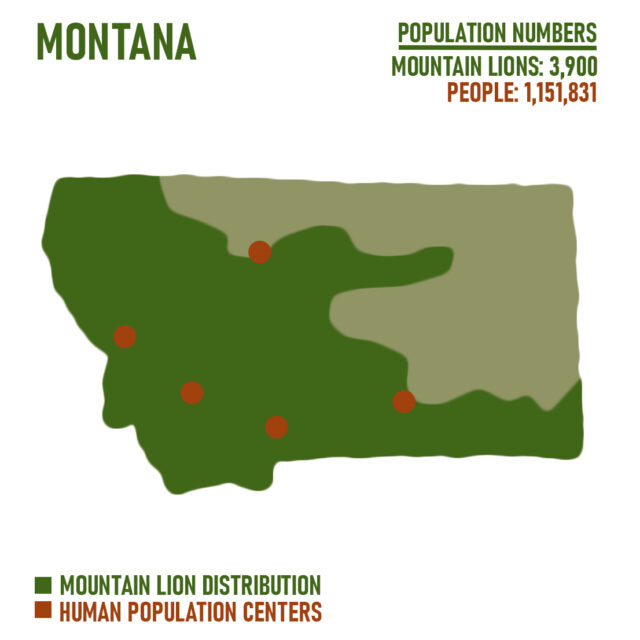
Montana is the third-largest state in the Lower 48 by land area–after Texas and California. The human population is relatively low for such a large state. The Mountain Lion population, on the other hand, is significant, and the big cats roam over more than half the state. Mountain Lion and human conflict is rare in Montana.
Montana considers the Mountain Lion a Game Animal and defines a specific Mountain Lion hunting season. Trapping Mountain Lions is illegal in the state. Juvenile Mountain Lions and their mothers are fully protected, and gender quotas are in place during hunting season. Montana maintains Special Exceptions to its hunting and trapping regulations for reasons of Public Safety, Depredation, and Research. Reporting of Mountain Lion mortalities is required in Montana, and the population is scientifically monitored and managed.
Montana-Texas Mountain Lion Regulations
| State | Montana | Texas |
| Status | Game Animal | Nongame Animal |
| Sport Hunting | Legal with Valid Hunting License | Legal with Valid Hunting License |
| Special Exceptions | Public Safety Depredation Research | None Needed |
| Special Exception – Public Safety | Legal lethal methods as last resort Reporting required Carcass surrendered | Sport Hunting Regulations apply. No special regulations. |
| Special Exception – Depredation | Legal Reporting required Carcass surrendered Depredation compensation | Sport Hunting Regulations apply. No special regulations. |
| Special Exception – Research | Special permit required Welfare of the Mountain Lion must be prioritized Reporting required | Sport Hunting Regulations apply. No special regulations. |
| Hunting Season | September 5 – May 25 | No Closed Season |
| Firearms | Legal with permitted equipment | Legal with permitted equipment |
| Archery | Legal with permitted equipment | Legal with permitted equipment |
| Dogs | Legal with permitted methods | Legal with permitted methods |
| Hunting Regulation Specifics | Montana Mountain Lion hunting regulations require a valid conservation license, base hunting license, and a specific Mountain Lion license, with season structures split into archery-only, fall without dogs, and winter hound/general periods. The state of Montana is divided into 87 Lion Management Units (LMUs) that are monitored by Montana Fish, Wildlife and Parks (MFWP) to regulate Mountain Lion populations. Harvest limits are set per LMU; hunters must verify unit status via Montana FWP before heading out, as units close immediately when the quota is reached. Archery Season (without dogs): September 5 – October 18. Fall Season (without dogs): October 24 – November 29. Winter Season: December 1 – April 14 (or extending to May 25 outside grizzly zones). Hound Training (Residents): December 2 – April 14. Grizzly Restriction: Hunting with hounds is prohibited in occupied grizzly bear habitat after April 14. Hunters may purchase only one Mountain Lion license per year, and licenses must generally be acquired by February 28. It is illegal to harvest a female Mountain Lion accompanied by dependent spotted kittens. Canned hunts are illegal. Two-way electronic devices are banned to locate lions once hounds are released on a track. Spotting or hunting from self-propelled vehicles or aircraft on the same day is strictly prohibited. | Mountain Lions may be hunted at any time by any lawful means or methods on private property. Public lands may have additional restrictions. It is unlawful to take any nongame species for commercial purposes (sale, offer for sale, barter, or exchange) from public lands or waters. No canned hunts. No person may hunt a Mountain Lion that is in captivity, or release a Mountain Lion from captivity for the purpose of being hunted or training dogs. Furthermore, no person may conduct, promote, assist, or advertise an activity prohibited under these rules. It is unlawful to hunt (capture, trap, take, collect, or kill) any wild animal or wild bird on a public road or the right-of-way of public roads. It is unlawful to take any nongame species for commercial purposes (sale, offer for sale, barter, or exchange) from public lands or waters. |
| Trapping | Illegal with Special Exceptions | Legal with permitted methods |
| Trapping Season | No Open Season | No Closed Season |
| Spring Traps | Illegal | Legal with permitted equipment |
| Wire Snares | Illegal with Special Exceptions | Legal with permitted equipment |
| Cage Traps | Illegal with Special Exceptions | Legal with permitted equipment |
| Trapping Regulation Specifics | Mountain Lions may not be trapped in Montana, as they are classified as a game animal rather than a furbearer or trapping species. Research trapping is allowed with a Scientific Collecting Permit. Reporting required. | A valid Texas hunting license is required to legally trap or hunt Mountain Lions in the state. Trapping is legal at any time by any lawful means or methods (heavy-duty footholds, cage/live traps, cable snares) on private property. Public lands may have additional restrictions. It is unlawful to allow a live Mountain Lion to be captured in a trap for more than 36 hours. It is unlawful to allow a live Mountain Lion to be captured in a snare for more than 36 hours unless the snare is incapable of producing a loop greater than 10 inches (ie accidentally caught in a small animal snare). |
| Bag Limit | One per calendar year | No Bag Limit |
| Possession Limit | One per calendar year | No Possession Limit |
| Mountain Lion Age and Gender Restrictions | It is illegal to kill spotted kittens or any female Mountain Lion accompanied by spotted kittens. Gender quotas in place for both male and female Mountain Lions. | No special restrictions. Mountain Lions of any gender or age can be taken. |
| Reporting | Required | Not Required |
| Reporting Specifics | Hunters are required to call in their lion harvest within 12 hours. Bring the skull and hide to an MFWP office within 10 days for mandatory pelt tagging and data collection. If a lactating female lion is accidentally killed, the hunter must inform an FWP official as soon as possible. | Reporting is encouraged but not required. |
| Population Monitoring | Active monitoring by Montana Fish, Wildlife and Parks | Informal and anecdotal |
Nebraska
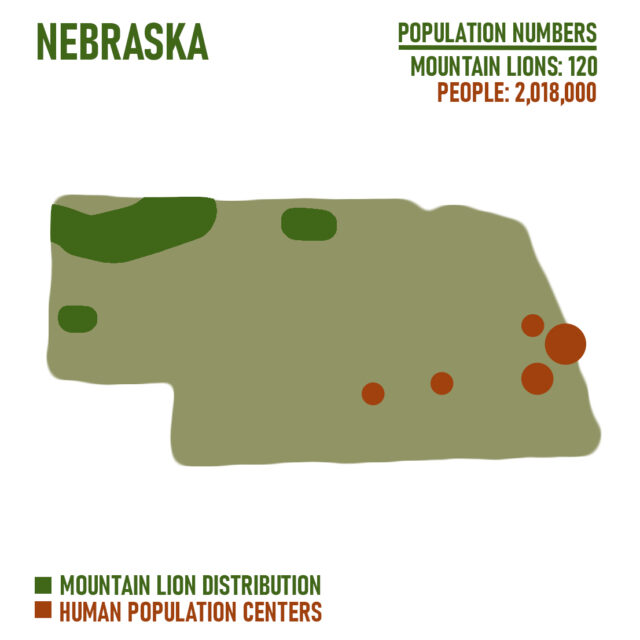
Nebraska is another large state in terms of land area, with a relatively small human population. There are only approximately 120 Mountain Lions in Nebraska–one of the smaller breeding populations in the nation. Mountain Lions range mostly in the northwest part of the state, well away from major population centers. Conflicts with Mountain Lions in Nebraska are decidedly rare.
Nebraska classifies the Mountain Lion as a Game Animal and defines a specific Mountain Lion hunting season. Trapping Mountain Lions is illegal in the state. Juvenile Mountain Lions and their mothers are fully protected. Further, it is illegal to kill any Mountain Lion in the company of another in Nebraska. The state maintains Special Exceptions to its hunting and trapping regulations for reasons of Public Safety, Depredation, and Research. Reporting of Mountain Lion mortalities is required in Nebraska, and the population is scientifically monitored and managed.
Nebraska-Texas Mountain Lion Regulations
| State | Nebraska | Texas |
| Status | Game Animal | Nongame Animal |
| Sport Hunting | Legal with Valid Hunting License | Legal with Valid Hunting License |
| Special Exceptions | Public Safety Depredation Research | None Needed |
| Special Exception – Public Safety | Legal lethal methods as last resort Reporting required Carcass surrendered | Sport Hunting Regulations apply. No special regulations. |
| Special Exception – Depredation | Legal Reporting required Carcass surrendered | Sport Hunting Regulations apply. No special regulations. |
| Special Exception – Research | Special permit required Welfare of the Mountain Lion must be prioritized Reporting required | Sport Hunting Regulations apply. No special regulations. |
| Hunting Season | January 2 – February 28, Optional Auxiliary Season in March | No Closed Season |
| Firearms | Legal with permitted equipment | Legal with permitted equipment |
| Archery | Legal with permitted equipment | Legal with permitted equipment |
| Dogs | Legal with permitted methods | Legal with permitted methods |
| Hunting Regulation Specifics | Mountain Lion hunting in Nebraska is regulated by the Nebraska Game and Parks Commission. Nebraska has three Mountain Lion hunting units: the Pine Ridge Unit, the Niobrara Unit, and the Wildcat Hills Unit. Pine Ridge Unit: Harvest limit of 12 Mountain Lions (sub-limit of 6 females). Niobrara Unit: Harvest limit of 6 Mountain Lions (sub-limit of 3 females). Wildcat Hills Unit: Harvest limit of 3 Mountain Lions (sub-limit of 2 females). Season 1 Dates: January 2 through the end of February (closes immediately if unit limits or female sub-limits are met). Auxiliary Season: March 14–31 (opened only if quotas are unfilled; allows the use of dogs). Bag limit of one Mountain Lion of either sex per valid permit. Hunting hours are sunrise to sunset. No dogs during Season 1, no baiting, and no trapping. It is illegal to harvest kittens, family groups, or any Mountain Lion with a spotted coat. Canned hunts are illegal. Hunters must check the daily open status of their unit via phone or the Nebraska Game and Parks Commission website before hunting, report harvests within 8 hours, and check in the carcass within 24 hours. | Mountain Lions may be hunted at any time by any lawful means or methods on private property. Public lands may have additional restrictions. It is unlawful to take any nongame species for commercial purposes (sale, offer for sale, barter, or exchange) from public lands or waters. No canned hunts. No person may hunt a Mountain Lion that is in captivity, or release a Mountain Lion from captivity for the purpose of being hunted or training dogs. Furthermore, no person may conduct, promote, assist, or advertise an activity prohibited under these rules. It is unlawful to hunt (capture, trap, take, collect, or kill) any wild animal or wild bird on a public road or the right-of-way of public roads. It is unlawful to take any nongame species for commercial purposes (sale, offer for sale, barter, or exchange) from public lands or waters. |
| Trapping | Illegal with Special Exceptions | Legal with permitted methods |
| Trapping Season | No Open Season | No Closed Season |
| Spring Traps | Illegal with Special Exceptions | Legal with permitted equipment |
| Wire Snares | Illegal with Special Exceptions | Legal with permitted equipment |
| Cage Traps | Illegal with Special Exceptions | Legal with permitted equipment |
| Trapping Regulation Specifics | Trapping Mountain Lions is strictly prohibited in Nebraska. Under the Nebraska Game & Parks Commission regulations, recreational or commercial trapping of Mountain Lions is not an allowed method of harvest during any established hunting or auxiliary season. Statutory defense provisions apply to immediate confrontations or active depredation and do not legally authorize setting traps to capture Mountain Lions. Research trapping is allowed with a Scientific Collecting Permit. Reporting required. | A valid Texas hunting license is required to legally trap or hunt Mountain Lions in the state. Trapping is legal at any time by any lawful means or methods (heavy-duty footholds, cage/live traps, cable snares) on private property. Public lands may have additional restrictions. It is unlawful to allow a live Mountain Lion to be captured in a trap for more than 36 hours. It is unlawful to allow a live Mountain Lion to be captured in a snare for more than 36 hours unless the snare is incapable of producing a loop greater than 10 inches (ie accidentally caught in a small animal snare). |
| Bag Limit | One per calendar year | No Bag Limit |
| Possession Limit | One per calendar year | No Possession Limit |
| Mountain Lion Age and Gender Restrictions | It is illegal to kill spotted kittens. It is illegal to kill any Mountain Lion that is accompanied by one or more other lions. Regional female quotas are in place. | No special restrictions. Mountain Lions of any gender or age can be taken. |
| Reporting | Required | Not Required |
| Reporting Specifics | Call the specified phone number or use the online reporting tool provided by Game and Parks within 8 hours of recovery. Present the unfrozen carcass to a commission representative or district office within 24 hours in the specific management unit where it was harvested to get an official harvest seal. Keep natural proof of gender attached to the animal until it is officially tagged by the commission. | Reporting is encouraged but not required. |
| Population Monitoring | Active monitoring by the Nebraska Game and Parks Commission | Informal and anecdotal |
Nevada
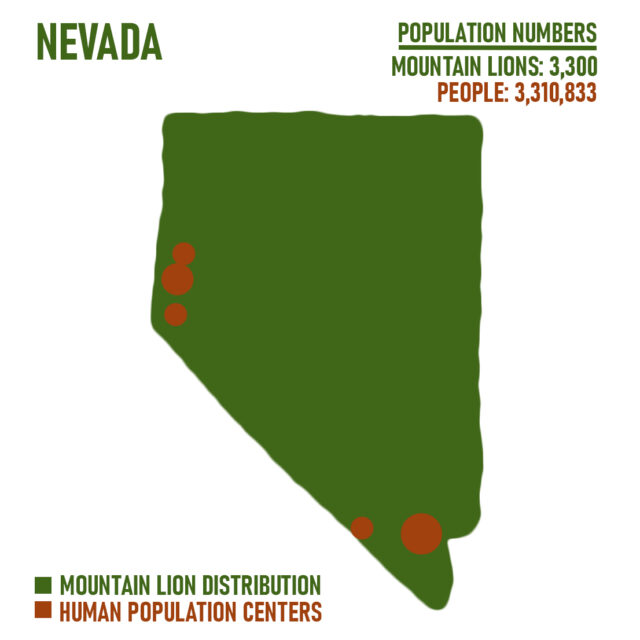
Nevada is a large state in terms of land area, but it is relatively small in terms of both human and Mountain Lion populations. Mountain Lions can be found throughout Nevada, but actual conflict with the big cats is rare.
Nevada classifies the Mountain Lion as a Game Animal and defines a specific Mountain Lion hunting season. Trapping Mountain Lions is illegal in the state. Juvenile Mountain Lions and their mothers are fully protected. Nevada maintains Special Exceptions to its hunting and trapping regulations for reasons of Public Safety, Depredation, and Research. Reporting of Mountain Lion mortalities is required in Nevada, and the population is scientifically monitored and managed.
Nevada-Texas Mountain Lion Regulations
| State | Nevada | Texas |
| Status | Game Animal | Nongame Animal |
| Sport Hunting | Legal with Valid Hunting License | Legal with Valid Hunting License |
| Special Exceptions | Public Safety Depredation Research | None Needed |
| Special Exception – Public Safety | Legal lethal methods as last resort Reporting required Carcass surrendered | Sport Hunting Regulations apply. No special regulations. |
| Special Exception – Depredation | Legal with Permit Reporting required Carcass surrendered | Sport Hunting Regulations apply. No special regulations. |
| Special Exception – Research | Special permit required Welfare of the Mountain Lion must be prioritized Reporting required | Sport Hunting Regulations apply. No special regulations. |
| Hunting Season | March 1 – End of February, or until annual quotas are met | No Closed Season |
| Firearms | Legal with permitted equipment | Legal with permitted equipment |
| Archery | Legal with permitted equipment | Legal with permitted equipment |
| Dogs | Legal with permitted methods | Legal with permitted methods |
| Hunting Regulation Specifics | Mountain Lion hunting in Nevada is regulated by the Nevada Department of Wildlife (NDOW). Nevada has 118 wildlife management units organized into 29 management areas for recreational Mountain Lion hunting, which are managed under a statewide framework rather than individual unit draw limits. Hunting season spans March 1 to the last day of February, closing early if a unit’s specific harvest limit is reached. Bag limit of one lion per tag, maximum of two tags per hunter annually. Hunting with dogs is permitted during open seasons in open management units. Hand-held dry-cell flashlights may be used while pursuing a lion, provided the hunter is not on or in a motorized vehicle. Legal any time of day or night (check local county ordinances for night shooting rules). Spotted kittens and female Mountain Lions accompanied by spotted kittens are strictly protected. Canned hunts are illegal. Harvested cats must be presented to an NDOW representative in person within 5 days of harvest. The skull must be unfrozen with the jaw propped open, and the pelt must be complete and unfrozen. Exact kill location (latitude/longitude coordinates or UTM) and sex must be provided, and NDOW will collect a tooth/tissue sample. | Mountain Lions may be hunted at any time by any lawful means or methods on private property. Public lands may have additional restrictions. It is unlawful to take any nongame species for commercial purposes (sale, offer for sale, barter, or exchange) from public lands or waters. No canned hunts. No person may hunt a Mountain Lion that is in captivity, or release a Mountain Lion from captivity for the purpose of being hunted or training dogs. Furthermore, no person may conduct, promote, assist, or advertise an activity prohibited under these rules. It is unlawful to hunt (capture, trap, take, collect, or kill) any wild animal or wild bird on a public road or the right-of-way of public roads. It is unlawful to take any nongame species for commercial purposes (sale, offer for sale, barter, or exchange) from public lands or waters. |
| Trapping | Illegal with Special Exceptions | Legal with permitted methods |
| Trapping Season | No Open Season | No Closed Season |
| Spring Traps | Illegal with Special Exceptions | Legal with permitted equipment |
| Wire Snares | Illegal with Special Exceptions | Legal with permitted equipment |
| Cage Traps | Illegal with Special Exceptions | Legal with permitted equipment |
| Trapping Regulation Specifics | Recreational and commercial trapping sets targeting Mountain Lions are illegal. Mountain Lions may not be intentionally trapped for fur or recreation in Nevada, as they are classified as a big game species rather than a furbearer. If a Mountain Lion is accidentally caught in a trap intended for other legal species (such as bobcats), the incident must be reported within 48 hours to a representative of the Nevada Department of Wildlife (NDOW). If the trapped Mountain Lion is still alive, it must be released following specific state guidelines. If the animal is dead, the carcass must be disposed of strictly in accordance with NDOW instructions. Research trapping is allowed with a Scientific Collecting Permit. Reporting required. | A valid Texas hunting license is required to legally trap or hunt Mountain Lions in the state. Trapping is legal at any time by any lawful means or methods (heavy-duty footholds, cage/live traps, cable snares) on private property. Public lands may have additional restrictions. It is unlawful to allow a live Mountain Lion to be captured in a trap for more than 36 hours. It is unlawful to allow a live Mountain Lion to be captured in a snare for more than 36 hours unless the snare is incapable of producing a loop greater than 10 inches (ie accidentally caught in a small animal snare). |
| Bag Limit | One per tag. No more than two per season | No Bag Limit |
| Possession Limit | One per tag. No more than two per season | No Possession Limit |
| Mountain Lion Age and Gender Restrictions | It is illegal to kill spotted kittens or any female Mountain Lion accompanied by spotted kittens. | No special restrictions. Mountain Lions of any gender or age can be taken. |
| Reporting | Required | Not Required |
| Reporting Specifics | A Mountain Lion killed by a hunter in Nevada must be reported and personally presented to the Nevada Department of Wildlife (NDOW) within five business days for inspection, sealing, and biological data collection. | Reporting is encouraged but not required. |
| Population Monitoring | Active monitoring by the Nevada Department of Wildlife | Informal and anecdotal |
New Mexico
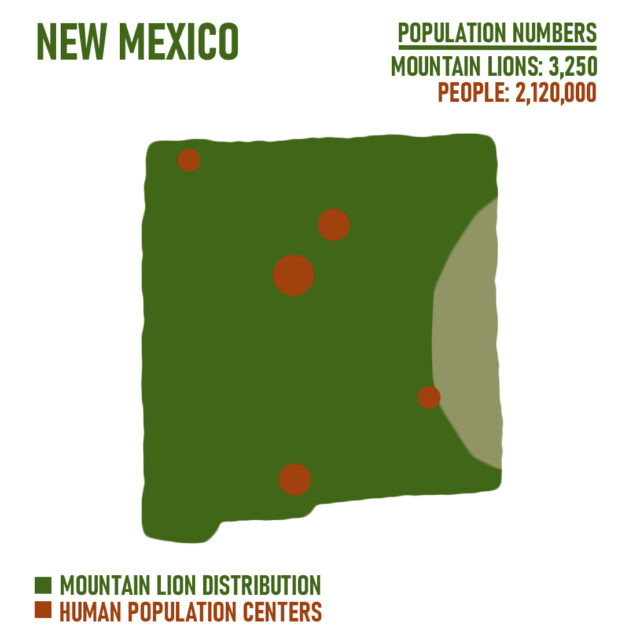
New Mexico is another large state by land area, but it is relatively small in terms of human population. The number of Mountain Lions in New Mexico is significant, and they can be found throughout most of the state–even in proximity to large urban areas. Nonetheless, Human-Mountain Lion conflict remains rare in New Mexico.
New Mexico classifies the Mountain Lion as a Game Animal and defines a specific Mountain Lion hunting season. Trapping Mountain Lions is illegal in the state. Juvenile Mountain Lions and their mothers are fully protected. New Mexico maintains Special Exceptions to its hunting and trapping regulations for reasons of Public Safety, Depredation, and Research. Reporting of Mountain Lion mortalities is required in New Mexico, and the population is scientifically monitored and managed.
New Mexico-Texas Mountain Lion Regulations
| State | New Mexico | Texas |
| Status | Game Animal | Nongame Animal |
| Sport Hunting | Legal with Valid Hunting License and Permit | Legal with Valid Hunting License |
| Special Exceptions | Public Safety Depredation Research | None Needed |
| Special Exception – Public Safety | Legal lethal methods as last resort Reporting required Carcass surrendered | Sport Hunting Regulations apply. No special regulations. |
| Special Exception – Depredation | Legal Reporting required Carcass surrendered | Sport Hunting Regulations apply. No special regulations. |
| Special Exception – Research | Special permit required Welfare of the Mountain Lion must be prioritized Reporting required | Sport Hunting Regulations apply. No special regulations. |
| Hunting Season | April 1 – March 31 | No Closed Season |
| Firearms | Legal with permitted equipment | Legal with permitted equipment |
| Archery | Legal with permitted equipment | Legal with permitted equipment |
| Dogs | Legal with permitted methods | Legal with permitted methods |
| Hunting Regulation Specifics | Managed by the New Mexico Department of Game and Fish. Seasons and bag limits are subject to closures across specific game management units. Mountain Lion hunting in New Mexico requires an over-the-counter license. Over-the-counter permits must be bought at least two calendar days before heading out to hunt. Hunters must complete the official cougar identification course on the NMDGF website before purchasing a license. Sport trapping of Mountain Lions is prohibited across the state. Hunting season runs from April 1 through March 31 of the following year, unless individual management zones close early. Spotted kittens and female Mountain Lions accompanied by spotted kittens are strictly protected. Canned hunts are illegal. The hide must be presented to a department officer for an official pelt tag. | Mountain Lions may be hunted at any time by any lawful means or methods on private property. Public lands may have additional restrictions. It is unlawful to take any nongame species for commercial purposes (sale, offer for sale, barter, or exchange) from public lands or waters. No canned hunts. No person may hunt a Mountain Lion that is in captivity, or release a Mountain Lion from captivity for the purpose of being hunted or training dogs. Furthermore, no person may conduct, promote, assist, or advertise an activity prohibited under these rules. It is unlawful to hunt (capture, trap, take, collect, or kill) any wild animal or wild bird on a public road or the right-of-way of public roads. It is unlawful to take any nongame species for commercial purposes (sale, offer for sale, barter, or exchange) from public lands or waters. |
| Trapping | Illegal with Special Exceptions | Legal with permitted methods |
| Trapping Season | No Open Season | No Closed Season |
| Spring Traps | Illegal with Special Exceptions | Legal with permitted equipment |
| Wire Snares | Illegal with Special Exceptions | Legal with permitted equipment |
| Cage Traps | Illegal with Special Exceptions | Legal with permitted equipment |
| Trapping Regulation Specifics | Mountain Lion (cougar) trapping is strictly banned on all public lands in New Mexico under Roxy’s Law, though limited recreational and targeted removal rules apply differently based on land type. Roxy’s Law (Wildlife Conservation and Public Safety Act): Prohibits the use of all traps, snares, and wildlife poisons on public lands (state, federal, and local government-owned lands). Government wildlife agency officials, federal services, and scientific researchers may still use traps for specific public health, safety, or authorized ecosystem management (such as bighorn sheep protection). Recreational or sport trapping of Mountain Lions using foot-holds or snares is prohibited statewide, meaning everyday tagholders cannot set traps for lions. Research trapping is allowed with a Scientific Collecting Permit. Reporting required. | A valid Texas hunting license is required to legally trap or hunt Mountain Lions in the state. Trapping is legal at any time by any lawful means or methods (heavy-duty footholds, cage/live traps, cable snares) on private property. Public lands may have additional restrictions. It is unlawful to allow a live Mountain Lion to be captured in a trap for more than 36 hours. It is unlawful to allow a live Mountain Lion to be captured in a snare for more than 36 hours unless the snare is incapable of producing a loop greater than 10 inches (ie accidentally caught in a small animal snare). |
| Bag Limit | Two per season | No Bag Limit |
| Possession Limit | Two per season | No Possession Limit |
| Mountain Lion Age and Gender Restrictions | It is illegal to kill spotted kittens or any female Mountain Lion accompanied by spotted kittens. Regional female quotas are in place. | No special restrictions. Mountain Lions of any gender or age can be taken. |
| Reporting | Required | Not Required |
| Reporting Specifics | The hide must be presented to a department officer for a official pelt tag. | Reporting is encouraged but not required. |
| Population Monitoring | Active monitoring by the New Mexico Department of Game and Fish | Informal and anecdotal |
North Dakota
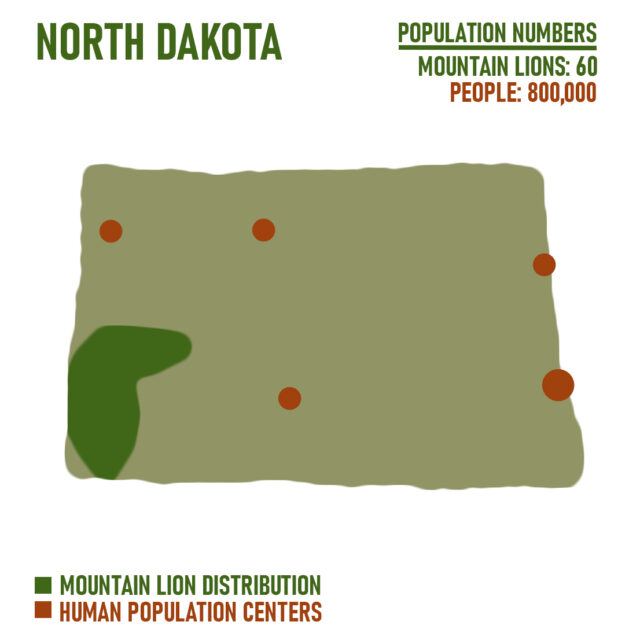
North Dakota has a significant amount of land area, but only a small human population. There are only around 60 Mountain Lions in North Dakota–likely the smallest breeding population in the country. Mountain Lions range mostly in the southwest corner of the state, well away from major population centers. Conflicts with Mountain Lions in North Dakota are extremely rare.
North Dakota classifies the Mountain Lion as a Furbearer and defines a specific Mountain Lion hunting season. Trapping Mountain Lions is illegal in the state. Juvenile Mountain Lions and their mothers are fully protected. The state maintains Special Exceptions to its hunting and trapping regulations for reasons of Public Safety, Depredation, and Research. Reporting of Mountain Lion mortalities is required in North Dakota, and the population is scientifically monitored and managed.
North Dakota-Texas Mountain Lion Regulations
| State | North Dakota | Texas |
| Status | Furbearer | Nongame Animal |
| Sport Hunting | Legal with Valid Hunting License | Legal with Valid Hunting License |
| Special Exceptions | Public Safety Depredation Research | None Needed |
| Special Exception – Public Safety | Legal lethal methods as last resort Reporting required Carcass surrendered | Sport Hunting Regulations apply. No special regulations. |
| Special Exception – Depredation | Legal Reporting required Carcass surrendered | Sport Hunting Regulations apply. No special regulations. |
| Special Exception – Research | Special permit required Welfare of the Mountain Lion must be prioritized Reporting required | Sport Hunting Regulations apply. No special regulations. |
| Hunting Season | August 29 – March 31, or until annual quotas are met | No Closed Season |
| Firearms | Legal with permitted equipment | Legal with permitted equipment |
| Archery | Legal with permitted equipment | Legal with permitted equipment |
| Dogs | Legal with permitted methods | Legal with permitted methods |
| Hunting Regulation Specifics | The state is divided into two Management Zones. Zone 1 (Western ND / Badlands) contains the state’s only established breeding population. Governed by an annual harvest quota (typically set at 21), and the season closes immediately once the limit is met Zone 1 has an annual harvest limit and up to 3 hunting seasons Zone 1 Early Season – Legal firearms and archery equipment may be used from August 29 through November 23. Harvest may be no more than eight Mountain Lions during the early season. Zone 1 Late Season – Legal firearms and archery equipment and pursuing with dogs may be used from November 24 through March 31. Harvest during the late season may be no more than seven Mountain Lions or three female Mountain Lions, whichever comes first. Zone 1 Conditional Season – If the harvest limit for the early season is not reached on or before November 23, and after the late season has been closed for 5 consecutive days, the early season will reopen until the Zone 1 early season harvest limit is reached or until March 31. If the late season closes after March 25, there will not be a Zone 1 conditional season. Zone 2 (Rest of the State): Comprises the rest of North Dakota where resident populations are absent. Zone 2 has no annual harvest limit. Zone 2 – Legal firearms and archery equipment may be used from August 29 through March 31. Pursuing with dogs is Legal only from November 24 through March 31 Taking spotted kittens or females accompanied by kittens is strictly prohibited. Canned hunts are illegal. Hunters must report their harvest to the North Dakota Game and Fish Department within 12 hours. The mandatory physical check requires presenting the intact carcass for biological analysis and tagging. After data and samples are collected, the carcass is returned so the hunter can keep the pelt. | Mountain Lions may be hunted at any time by any lawful means or methods on private property. Public lands may have additional restrictions. It is unlawful to take any nongame species for commercial purposes (sale, offer for sale, barter, or exchange) from public lands or waters. No canned hunts. No person may hunt a Mountain Lion that is in captivity, or release a Mountain Lion from captivity for the purpose of being hunted or training dogs. Furthermore, no person may conduct, promote, assist, or advertise an activity prohibited under these rules. It is unlawful to hunt (capture, trap, take, collect, or kill) any wild animal or wild bird on a public road or the right-of-way of public roads. It is unlawful to take any nongame species for commercial purposes (sale, offer for sale, barter, or exchange) from public lands or waters. |
| Trapping | Illegal with Special Exceptions | Legal with permitted methods |
| Trapping Season | No Open Season | No Closed Season |
| Spring Traps | Illegal with Special Exceptions | Legal with permitted equipment |
| Wire Snares | Illegal with Special Exceptions | Legal with permitted equipment |
| Cage Traps | Illegal with Special Exceptions | Legal with permitted equipment |
| Trapping Regulation Specifics | Trapping Mountain Lions is not legal in North Dakota. Research trapping is allowed with a Scientific Collecting Permit. Reporting required. | A valid Texas hunting license is required to legally trap or hunt Mountain Lions in the state. Trapping is legal at any time by any lawful means or methods (heavy-duty footholds, cage/live traps, cable snares) on private property. Public lands may have additional restrictions. It is unlawful to allow a live Mountain Lion to be captured in a trap for more than 36 hours. It is unlawful to allow a live Mountain Lion to be captured in a snare for more than 36 hours unless the snare is incapable of producing a loop greater than 10 inches (ie accidentally caught in a small animal snare). |
| Bag Limit | One per season | No Bag Limit |
| Possession Limit | One per season | No Possession Limit |
| Mountain Lion Age and Gender Restrictions | It is illegal to kill spotted kittens or any female Mountain Lion accompanied by spotted kittens. | No special restrictions. Mountain Lions of any gender or age can be taken. |
| Reporting | Required | Not Required |
| Reporting Specifics | Hunters must either contact the local game warden or Department field office or register their harvest online via their account within 12 hours and make arrangements to have the Mountain Lion tagged. The entire Mountain Lion, including the head, must be presented for inspection and tagging. Legally taken animals will be returned to the hunter following analysis so that the pelt may be removed but the carcass shall remain the property of the Department. | Reporting is encouraged but not required. |
| Population Monitoring | Active monitoring by the North Dakota Game and Fish Department | Informal and anecdotal |
Oregon
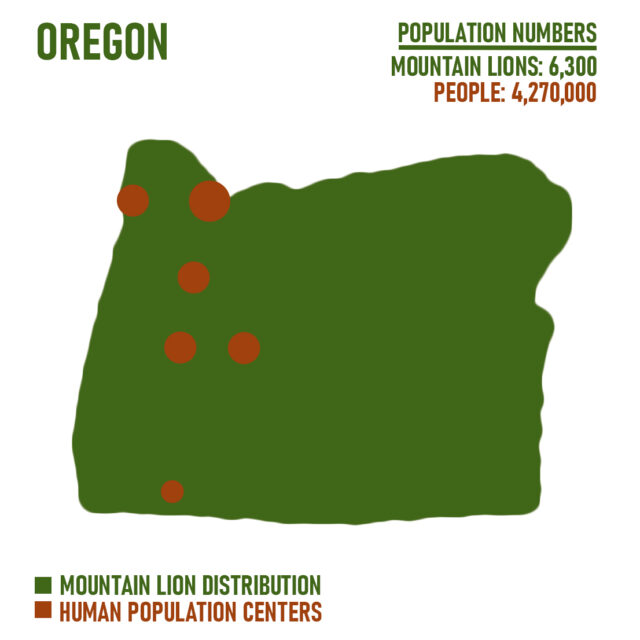
With somewhere around 6300 big cats, Oregon has the largest Mountain Lion population of any state in the country. Oregon has a vast land area and many varied habitats. The human population size is moderate at approximately 4.27 million people. Mountain Lions roam the entire state — even in close proximity to major urban areas. Despite the large number of Mountain Lions in Oregon, conflicts with humans and livestock remain exceedingly rare.
Oregon classifies the Mountain Lion as a Game Mammal and defines a specific Mountain Lion hunting season. Trapping Mountain Lions is illegal in the state. Juvenile Mountain Lions and their mothers are fully protected. The state maintains Special Exceptions to its hunting and trapping regulations for reasons of Public Safety, Depredation, and Research. Reporting of Mountain Lion mortalities is required in Oregon, and the population is scientifically monitored and managed.
Oregon-Texas Mountain Lion Regulations
| State | Oregon | Texas |
| Status | Game Mammal | Nongame Animal |
| Sport Hunting | Legal with Valid Hunting License | Legal with Valid Hunting License |
| Special Exceptions | Public Safety Depredation Research | None Needed |
| Special Exception – Public Safety | Legal lethal methods as last resort Reporting required Carcass surrendered | Sport Hunting Regulations apply. No special regulations. |
| Special Exception – Depredation | Legal Reporting required Carcass surrendered | Sport Hunting Regulations apply. No special regulations. |
| Special Exception – Research | Special permit required Welfare of the Mountain Lion must be prioritized Reporting required | Sport Hunting Regulations apply. No special regulations. |
| Hunting Season | January 1 – December 31, or until annual quotas are met | No Closed Season |
| Firearms | Legal with permitted equipment | Legal with permitted equipment |
| Archery | Legal with permitted equipment | Legal with permitted equipment |
| Dogs | Illegal | Legal with permitted methods |
| Hunting Regulation Specifics | The state is split into six zones (A through F) with specific harvest quotas totaling 970 statewide. Zones close immediately if their individual quota is met. Mountain Lion (cougar) hunting in Oregon is open year-round from January 1 to December 31. Requires a current valid hunting license and a General Season Cougar Tag (purchased before the fall deer/elk deadline to qualify for an additional tag). Bag limit of one cougar per tag, with a maximum of two tags per hunter per year. Hunters must follow strict rules managed by the Oregon Department of Fish and Wildlife regarding zone quotas, equipment limits, and mandatory check-ins. Using dogs to hunt, track, or pursue cougars is strictly illegal under state law. It is unlawful to harvest spotted kittens or any female cougar accompanied by spotted kittens. Canned hunts are illegal. Explicit landowner permission is mandatory before hunting on private property. Successful hunters must present the harvested animal in person to an ODFW office or designated site within 10 days of the kill. The hide and skull must be unfrozen and presented with proof of sex attached. Hunters must submit the reproductive tract of any female cougar harvested. | Mountain Lions may be hunted at any time by any lawful means or methods on private property. Public lands may have additional restrictions. It is unlawful to take any nongame species for commercial purposes (sale, offer for sale, barter, or exchange) from public lands or waters. No canned hunts. No person may hunt a Mountain Lion that is in captivity, or release a Mountain Lion from captivity for the purpose of being hunted or training dogs. Furthermore, no person may conduct, promote, assist, or advertise an activity prohibited under these rules. It is unlawful to hunt (capture, trap, take, collect, or kill) any wild animal or wild bird on a public road or the right-of-way of public roads. It is unlawful to take any nongame species for commercial purposes (sale, offer for sale, barter, or exchange) from public lands or waters. |
| Trapping | Illegal with Special Exceptions | Legal with permitted methods |
| Trapping Season | No Open Season | No Closed Season |
| Spring Traps | Illegal with Special Exceptions | Legal with permitted equipment |
| Wire Snares | Illegal with Special Exceptions | Legal with permitted equipment |
| Cage Traps | Illegal with Special Exceptions | Legal with permitted equipment |
| Trapping Regulation Specifics | Mountain Lions (cougars) cannot be trapped for sport or recreation in Oregon. Trapping is strictly limited to government agents, authorized public safety personnel, or landowners handling specific property damage, livestock threats, or human safety emergencies. Cougars are classified as game animals, and recreational fur-trapping, or sport-trapping, is illegal. General citizens cannot set traps for Mountain Lions on public or private lands without explicit authorization or a verified public safety/livestock conflict context. Official removal is primarily handled by the Oregon Department of Fish and Wildlife (ODFW) or USDA Wildlife Services agents using approved restraining or killing methods during active conflicts. Reporting required. | A valid Texas hunting license is required to legally trap or hunt Mountain Lions in the state. Trapping is legal at any time by any lawful means or methods (heavy-duty footholds, cage/live traps, cable snares) on private property. Public lands may have additional restrictions. It is unlawful to allow a live Mountain Lion to be captured in a trap for more than 36 hours. It is unlawful to allow a live Mountain Lion to be captured in a snare for more than 36 hours unless the snare is incapable of producing a loop greater than 10 inches (ie accidentally caught in a small animal snare). |
| Bag Limit | Two per calendar year | No Bag Limit |
| Possession Limit | Two per calendar year | No Possession Limit |
| Mountain Lion Age and Gender Restrictions | It is illegal to kill spotted kittens or any female Mountain Lion accompanied by spotted kittens. | No special restrictions. Mountain Lions of any gender or age can be taken. |
| Reporting | Required | Not Required |
| Reporting Specifics | Must present the animal to an Oregon Department of Fish and Wildlife (ODFW) field office or designated site within 10 days of the kill. The hide must be unfrozen with the skull and proof of sex naturally attached. Must submit the reproductive tract if the harvested cougar is a female. Date, harvest location (Wildlife Management Unit), and tag confirmation details. | Reporting is encouraged but not required. |
| Population Monitoring | Active monitoring by the Oregon Department of Fish and Wildlife | Informal and anecdotal |
South Dakota
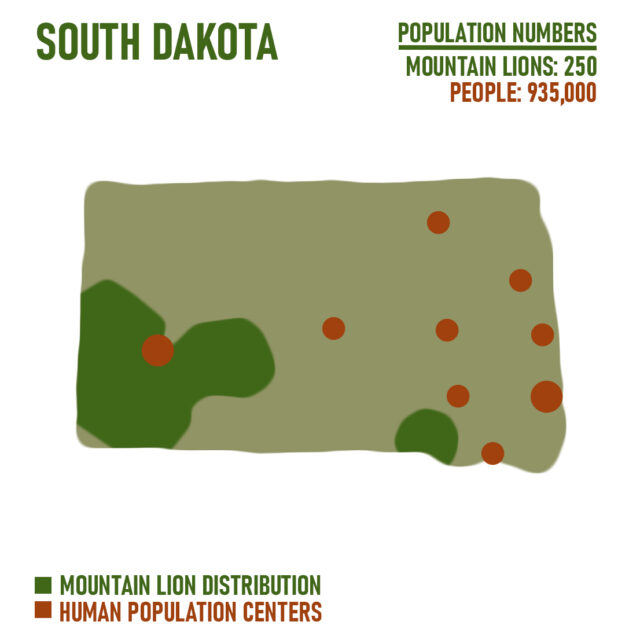
South Dakota has a significant amount of land area, but only a small human population. Somewhere around 250 Mountain Lions call South Dakota home, all confined to two relatively small areas in the south and in the southwest. Conflicts with Mountain Lions in South Dakota are an extremely rare occurrence.
South Dakota considers the Mountain Lion a Big Game Animal and defines a specific Mountain Lion hunting season. Trapping Mountain Lions is illegal in the state. Juvenile Mountain Lions and their mothers are fully protected. Further, it is illegal to kill any Mountain Lion in the company of another in South Dakota. The state maintains Special Exceptions to its hunting and trapping regulations for reasons of Public Safety, Depredation, and Research. Reporting of Mountain Lion mortalities is required in South Dakota, and the population is scientifically monitored and managed.
South Dakota-Texas Mountain Lion Regulations
| State | South Dakota | Texas |
| Status | Big Game Animal | Nongame Animal |
| Sport Hunting | Legal with Valid Hunting License – Residents Only | Legal with Valid Hunting License |
| Special Exceptions | Public Safety Depredation Research | None Needed |
| Special Exception – Public Safety | Legal lethal methods as last resort Reporting required Carcass surrendered | Sport Hunting Regulations apply. No special regulations. |
| Special Exception – Depredation | Legal Reporting required Carcass surrendered | Sport Hunting Regulations apply. No special regulations. |
| Special Exception – Research | Special permit required Welfare of the Mountain Lion must be prioritized Reporting required | Sport Hunting Regulations apply. No special regulations. |
| Hunting Season | December 26 – December 25, or until annual quotas are met | No Closed Season |
| Firearms | Legal with permitted equipment | Legal with permitted equipment |
| Archery | Legal with permitted equipment | Legal with permitted equipment |
| Dogs | Legal with permitted methods | Legal with permitted methods |
| Hunting Regulation Specifics | Mountain Lion hunting regulations in South Dakota vary by region, featuring a restricted quota season in the Black Hills and a flexible year-round framework elsewhere. Licenses are unlimited for residents ($30 for one Mountain Lion), and details can be managed via the South Dakota Game, Fish, and Parks portal. Black Hills Fire Protection District (BHFPD) season is December 26 through April 30 (closes early if harvest limits are reached). BHFPD Harvest Limit: Season closes immediately upon reaching 60 total Mountain Lions or 40 female Mountain Lions. BHFPD Bag Limit: One Mountain Lion per hunter per season. Hunting with dogs inside the BHFPD requires a specialized, random-draw access permit from December 26 to April 30 Statewide (excluding BHFPD) Season is open year-round (December 26 to December 25). The use of dogs is allowed year-round outside of the BHFPD. Private landowners may kill a Mountain Lion on their own property year-round outside the Black Hills unit without it counting toward state quotas. All harvested Mountain Lions (including carcass and pelt) must be presented to a GFP representative within 24 hours of harvest. No trapping, no baiting, no taking spotted kittens, and no taking any lion accompanying another. Canned hunts are illegal. Shooting Hours: One-half hour before sunrise to one-half hour after sunset. Electronic calls are permitted. | Mountain Lions may be hunted at any time by any lawful means or methods on private property. Public lands may have additional restrictions. It is unlawful to take any nongame species for commercial purposes (sale, offer for sale, barter, or exchange) from public lands or waters. No canned hunts. No person may hunt a Mountain Lion that is in captivity, or release a Mountain Lion from captivity for the purpose of being hunted or training dogs. Furthermore, no person may conduct, promote, assist, or advertise an activity prohibited under these rules. It is unlawful to hunt (capture, trap, take, collect, or kill) any wild animal or wild bird on a public road or the right-of-way of public roads. It is unlawful to take any nongame species for commercial purposes (sale, offer for sale, barter, or exchange) from public lands or waters. |
| Trapping | Illegal with Special Exceptions | Legal with permitted methods |
| Trapping Season | No Open Season | No Closed Season |
| Spring Traps | Illegal with Special Exceptions | Legal with permitted equipment |
| Wire Snares | Illegal with Special Exceptions | Legal with permitted equipment |
| Cage Traps | Illegal with Special Exceptions | Legal with permitted equipment |
| Trapping Regulation Specifics | Trapping Mountain Lions is strictly prohibited in South Dakota, as state regulations explicitly state that no person may hunt or take Mountain Lions with the aid of traps or bait. Research trapping is allowed with a Scientific Collecting Permit. Reporting required. | A valid Texas hunting license is required to legally trap or hunt Mountain Lions in the state. Trapping is legal at any time by any lawful means or methods (heavy-duty footholds, cage/live traps, cable snares) on private property. Public lands may have additional restrictions. It is unlawful to allow a live Mountain Lion to be captured in a trap for more than 36 hours. It is unlawful to allow a live Mountain Lion to be captured in a snare for more than 36 hours unless the snare is incapable of producing a loop greater than 10 inches (ie accidentally caught in a small animal snare). |
| Bag Limit | One per season until statewide quota reached | No Bag Limit |
| Possession Limit | One per season until statewide quota reached | No Possession Limit |
| Mountain Lion Age and Gender Restrictions | It is illegal to kill spotted kittens. It is illegal to kill any Mountain Lion that is accompanied by one or more other lions. Statewide female quotas apply. | No special restrictions. Mountain Lions of any gender or age can be taken. |
| Reporting | Required | Not Required |
| Reporting Specifics | Must report and present the entire carcass and pelt within 24 hours of the kill. | Reporting is encouraged but not required. |
| Population Monitoring | Active monitoring by South Dakota Game, Fish and Parks | Informal and anecdotal |
Utah
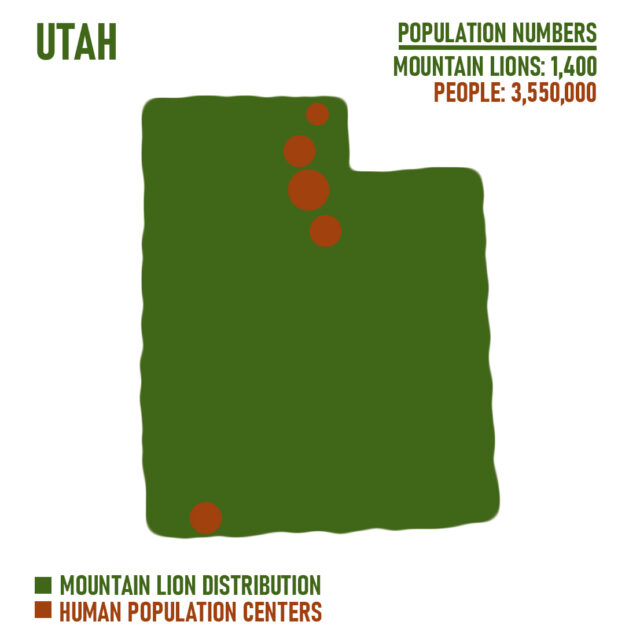
Utah has both a moderate human and Mountain Lion population. Somewhere around 1,400 Mountain Lions live in Utah, alongside roughly 3.55 million people. The big cats range across the entire state and may be found in close proximity to major urban areas. Conflicts with Mountain Lions in Utah are extremely rare.
Utah classifies the Mountain Lion as Protected Wildlife. After Texas, Utah may be considered to have the least restrictive Mountain Lion hunting regulations in the country. In Utah, there are no bag limits or possession limits. Mountain Lion hunting season is open year-round. Trapping Mountain Lions is legal in the state, using permitted methods. Juvenile Mountain Lions and their mothers are fully protected. The state maintains Special Exceptions to its hunting and trapping regulations for reasons of Public Safety, Depredation, and Research. Reporting of Mountain Lion mortalities is required in Utah, and the population is scientifically monitored and managed.
Utah-Texas Mountain Lion Regulations
| State | Utah | Texas |
| Status | Protected Wildlife | Nongame Animal |
| Sport Hunting | Legal with Valid Hunting License | Legal with Valid Hunting License |
| Special Exceptions | Public Safety Depredation Research | None Needed |
| Special Exception – Public Safety | Legal lethal methods as last resort Reporting required Carcass surrendered | Sport Hunting Regulations apply. No special regulations. |
| Special Exception – Depredation | Legal Reporting required Carcass surrendered–Retention Permit available Depredation compensation | Sport Hunting Regulations apply. No special regulations. |
| Special Exception – Research | Special permit required Welfare of the Mountain Lion must be prioritized Reporting required | Sport Hunting Regulations apply. No special regulations. |
| Hunting Season | Year-round | No Closed Season |
| Firearms | Legal with permitted equipment | Legal with permitted equipment |
| Archery | Legal with permitted equipment | Legal with permitted equipment |
| Dogs | Legal with permitted methods | Legal with permitted methods |
| Hunting Regulation Specifics | There are 30 primary wildlife management units across Utah that serve as the framework for big game and cougar management. Utah allows year-round, unlimited Mountain Lion (cougar) hunting and trapping for anyone with a valid general hunting or combination license. There are no harvest limits, quotas, or separate draw permits required. Only a valid Utah general hunting or combination license is required. There is no seasonal or annual limit on the number of cougars a person can take. Hunting season is open year-round. Legal weapons, pursuit with dogs, and trapping/snaring are permitted. Night hunting is prohibited. It is unlawful to harvest spotted kittens or any female cougar accompanied by spotted kittens. Canned hunts are illegal. Every harvested Mountain Lion must be checked in with Utah Division of Wildlife Resources personnel within 48 hours of harvest. Hunters must provide the exact harvest location (GPS coordinates) and the specific DWR cougar management unit. Personnel will collect biological data and issue a required permanent possession tag for the pelt and skull. | Mountain Lions may be hunted at any time by any lawful means or methods on private property. Public lands may have additional restrictions. It is unlawful to take any nongame species for commercial purposes (sale, offer for sale, barter, or exchange) from public lands or waters. No canned hunts. No person may hunt a Mountain Lion that is in captivity, or release a Mountain Lion from captivity for the purpose of being hunted or training dogs. Furthermore, no person may conduct, promote, assist, or advertise an activity prohibited under these rules. It is unlawful to hunt (capture, trap, take, collect, or kill) any wild animal or wild bird on a public road or the right-of-way of public roads. It is unlawful to take any nongame species for commercial purposes (sale, offer for sale, barter, or exchange) from public lands or waters. |
| Trapping | Legal with permitted methods | Legal with permitted methods |
| Trapping Season | Year-round | No Closed Season |
| Spring Traps | Legal with permitted equipment | Legal with permitted equipment |
| Wire Snares | Legal with permitted equipment | Legal with permitted equipment |
| Cage Traps | Legal with permitted equipment | Legal with permitted equipment |
| Trapping Regulation Specifics | Trapping Mountain Lions (cougars) in Utah is allowed year-round. Valid hunting or combination license plus a valid trap registration license. There are no bag limits. No special permits required. Trappers must comply with state guidelines. Cable snares (including lethal snares on public lands) and standard foothold traps (underspring, jump, longspring, and coil-spring). Traps and snares must be securely anchored to a stable object like a large rock or tree. Snares must feature a breakaway lock mechanism designed to release if a force greater than 300 pounds is applied. Reporting required. | A valid Texas hunting license is required to legally trap or hunt Mountain Lions in the state. Trapping is legal at any time by any lawful means or methods (heavy-duty footholds, cage/live traps, cable snares) on private property. Public lands may have additional restrictions. It is unlawful to allow a live Mountain Lion to be captured in a trap for more than 36 hours. It is unlawful to allow a live Mountain Lion to be captured in a snare for more than 36 hours unless the snare is incapable of producing a loop greater than 10 inches (ie accidentally caught in a small animal snare). |
| Bag Limit | No Bag Limit | No Bag Limit |
| Possession Limit | No Possession Limit | No Possession Limit |
| Mountain Lion Age and Gender Restrictions | It is illegal to kill spotted kittens or any female Mountain Lion accompanied by spotted kittens. | No special restrictions. Mountain Lions of any gender or age can be taken. |
| Reporting | Required | Not Required |
| Reporting Specifics | Must be reported within 48 hours of the harvest. The exact location where the Mountain Lion was harvested must be reported. An official permanent tag must be secured for the cougar during your appointment. | Reporting is encouraged but not required. |
| Population Monitoring | Active monitoring by Utah Division of Wildlife Resources | Informal and anecdotal |
Washington
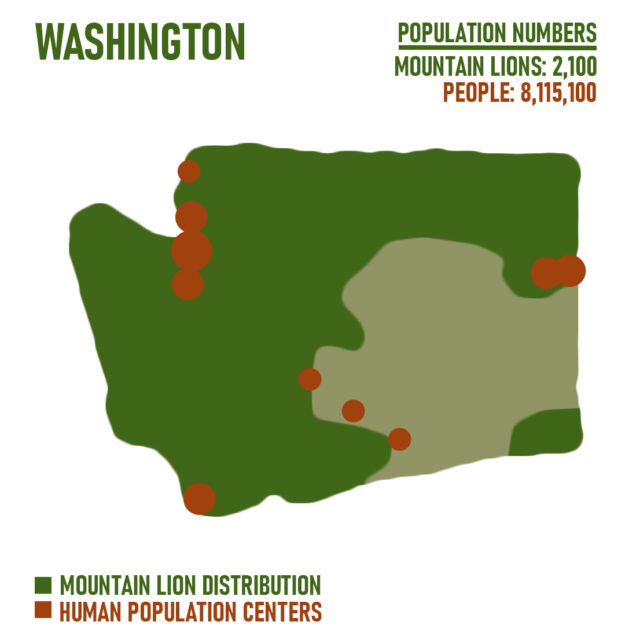
Washington has both a sizeable human and Mountain Lion population. In Washington, Mountain Lions can be found across much of the state. Some of the largest urban areas in the state border known Mountain Lion distribution.
Washington classifies the Mountain Lion as a Game Animal and defines a specific Mountain Lion hunting season and quotas. Trapping Mountain Lions is illegal in the state. Juvenile Mountain Lions and any adult accompanying them are fully protected. Washington maintains Special Exceptions to its hunting and trapping regulations for reasons of Public Safety, Depredation, and Research. Reporting of Mountain Lion mortalities is required by law in Washington, and the population is scientifically monitored and managed.
Washington-Texas Mountain Lion Regulations
| State | Washington | Texas |
| Status | Game Animal | Nongame Animal |
| Sport Hunting | Legal with Valid Hunting License | Legal with Valid Hunting License |
| Special Exceptions | Public Safety Depredation Research | None Needed |
| Special Exception – Public Safety | Legal lethal methods as last resort Reporting required Carcass surrendered | Sport Hunting Regulations apply. No special regulations. |
| Special Exception – Depredation | Legal Reporting required Carcass surrendered Depredation compensation | Sport Hunting Regulations apply. No special regulations. |
| Special Exception – Research | Special permit required Welfare of the Mountain Lion must be prioritized Reporting required | Sport Hunting Regulations apply. No special regulations. |
| Hunting Season | September 1 – March 31, or until annual quotas are met | No Closed Season |
| Firearms | Legal with permitted equipment | Legal with permitted equipment |
| Archery | Legal with permitted equipment | Legal with permitted equipment |
| Dogs | Illegal | Legal with permitted methods |
| Hunting Regulation Specifics | There are 58 Cougar Hunt Management Units (CHMUs) in Washington state, according to the Washington Department of Fish and Wildlife regulations. Mountain Lion (cougar) hunting regulations in Washington state require a valid big game license with a cougar tag. There is a statewide bag limit of one cougar per year. Hunting season runs from September 1 through March 31, subject to strict localized harvest caps. Each Cougar Hunt Management Unit (CHMU) has a harvest cap set at 13% of the independent-aged cougar population. When total mortality (harvests plus conflict kills) hits this limit, that specific unit closes. It is strictly illegal to kill or possess spotted cougar kittens (under roughly 80 lbs) or any adult cougar accompanied by spotted kittens. Canned hunts are illegal. The recreational use of dogs/hounds to hunt cougars is prohibited statewide by law, except during specialized public safety removals authorized by the Washington Department of Fish and Wildlife. Successful hunters must have the hide and skull sealed at a WDFW office within 3 business days of the kill. All tag holders must report hunting activity via the WILD system by March 31, regardless of success. | Mountain Lions may be hunted at any time by any lawful means or methods on private property. Public lands may have additional restrictions. It is unlawful to take any nongame species for commercial purposes (sale, offer for sale, barter, or exchange) from public lands or waters. No canned hunts. No person may hunt a Mountain Lion that is in captivity, or release a Mountain Lion from captivity for the purpose of being hunted or training dogs. Furthermore, no person may conduct, promote, assist, or advertise an activity prohibited under these rules. It is unlawful to hunt (capture, trap, take, collect, or kill) any wild animal or wild bird on a public road or the right-of-way of public roads. It is unlawful to take any nongame species for commercial purposes (sale, offer for sale, barter, or exchange) from public lands or waters. |
| Trapping | Illegal with Special Exceptions | Legal with permitted methods |
| Trapping Season | No Open Season | No Closed Season |
| Spring Traps | Illegal with Special Exceptions | Legal with permitted equipment |
| Wire Snares | Illegal with Special Exceptions | Legal with permitted equipment |
| Cage Traps | Illegal with Special Exceptions | Legal with permitted equipment |
| Trapping Regulation Specifics | It is illegal to trap Mountain Lions (cougars) for fur or recreational purposes. Mountain Lions are not classified as furbearing animals eligible for trapping, and intentional trapping of a cougar is a misdemeanor. Trapping licenses only apply to approved furbearers; catching a Mountain Lion in a trap requires immediate release if unharmed. Body-gripping traps and snares are generally banned for nuisance wildlife unless a special, highly restricted permit is authorized directly by WDFW to resolve specific public safety conflicts Research trapping is allowed with a Scientific Collecting Permit. Reporting required. | A valid Texas hunting license is required to legally trap or hunt Mountain Lions in the state. Trapping is legal at any time by any lawful means or methods (heavy-duty footholds, cage/live traps, cable snares) on private property. Public lands may have additional restrictions. It is unlawful to allow a live Mountain Lion to be captured in a trap for more than 36 hours. It is unlawful to allow a live Mountain Lion to be captured in a snare for more than 36 hours unless the snare is incapable of producing a loop greater than 10 inches (ie accidentally caught in a small animal snare). |
| Bag Limit | One per license year | No Bag Limit |
| Possession Limit | One per license year | No Possession Limit |
| Mountain Lion Age and Gender Restrictions | Spotted Mountain Lion kittens or any adult cougars accompanied by spotted kittens–regardless of gender–cannot be killed. | No special restrictions. Mountain Lions of any gender or age can be taken. |
| Reporting | Required | Not Required |
| Reporting Specifics | Successful hunters must present the unfrozen hide and skull with proof of sex attached to the Washington Department of Fish & Wildlife within 3 business days of the kill for biological sample collection. All hunters who purchase a cougar tag must report their hunt activity—whether successful or unsuccessful—through the WILD licensing system by the end of the season. | Reporting is encouraged but not required. |
| Population Monitoring | Active monitoring by the Washington Department of Fish and Wildlife | Informal and anecdotal |
Wyoming
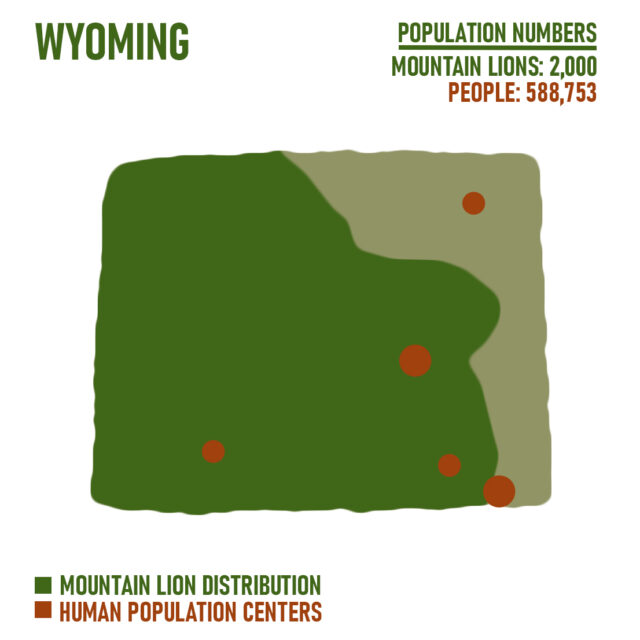
Wyoming is a large state by land area but small in human population. There are approximately 2000 Mountain lions living in Wyoming, and they range across most of the state. Conflicts with Mountain lions are rare in Wyoming.
Wyoming classifies the Mountain Lion as a Trophy Game Animal and defines a specific Mountain Lion hunting season and quotas. Trapping Mountain Lions is illegal in the state. Juvenile Mountain Lions and their mothers are fully protected. Wyoming maintains Special Exceptions to its hunting and trapping regulations for reasons of Public Safety, Depredation, and Research. Reporting of Mountain Lion mortalities is required in Wyoming, and the population is scientifically monitored and managed.
Wyoming-Texas Mountain Lion Regulations
| State | Wyoming | Texas |
| Status | Trophy Game Animal | Nongame Animal |
| Sport Hunting | Legal with Valid Hunting License | Legal with Valid Hunting License |
| Special Exceptions | Public Safety Depredation Research | None Needed |
| Special Exception – Public Safety | Legal lethal methods as last resort Reporting required Carcass surrendered | Sport Hunting Regulations apply. No special regulations. |
| Special Exception – Depredation | Legal Reporting required Pelt must be preserved for tagging Depredation compensation | Sport Hunting Regulations apply. No special regulations. |
| Special Exception – Research | Special permit required Welfare of the Mountain Lion must be prioritized Reporting required | Sport Hunting Regulations apply. No special regulations. |
| Hunting Season | September 1 – March 31, or until annual quotas are met | No Closed Season |
| Firearms | Legal with permitted equipment | Legal with permitted equipment |
| Archery | Legal with permitted equipment | Legal with permitted equipment |
| Dogs | Legal with permitted methods | Legal with permitted methods |
| Hunting Regulation Specifics | Mountain Lion hunting in Wyoming is regulated by the Wyoming Game & Fish Department under specific season dates, strict hunt area mortality limits, and legal weapon rules. Wyoming is divided into 5 Mountain Lion Management Units (MLMUs), which are further split into 32 distinct Mountain Lion hunt areas. Hunters must check area closure statuses before hunting. Runs from September 1 through March 31 of the following year in most hunt areas, though specific dates vary by region. Each hunt area has a set harvest quota. Once the limit is met, that specific area closes immediately. A hunter may obtain a maximum of one full-priced Mountain Lion license and one reduced-priced license per calendar year. Reduced-price licenses are restricted to specific hunt areas, including areas 5, 7, 8, 9, 15, 16, 19, 24, 25, 27, and 31. Taking spotted kittens or any female Mountain Lion accompanied by kittens is strictly prohibited. Canned hunts are illegal. Legal shooting hours are from one-half hour before sunrise to one-half hour after sunset. Legal firearms or archery equipment (including crossbows and compound bows) are permitted. The use of dogs to pursue and take Mountain Lions is allowed during open season hours; once a lion is bayed or treed, the hunter must promptly harvest or release it. | Mountain Lions may be hunted at any time by any lawful means or methods on private property. Public lands may have additional restrictions. It is unlawful to take any nongame species for commercial purposes (sale, offer for sale, barter, or exchange) from public lands or waters. No canned hunts. No person may hunt a Mountain Lion that is in captivity, or release a Mountain Lion from captivity for the purpose of being hunted or training dogs. Furthermore, no person may conduct, promote, assist, or advertise an activity prohibited under these rules. It is unlawful to hunt (capture, trap, take, collect, or kill) any wild animal or wild bird on a public road or the right-of-way of public roads. It is unlawful to take any nongame species for commercial purposes (sale, offer for sale, barter, or exchange) from public lands or waters. |
| Trapping | Illegal with Special Exceptions | Legal with permitted methods |
| Trapping Season | No Open Season | No Closed Season |
| Spring Traps | Illegal with Special Exceptions | Legal with permitted equipment |
| Wire Snares | Illegal with Special Exceptions | Legal with permitted equipment |
| Cage Traps | Illegal with Special Exceptions | Legal with permitted equipment |
| Trapping Regulation Specifics | Mountain Lion trapping in Wyoming is strictly governed by the Wyoming Game and Fish Department under state statutes and commission regulations. Mountain Lions are classified as trophy game animals in Wyoming and require a valid Mountain Lion license to take. It is illegal to use any game animal, game bird, or game fish parts as bait for trapping or hunting wildlife in Wyoming. Research trapping is allowed with a Scientific Collecting Permit. Reporting required. | A valid Texas hunting license is required to legally trap or hunt Mountain Lions in the state. Trapping is legal at any time by any lawful means or methods (heavy-duty footholds, cage/live traps, cable snares) on private property. Public lands may have additional restrictions. It is unlawful to allow a live Mountain Lion to be captured in a trap for more than 36 hours. It is unlawful to allow a live Mountain Lion to be captured in a snare for more than 36 hours unless the snare is incapable of producing a loop greater than 10 inches (ie accidentally caught in a small animal snare). |
| Bag Limit | One per calendar year. Two with special license | No Bag Limit |
| Possession Limit | One per calendar year. Two with special license | No Possession Limit |
| Mountain Lion Age and Gender Restrictions | Dependent young and females with dependent young cannot be killed. Specific local male and female quotas may apply. | No special restrictions. Mountain Lions of any gender or age can be taken. |
| Reporting | Required | Not Required |
| Reporting Specifics | Must be reported within 72 hours of the harvest. Hunters must present the pelt and skull for inspection. Hunter’s name, phone number, license number, residency status, date of kill, and exact location/hunt area must be provided. | Reporting is encouraged but not required. |
| Population Monitoring | Active monitoring by the Wyoming Game and Fish Department | Informal and anecdotal |