

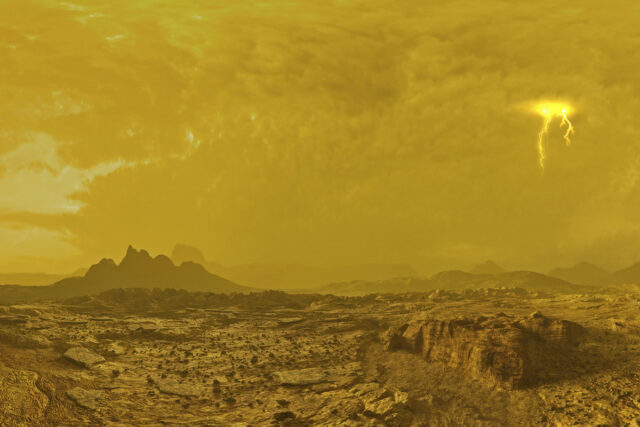
Of the eight planets in our solar system, Venus is in some ways the one most similar to Earth–especially in terms of size and composition. But there are also many stark and dramatic differences between the two. Earth is a blue and green water planet teeming with life, while Venus has become a cauldron of toxic chemicals and searing heat. If Earth were imagined as heaven, then, by comparison, Venus would certainly fit the bill as hell.
Nonetheless, some speculate that there was a time when Venus was much more like Earth than it is today. Some evidence suggests that Venus may once have had oceans of liquid water and a moderate climate similar to Earth’s. But somewhere along the way, the fate of the two planets diverged dramatically. How could two planets so similar, in so many ways, become so extremely different?
The hell-scape on Venus is caused by something known as the runaway greenhouse effect. The runaway greenhouse effect is a much more severe manifestation of the simple atmospheric greenhouse effect that we hear so much about in discussions about climate change here on Earth. The simple greenhouse effect is the result of greenhouse gases in the atmosphere of Earth and other planets. These gases allow visible light from the sun to pass through and heat the planet’s surface, but they also absorb heat as it tries to radiate back into space. Greenhouse gases act like a blanket, hampering the planet’s ability to cool.
The simple greenhouse effect becomes a runaway greenhouse effect when a self-reinforcing feedback loop sets in, causing temperatures to rise to extreme, unlivable levels. This is what happened on Venus, where the atmosphere is now composed almost entirely of greenhouse gases, and is by far the densest atmosphere of any terrestrial body in our solar system. Further, the thick lower atmosphere is topped by a layer of sulphuric acid clouds. If ever there were a recipe for creating hell, the runaway greenhouse effect would be it.
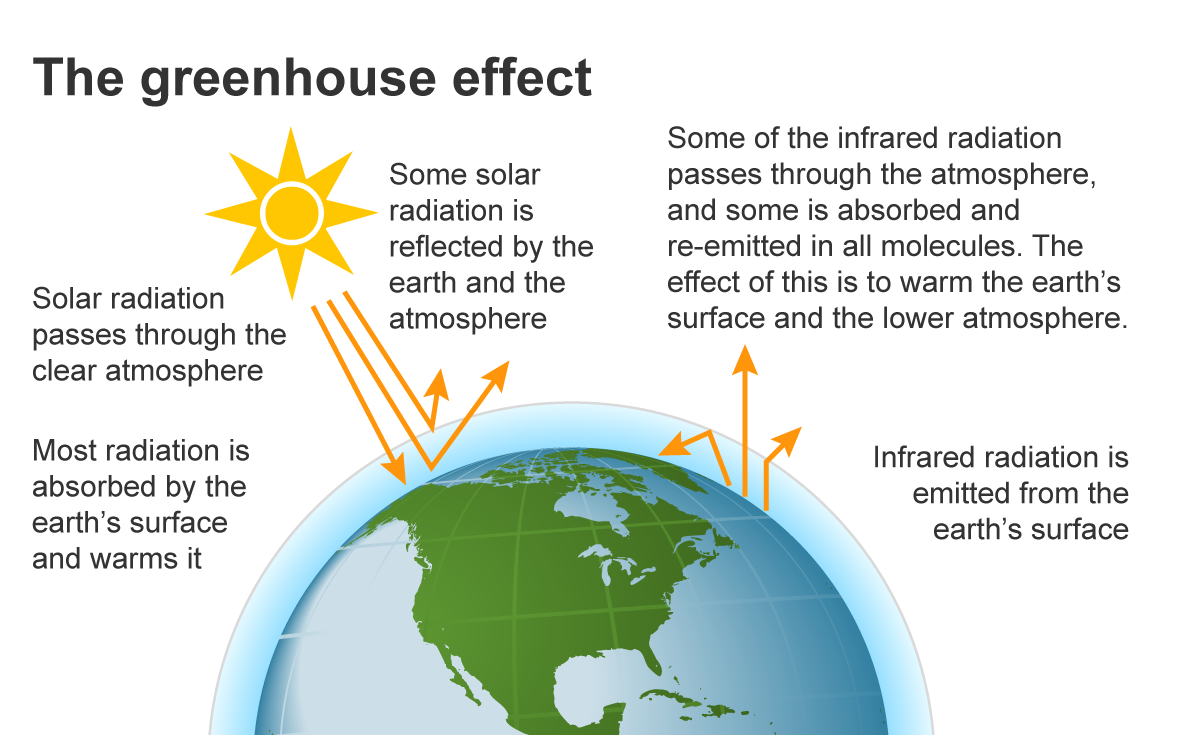
The greenhouse effect is a real thing. It is demonstrable. Carbon Dioxide is the most frequently mentioned greenhouse gas on Earth, but there are others. Water vapor, methane, nitrous oxide, and ozone all contribute to the greenhouse effect. Perhaps the easiest way to observe the phenomenon of greenhouse warming on Earth is to notice how the temperature behaves on cold winter nights when the sky is clear versus nights when there is a blanket of cloud cover (water vapor). When all else is equal, the temperature will cool off much more on nights with clear skies, and stay much warmer when there is ample cloud cover. The difference can be dramatic. That is the greenhouse effect in action.
But the simple greenhouse effect we experience here on Earth is very different than a runaway greenhouse effect seen on Venus. The climate of the Earth is hospitable because of the action of greenhouse gases. Without greenhouse warming, the climate would be much colder–Earth would be a frozen planet. So, while the extremes of runaway greenhouse warming are unquestionably a bad thing, the right amount of greenhouse warming is a good and necessary thing. On Earth, it sustains life and fosters a livable climate.
The hellish conditions on Venus often come up in discussions of global warming here on Earth. Many proponents of Catastrophic Global Climate Change like to suggest, imply, or even outright assert that the runaway greenhouse effect that occurred on Venus will happen here on Earth as well. It’s a common trope. Ordinarily, this kind of talk comes from activists, journalists, and politicians. They use this exaggeration to scare, sell, and recruit. But on occasion, even respected scientists may make the claim. A notable example comes from the famous astrophysicist, Stephen Hawking, who said the following in reference to President Trump pulling the US out of the Paris climate agreement…
“We are close to the tipping point where global warming becomes irreversible. Trump’s action could push the Earth over the brink, to become like Venus, with a temperature of two hundred and fifty degrees, and raining sulphuric acid”
Stephen Hawking – Astrophysicist, University of Cambridge
What Hawking says here simply isn’t true. The Earth is nowhere near a tipping point that would transform it into a Venus-like inferno. Most respected scientists–even those who are proponents of anthropogenic climate change–do not share the view that the Earth will ever experience runaway greenhouse warming. For example, famous climate alarmist Michael Mann acknowledges that the Earth will not experience runaway greenhouse warming as occurred on Venus. Mann had this to say in response to Hawking’s hyperbole…
“Hawking is taking some rhetorical license here. Earth is further away from the sun than Venus and likely cannot experience a runaway greenhouse effect in the same sense as Venus — i.e. a literal boiling away of the oceans.”
Michael Mann – Climatologist, University of Pennsylvania
When people exaggerate in the way Hawking did, it is a tacit admission that either they don’t know what they are talking about, or that they do not have faith that truth-based arguments are compelling enough to persuade–in other words, they are purposely attempting to mislead. They are trying to recruit supporters to their side of a political argument. But such exaggeration is generally counterproductive and irresponsible. When revealed as hyperbole, misrepresentations like these tend to damage the case being made rather than to strengthen it.
Still, it’s not impossible to imagine a way in which the Earth could experience a period of runaway heating like that which occurred on Venus–but if it did, it would be due to the actions of the planet or the cosmos, not people. Some kind of massive global volcanism event or a cosmic impactor might create conditions for a Venus-like transformation of the Earth. Fortunately, these are extreme outlier scenarios with a virtually zero chance of occurring.
Another opportunity to transform the Earth into a Venus-like cauldron will happen when the sun enters the red giant phase of its life (or death, depending on how you want to look at it). This isn’t expected to occur for 5 billion years, and it appears unavoidable.
One thing is certain, however: anthropological actions will not create a runaway greenhouse effect here on Earth. The emissions from your gas-guzzling jalopy are not going to transform the Earth into Venus. At present, people could not turn the Earth into Venus even if they actively tried. The Earth and Venus are simply too different from one another for it to be possible.
It is precisely because of the differences that a runaway greenhouse effect exists on Venus, and also why a similar phenomenon is unlikely on Earth. For context, let’s explore some of the ways these two planets differ.
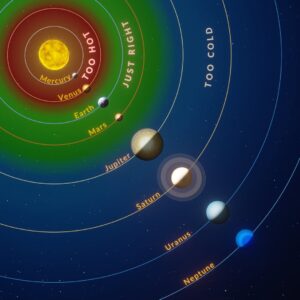
To begin with, Venus is much closer to the sun than the Earth. The Earth has an average distance from the Sun of around 93 million miles. Venus, on the other hand, averages about 67 million miles, some 26 million miles closer to the Sun than the Earth. This distance puts Venus just outside of the so-called Habitable Zone and into a region of the solar system generally thought to receive too much solar radiation to support life.
Venus has no moon. The Earth has the largest moon relative to planet size in the entire solar system (Excluding the dwarf planet system of Pluto and Charon).
Venus has a slight axial tilt of only 2.6 degrees, whereas the Earth is tilted at 23.5 degrees. The notable tilt on Earth is what creates our seasons–winter, spring, summer, and fall. Venus’ negligible tilt means that the planet essentially has no seasons, and its climate conditions are similar year-round.
It takes 225 Earth days for Venus to orbit the sun (One Venusian Year). The Earth requires 365 days to complete one orbit around the sun (An Earth Year).
Venus has a retrograde rotation, meaning its rotation is clockwise when viewed from above the north pole, while its revolution around the sun is counterclockwise. A complete rotation on Venus takes 243 Earth days to complete. This is 18 Earth days longer than a Venusian year. A solar day on Venus lasts 117 Earth days. As a consequence, a point on the surface of Venus is exposed to the sun for about 58 Earth days at a time
Both Venus and the Earth have magnetic fields, but the two are very different from one another. Venus has a weak magnetic field created by the interaction of its ionosphere and the solar wind. It provides the planet with almost no protection from solar and cosmic radiation. The Earth, on the other hand, has a very strong magnetic field. The Earth’s magnetic field is generated in the planet’s interior and results from convection currents in the molten metal outer core. The resulting planetary dynamo creates a magnetic field that surrounds the Earth and protects it from the negative effects of solar and cosmic radiation.
The Earth is covered in a vast ocean of liquid water. This water supports life on the planet, lubricates plate tectonics, and contributes to the cooling effect of the water cycle. Venus has essentially no water.
The surface of the Earth is divided into 16 principal tectonic plates. Over geological timescales, these plates move relative to each other along convergent, divergent, and transform boundaries. Ocean water on Earth is thought to play an important role in the operation of plate tectonics. Meanwhile, on Venus, there is no ocean, and there are no plate tectonics at work. Without the action of plate tectonics to dissipate heat from its mantle, it is thought that Venus may experience periodic, massive volcanic resurfacing events. At which time, large portions of its surface are subject to huge volcanic cataclysms, releasing vast quantities of greenhouse gases into the atmosphere.
The principal difference between the two planets is the lack of evidence for plate tectonics on Venus, possibly because its crust is too strong to subduct without water to make it less viscous. This results in reduced heat loss from the planet, preventing it from cooling and providing a likely explanation for its lack of an internally generated magnetic field. Instead, Venus may lose its internal heat in periodic major resurfacing events.
Wikipedia
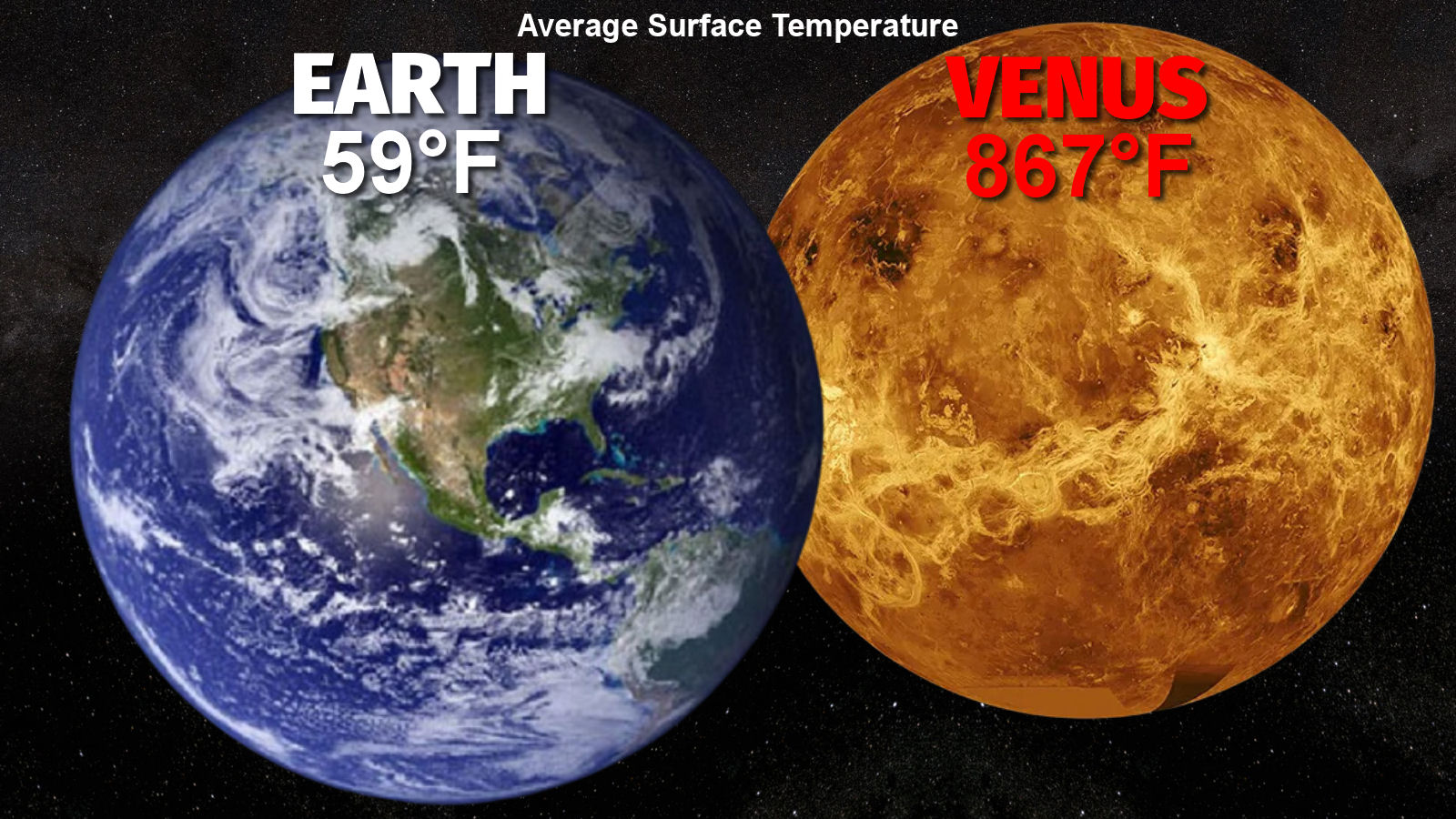
The average temperature on Venus is much hotter than it is on Earth. On Venus, the average surface temperature is thought to be around 867 degrees Fahrenheit. This temperature is comparable to that reached during oven self-cleaning cycles. It’s hot enough to melt zinc, tin, and lead. On the Earth, the average temperature is a comparatively balmy 59 degrees Fahrenheit.
The composition of the atmosphere is very different on Venus than it is on Earth. The atmosphere on Venus is primarily composed of carbon dioxide at 97%. The most abundant gas in the Earth’s atmosphere is nitrogen, which makes up some 78% of the total. On Earth, carbon dioxide makes up a very small part of the atmosphere, coming in at only 0.04%.
The atmosphere on Venus is also extremely dense, creating atmospheric pressure at the planet’s surface comparable to that exerted by water at around half a mile beneath the ocean’s surface on Earth. This is 93 times the atmospheric pressure exerted on Earth. Venusian atmospheric pressure would be crushing and fatal.
Furthermore, the atmosphere on Venus also exhibits a phenomenon known as atmospheric super-rotation. The Venusian atmosphere rotates around the planet in 4 days, generating powerful winds. This atmospheric rotational speed exceeds the planet’s rotation speed by a factor of 60. On Earth, the strongest winds can only be expected to reach around 15% of the planet’s rotational speed.
See the table below for a summary of some of the more important differences between the two planets…
| Earth | Venus | |
| Diameter | 7926 mi | 7521 mi |
| Distance from Sun | 93 million mi | 67 million mi |
| Axial Tilt | 23.5 degrees | 2.6 degrees |
| Seasons | Winter, Spring, Summer, Fall | None |
| Magnetic Field | Strong | Weak |
| Surface Gravity | 1 g | 0.9 g |
| Solar Day | 24 hours | 2808 hours (117 Earth Days) |
| Rotation Period | 23 hours 56 minutes | 5832 hours (243 Earth Days) |
| Year | 365 Earth days | 0.93 Venus days |
| Water | Global Ocean | No Liquid Water |
| Avg Surface Temperature | 59 degrees F | 867 degrees F |
| Atmospheric Surface Pressure | 1 bar | 93 bars |
| Atmosphere Composition | Earth | Venus |
| Nitrogen | 78% | 4% |
| Oxygen | 21% | 0% |
| Water Vapor | 1% | 0.002% |
| Argon | 0.9% | 0.007% |
| Carbon Dioxide | 0.04% | 97% |
| Neon | 0.002% | 0.0007% |
| Helium | 0.0005% | 0.001% |
| Methane | 0.0002% | 0% |
| Krypton | 0.0001% | 0% |
| Hydrogen | 0.00006% | 0% |
| Sulphur Dioxide | 0% | 0.02% |
| Carbon Monoxide | 0% | 0.002% |
The differences between Venus and Earth do not exist because Venus is a hellscape; rather, the hellish conditions on Venus result from the extreme differences between the two planets. The unique circumstances on Venus are what fostered a runaway greenhouse effect, while the more favorable conditions on Earth prevent the same from happening here.
A runaway greenhouse, like that on Venus, is not going to occur on Earth. Runaway greenhouse warming requires extreme events and progressions–things really have to spiral out of control on an unimaginable scale. Burning so-called fossil fuels on Earth is simply not going to raise atmospheric carbon dioxide levels from 0.04% to 97%. It will not increase atmospheric pressure by a factor of 93. These things cannot happen.
There are those who argue that climate change on Earth is mainly caused by human activities, and they may or may not be right in that assessment. But one of the most important lessons from Venus’s extreme climate is that runaway global warming can occur naturally, without human involvement.
When climate alarmists say that the Earth is in danger of becoming like Venus, they are being misleading, and this kind of misrepresentation is extremely unfortunate. Environmentalism is an incredibly important pursuit. Good stewardship of the planet is critical to our future. People involved in efforts to protect the planet should not exaggerate or indulge in hyperbole. It only serves to discredit the cause. It hampers the ability to engage in honest, open discourse on the subject.
If climate change is really the existential threat they want us to believe it is, there should be no need to exaggerate or mislead. A truthfully presented case should be strong enough to stand on its own. To have the impact activists hope to have on the future, it is imperative that the case they make does not require deviations from the truth. And when a proponent does stray into hyperbole, it should be expected that the scientific community steps in and vociferously sets the record straight. Issues of this level of importance should be addressed only through strict adherence to the truth.