
It is not uncommon for people to think of rabbits and their kin as kinds of rodents, similar to rats, mice, and the like. But, rabbits, hares, and pikas belong to the order Lagomorpha, which is separate and distinct from the order Rodentia. The confusion often stems from the many traits the animals in these two orders have in common. Both contain relatively small species that characteristically engage in gnawing behaviors. And both orders contain species with high reproductive potentials.
But there are some important differences between these two categories of small mammals as well. The most immediate variance is found in the teeth. For instance, Lagomorphs have four incisor in the upper jaw, while animals in Rodentia only have two. There are also important skeletal, reproductive, dietary, and adaptability disparities that further differentiate these two orders.
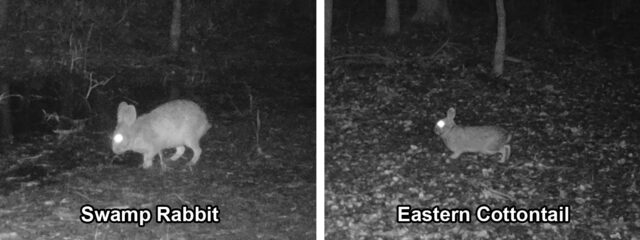
In North Texas we have three representatives species from the order Lagomorpha: the Black-tailed Jackrabbit (Lepus californicus), the Eastern Cottontail (Sylvilagus floridanus), and another species of cottontail–the Swamp Rabbit (Sylvilagus aquaticus). Of these, the Black-tailed Jackrabbit–a type of hare–is the most distinctive in appearance, while the Eastern Cottontail is by far and away the most abundant. The less common Swamp Rabbit can be easily confused with the Eastern Cottontail due to their similar appearance, but there are some important differences that can aid in telling them apart.
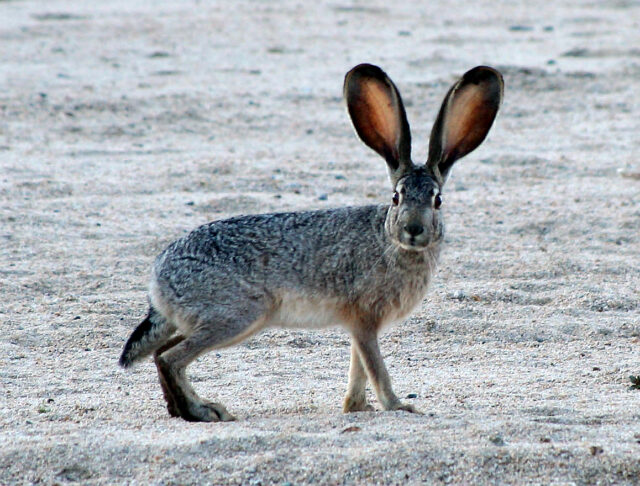
are easy to distinguish from rabbits in the cottontail family
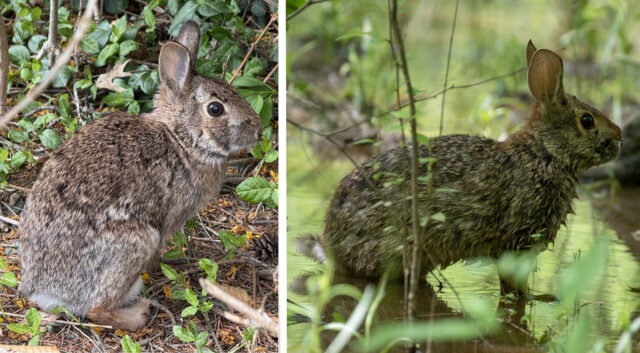
Eastern Cottontails are very numerous throughout their range in North Texas–in both rural and urban areas. There are a whole lot of these rabbits in the Dallas/Fort Worth metroplex. This is the species of bunny that we see in our front yards and neighborhood parks. Swamp Rabbits are here too, but they prefer a different type of habitat. The wet bottomland woods that follow the Trinity River and its tributaries are more to their liking.
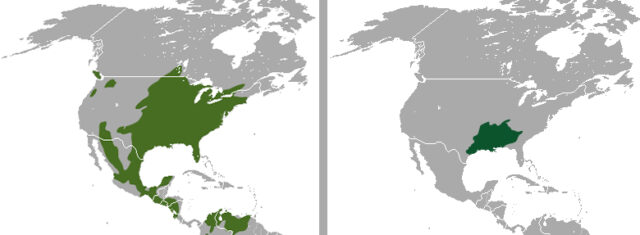
Recognizing the differences between the two species of cottontail rabbits in DFW can begin by noticing their behaviors. Swamp Rabbits are said to be semiaquatic, and they will navigate streams and rivers in a way that is not typical of any other rabbit species in Texas. Swamp Rabbits will readily take to water when fleeing predators–and sometimes even just for a swim. Eastern Cottontails, on the other hand, prefer drier locations, and are not particularly fond of water.
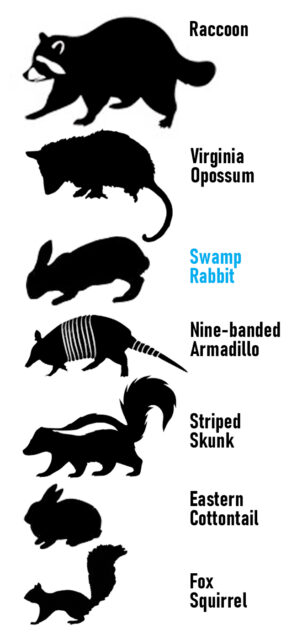
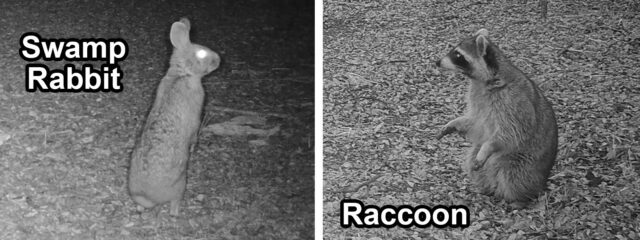
Swamp Rabbits are also decidedly larger than their dry-land cousins. Swamp Rabbits average around 21 inches in length, while the smaller Eastern Cottontail tops out around 16 inches. In terms of size and bulk, the Swamp Rabbit is closer to Opossums, Skunks, and Armadillos, while Eastern Cottontails are just a little larger than Fox Squirrels. If you ever happen flush a full grown Swamp Rabbit in the field, you will likely be struck by its unexpectedly large size.
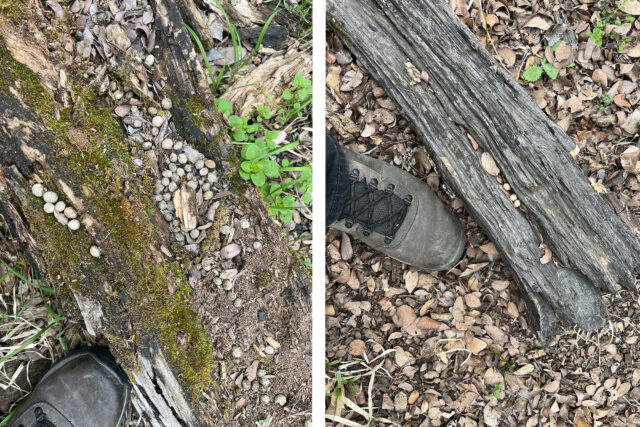
Swamp rabbits also have the unusual habit of leaving piles of their droppings on stumps and deadfalls–something referred to as a Swamp Rabbit latrine. This may be the most important clue that Swamp Rabbits are to be found in a particular location. If piles of droppings are found on deadfalls, in an area frequented by large rabbits, it is a good indication that Swamp Rabbits are present.
In the metroplex, we have a well recognized population of Swamp Rabbits in Dallas County, mostly located in the Trinity River bottoms east of Interstate 45. The presence of Swamp Rabbits in Denton County is not as certain.
I have heard it asserted that we simply do not have Swamp Rabbits in Denton County. But, I have also been presented with some evidence that Swamp Rabbit can be found in this part of the metroplex. Unfortunately, none of this evidence has been very compelling. Some has come in the form of pictures of cottontail rabbits in habitats that could be appropriate for Swamp Rabbits. But, a picture alone is not enough to confirm the species identification–Swamp Rabbits and Eastern Cottontails are just too similar in appearance. Additional evidence that I have seen, includes a picture of a supposed Swamp Rabbit latrine, which upon further examinations appear to actually consist of White-tailed Deer droppings that just happened to fall on a deep woods deadfall.
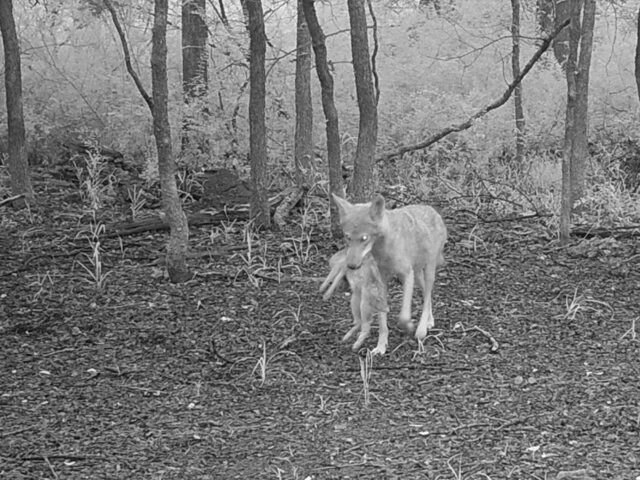
For a little over the past year, I have been running a long term trail camera survey deep in an area of the Dallas/Fort Worth Trinity River bottoms located in Denton County. Early on in the effort I began to notice photographs of what appeared to be unusually large cottontails coming in on the regular. I kept a close eye on this development as new pictures continued to be uploaded month after month. I carefully compared the pictures of rabbits with those of other forest critters taken in the same locations, and soon began to suspect that these were not just Eastern Cottontail I was recording. Many of the pictures showed rabbits that were competing in size with opossums, skunks, armadillos, and sometime even raccoons.


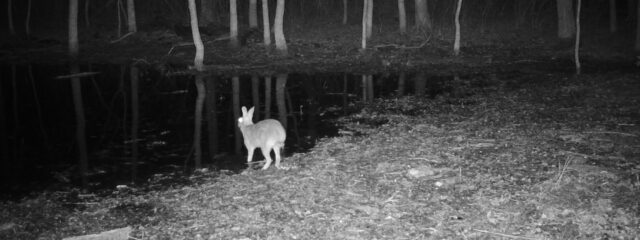
Other pictures showed rabbits that appeared to be entering or exiting vernal pools that formed in the forest during the wet season. Below, you will find a sequence of pictures showing cottontail rabbits accessing a large vernal pool on several different occasions. This behavior is suggests these are likely Swamp Rabbits, as Eastern Cottontails do not prefer the water. Eastern Cottontails rarely even come to water to drink, meeting most of their hydration needs via the moisture found in the vegetation they eat.


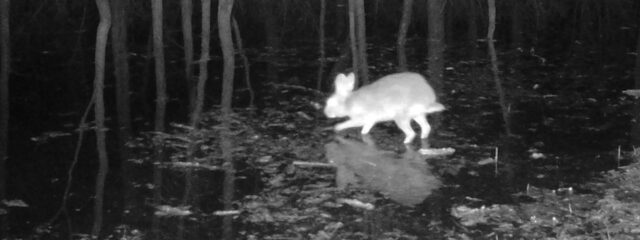
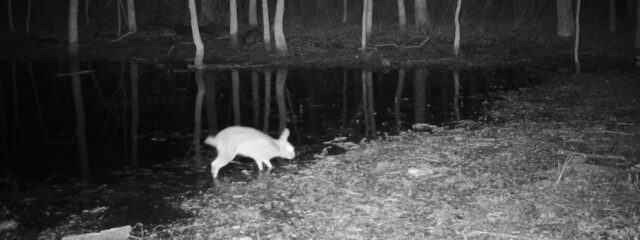
When I finally got out to service the cameras late this winter, I made a point of searching the immediate area for Swamp Rabbit sign. It didn’t take me long to find what I was looking for. In several locations I found evidence of Swamp Rabbit latrines on elevated deadfalls. With that, I had the last bit of corroboration I needed to make a reasonable case. All indications are that we have a healthy population of Swamp Rabbits in this part of Denton County!