
Dateline – May 11, 2020 – Dallas/Fort Worth – Completed January 2026
Over the years I have found that there are a several turtle species in North Texas that I consistently have difficulty identifying. Information online concerning these turtles has proven to be sparse, confusing, and unreliable. I always find it difficult to sort through.
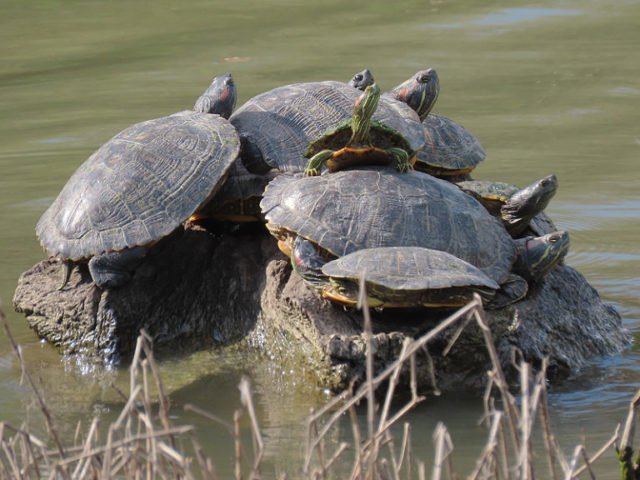
On the rare occasions when I do photograph one of these turtles the effort to track down a good ID always turns into a sizable chore. To make matters worse, I typically forget the important diagnostic details promptly after I complete whatever turtle related project I happened to be working on at the time. That means I am required to do the research all over again every time I encounter one of these hard-to-identify reptiles.
What I really needed was a good place to keep all of the pertinent information in a handy location, so that I don’t have to search as long and hard the next time it is needed. That kind of repository is what I hope this post will provide.
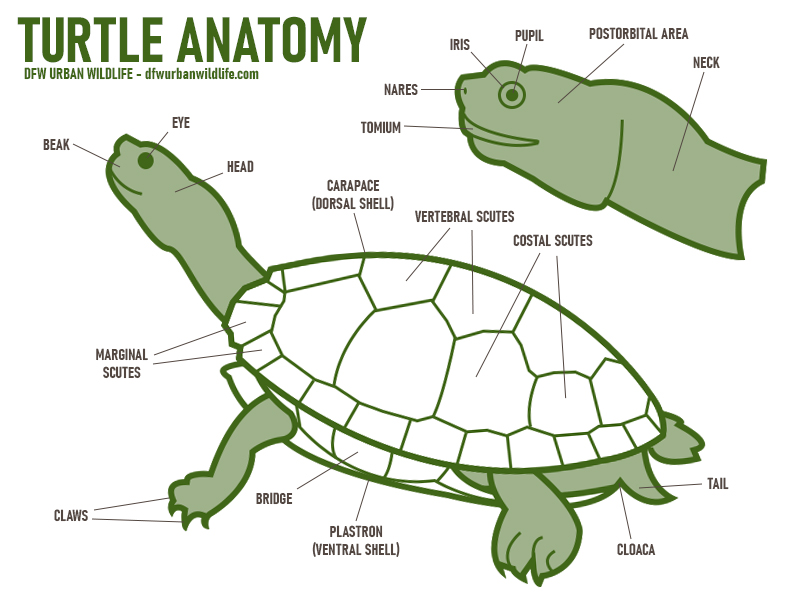
In this article, I have collected relevant information about the different turtle species found in the DFW area. For each entry, an infographic is provided describing important characteristics used to determine which turtle species has been observed. With a little luck, that will make identifications easier going forward.
I’ve included information for all native species of turtles that can be found in and around the Dallas/Fort Worth area–a total of sixteen different species. Both terrestrial and aquatic turtles are covered.
I’ve also included a couple of entries for turtles species that are not native to the area, but that nonetheless have been introduced and are now somewhat established here. These writeups are clearly marked as covering non-native species. The list of non-native turtles present in DFW may be incomplete. It will be expanded as warranted by new information.
This article will likely remain subject to updating for some time, as more refined information becomes available. Please feel free to contact me thoughts, suggestions, and corrections.
Box Turtles
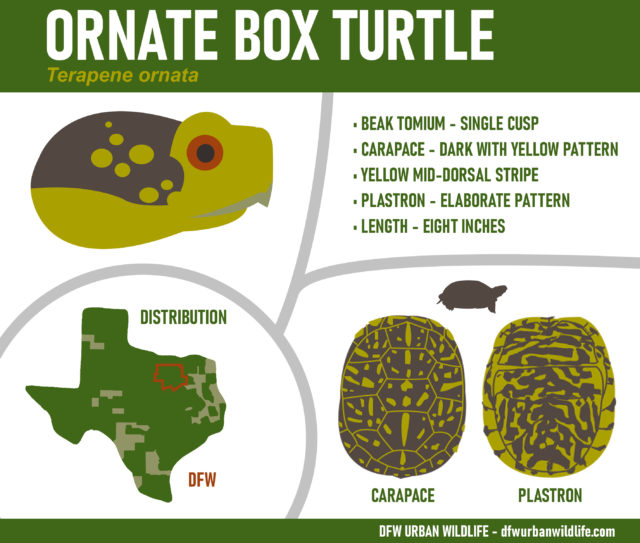
Ornate Box Turtle

The Ornate Box Turtle is a relatively small, terrestrial turtle. They can be found in prairies and wooded areas all across Texas. A subspecies—the Desert Box Turtle (Terapene ornata luteola)—lives in the Trans-Pecos part of the state.
Adult Ornate Box Turtles have a domed carapace which is approximately 5 inches in length. These turtles may approach 8 inches in length when the head and tail are fully extended.
On the turtle’s underside, the plastron is hinged, allowing the Ornate Box Turtle to completely close its shell after fully retracting its head, legs, and tail. This defense mechanism is where this and other box turtles derive their name.
The beak is equipped with a single cusped tomium.
Coloration can vary dramatically between individual turtles, but in general the carapace will be darkly colored with distinct yellow markings. A yellow mid-dorsal stripe is present running the length of the carapace. On the underside, the plastron is decorated with an elaborate pattern of dark and yellow patterns. The head and front legs may be colored with various areas of red, orange, or yellow.
Male box turtles are typically slightly smaller than females. Eyes will be a deep red with males, and brown or yellow on females. Males also possess a larger, thicker tail than females.
The Ornate Box Turtle can live to be 30 or more years old. They are diurnal in their behaviors, operating most often at dawn and dusk. They are omnivores, and will consume a wide variety of available foods. They can often be found feeding on earthworms emerging from the ground during or after a suitable rain event.
Ornate Box Turtles hibernate in the winter. They sit out all extremes in hot or cold weather buried in a shallow burrow.
Three-toed Box Turtle
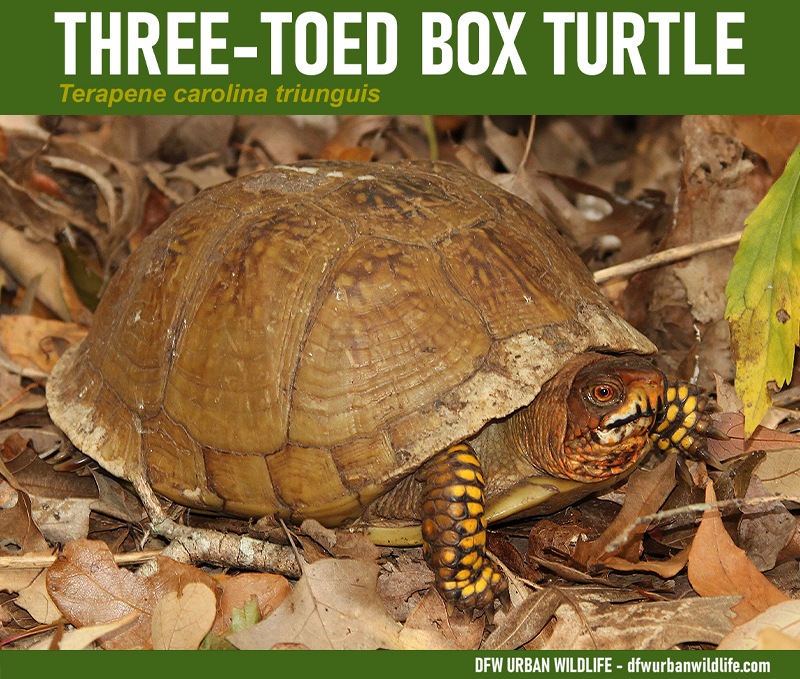
Three-toed Box Turtles are very similar in general appearance to Ornate Box Turtles. Size is comparable between the two at 5 inches for the adult carapace, and 7 inches over all. The beak on both turtles includes a single cusped tomium.
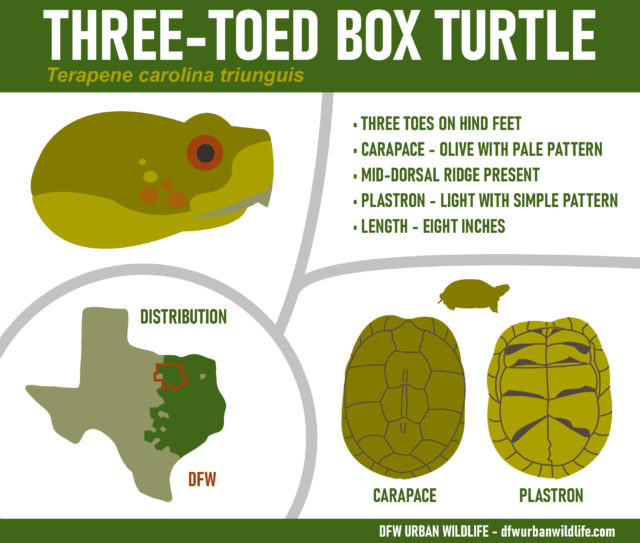
Differences include three toes on the back feet, rather than four as is the case with the Ornate Box Turtle. Three-toed Box Turtles often have an olive colored carapace, which can sometimes include a mixture of dark and light markings. These patterns are typically fainter and less vivid than those on an Ornate Box Turtle.
The carapace of the Three-toed Box Turtle includes a slight mid-dorsal ridge that is not present on the Ornate Box Turtle. Additionally, the underside of the Three-toed Box Turtles is yellow with a simple pattern made up of limited dark areas. This is in sharp contrast to the far more elaborate pattern found on the plastron of the Ornate Box Turtle.
Coloration can vary significantly between individual turtles. Olive or brown skin may contain vivid spots of red, yellow, orange, and white. The eyes of males are red, and those of female turtles will be yellow or brown.
Three-toed Box Turtles share many behaviors with the Ornate Box Turtle, including the ability to fully retract their head, legs, and tail into their shell.
Diet and foraging strategies are also largely shared by both species of box turtle. Both are generalists, eating a wide range of animals and vegetable matter. Three-toed Box Turtles are often inspired to search for food during or shortly after rain showers.
Three-toed Box Turtles are found throughout the eastern part of the state. Prairies and wooded areas are their preferred habitats. These turtles are typically active early and late in the day. They hibernate in the winter and seek shelter from both hot and cold extremes by burying themselves in shallow burrows.
Chicken Turtles
Western Chicken Turtle
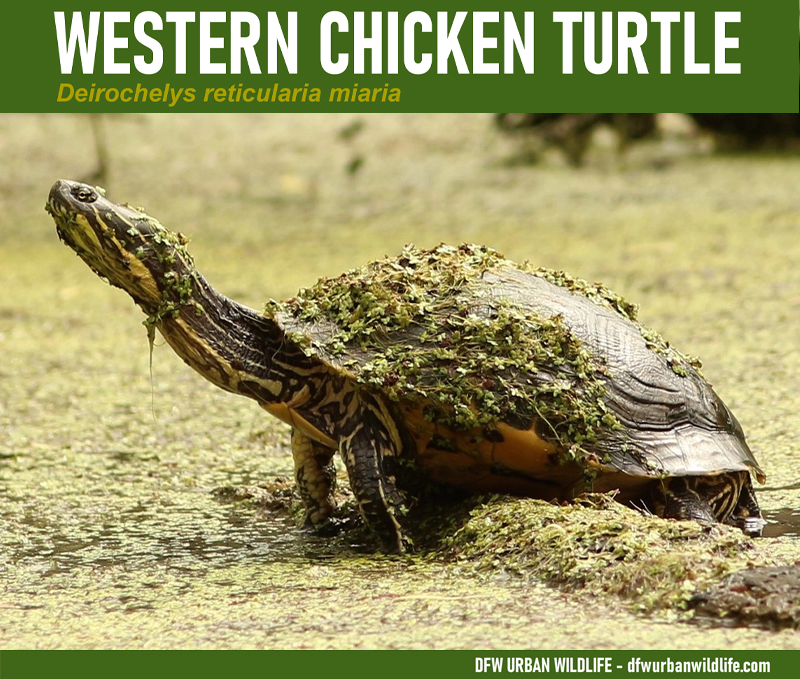
The Western Chicken Turtle is the the subspecies of Chicken Turtle found in Texas. The Chicken Turtle is so named because its meat is said to taste like chicken.
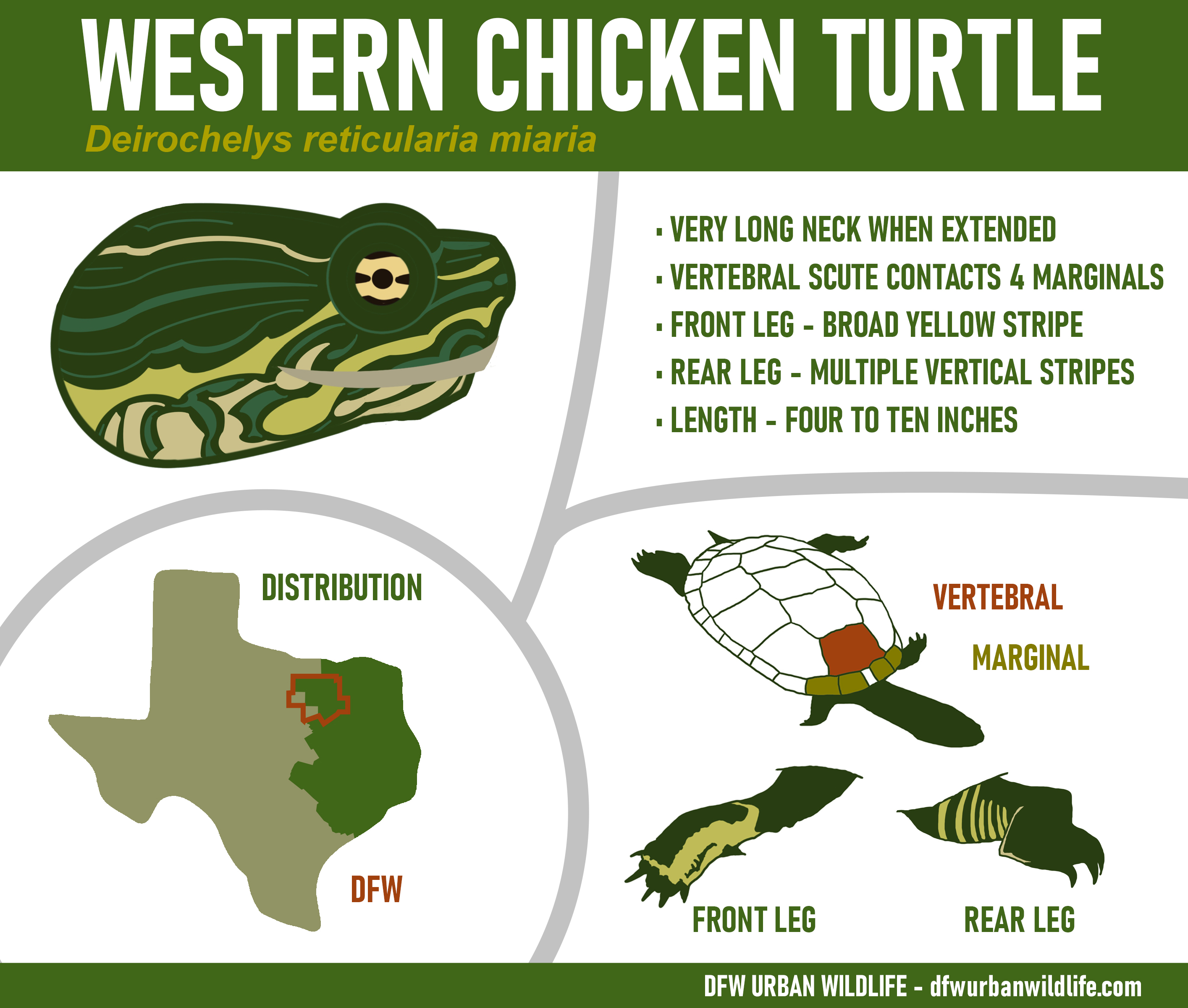
This small pond turtle is similar in many ways to other species of pond turtles in general appearance. The Western Chicken Turtle’s carapace is flat in profile and roughly egg-shaped–narrow toward the front and broad at the rear. Coloration includes various shades of greens, browns, and yellows. The head, neck, limbs, and tail are dark green with yellow striping. The carapace is brownish with a faint light-colored pattern. The plastron is light in color.
Adult Western Chicken Turtles achieve a carapace length of 4 to 10 inches, with females typically growing larger than males.
The Western Chicken Turtle is most easily distinguishable from other pond turtles by its especially long neck, which when fully extended, make the head and neck to be nearly as long as the carapace. The beak is equipped with a notched tomium. The front legs of the Western Chicken Turtle are marked with distinctive broad yellow bars, one on each leg. The hind legs have a series of narrow vertical stripes, that are useful for identification purposes. The plastron is yellow, with dark coloration along the seams.
Another–more subtle–diagnostic is to note that, in the Western Chicken Turtle, the first vertebral scute on the comes into contact with four marginal scutes. This is a unique feature among the different pond turtle species.
Western Chicken Turtles can be found in large and small freshwater bodies across their range in Texas. They are omnivorous, and feed on a wide variety of foods, such as aquatic vegetation, invertebrates, tadpoles, crayfish, and carrion.
Western Chicken Turtles are not commonly encountered in Texas, and are rarely observed in the Dallas/Forth Worth area.
Cooters
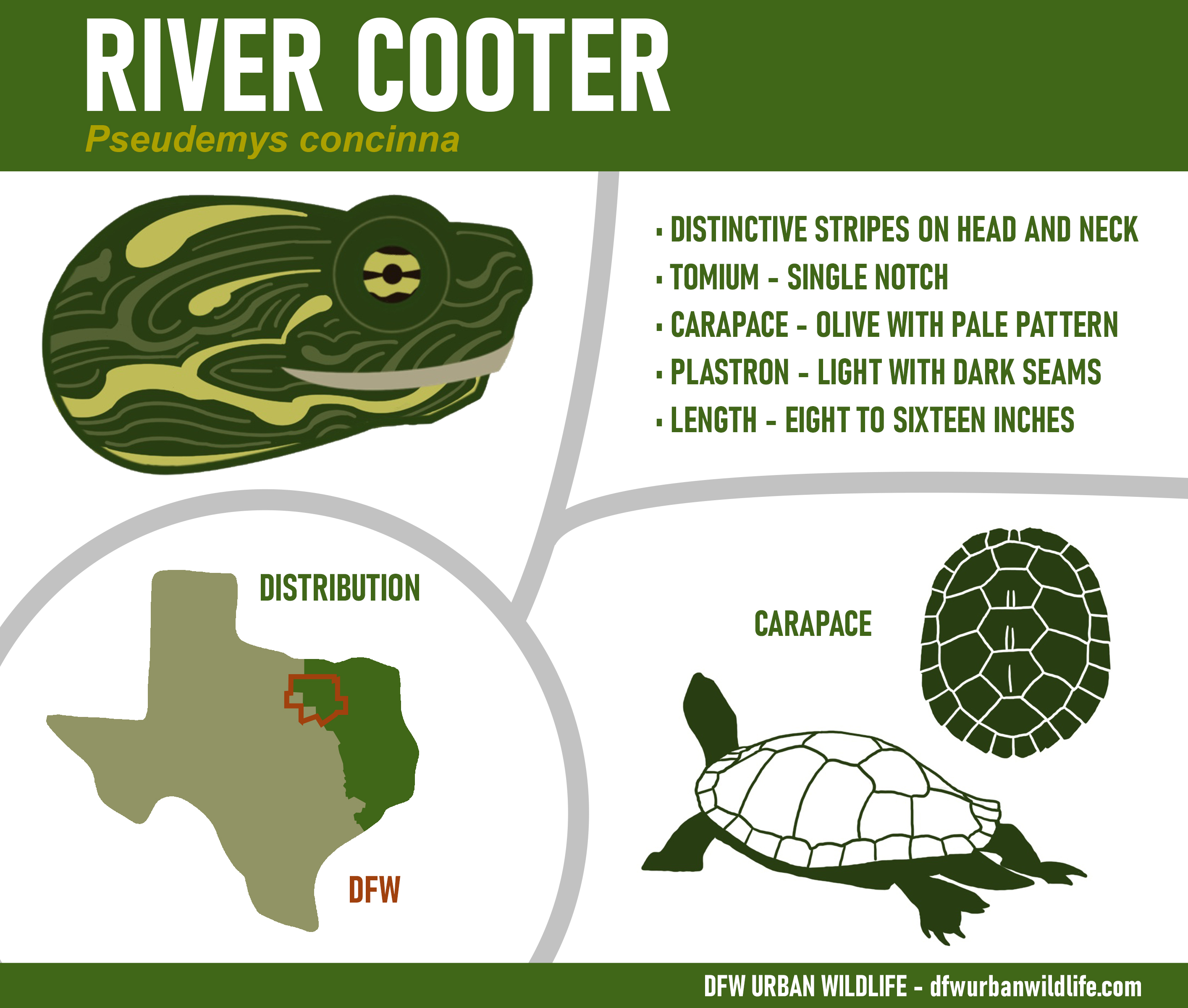
River Cooter
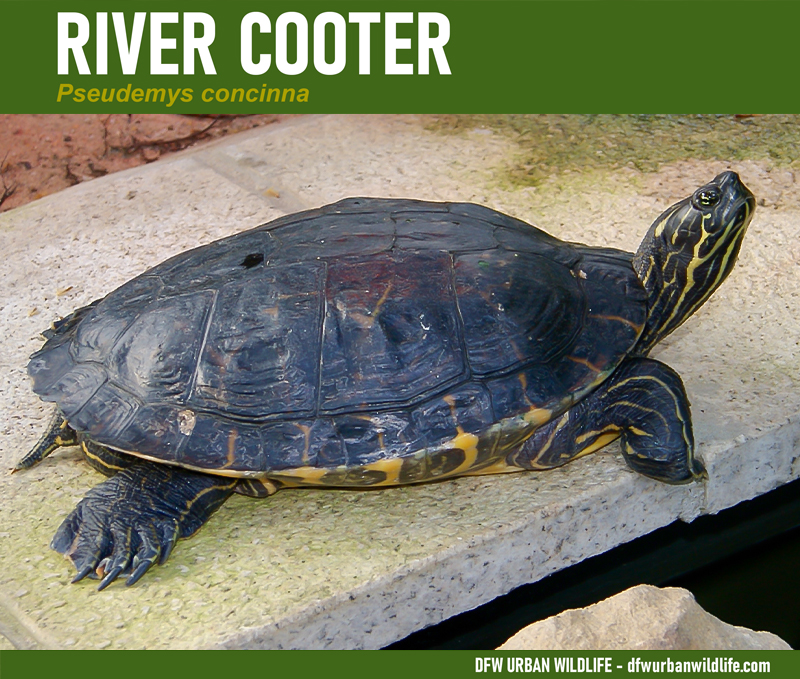
The River Cooter is a commonly seen basking turtle in the Dallas/Fort Worth area. The subspecies found in Texas is the Eastern River Cooter (Pseudemys concinna concinna).
The River Cooter is the largest of the areas basking turtles. This turtle resembles other species of pond turtles in general appearance. Its carapace is flat in profile and egg-shaped when viewed from above. Posterior marginal scutes are serrated. Coloration includes various shades of greens, browns, and yellows. The head, neck, limbs, and tail are dark green with yellow striping. The carapace is dark with a faint light-colored pattern. The plastron is light in color with variable dark markings.
Adult River Cooter achieve a carapace length of 8 to 16 inches. Female River Cooters are typically larger than males.
The River Cooter is very similar in appearance to the Texas Cooter, and their ranges overlap in the Dallas/Forth metroplex. River Cooters can be differentiated by the reclining Y-shaped stripe running from head to neck. One branch of the Y begins just behind the eye, while the other starts on the lower beak. The two branches merge just behind the mouth and the post continues along the turtle’s neck. River Cooters can be further differentiated by their notched beak tomium, in contrast with the Texas Cooter, which has two teeth-like cusps bordering its tomium notch. Older River Cooters may become melanistic as they age, with light coloration fading to dark.
The Western Chicken Turtle is most easily distinguishable from other pond turtles by its especially long neck, which when fully extended, make the head and neck to be nearly as long as the carapace. The beak is equipped with a notched tomium. The front legs of the Western Chicken Turtle are marked with distinctive broad yellow bars, one on each leg. The hind legs have a series of narrow vertical stripes, that are useful for identification purposes. The plastron is yellow, with dark coloration along the seams.
The range of the River Cooter in Texas includes DFW and areas to the north and east, down to the gulf coast. River Cooters can be found in large and small freshwater bodies across their range in Texas, where they are frequently seen basking–often in sizeable groups, sometimes made up of multiple species. River Cooters are primarily herbivorous as adults , but will occasionally feed on insects and other small aquatic animals.
Texas Cooter
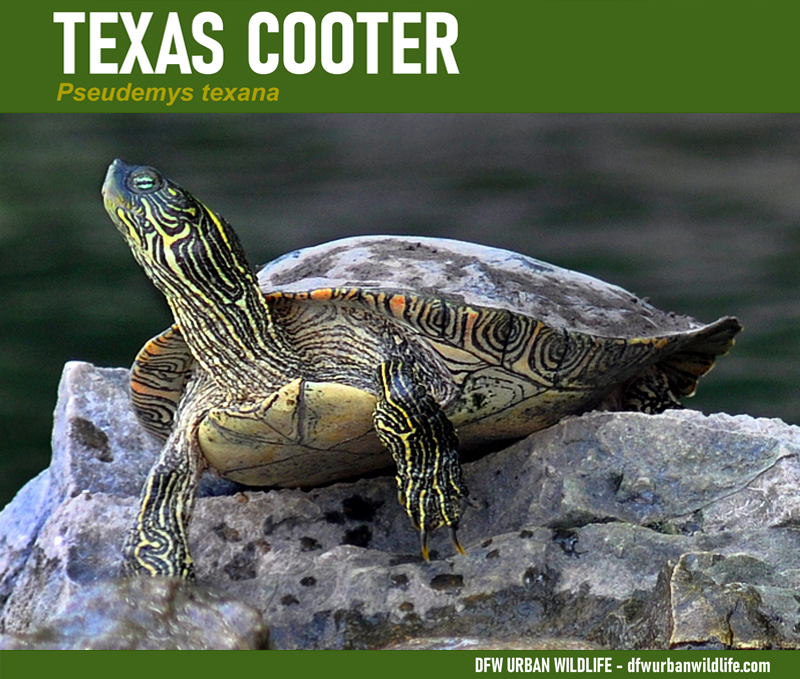
The Texas Cooter is a another relatively large basking turtle found in the Dallas/Fort Worth metroplex.
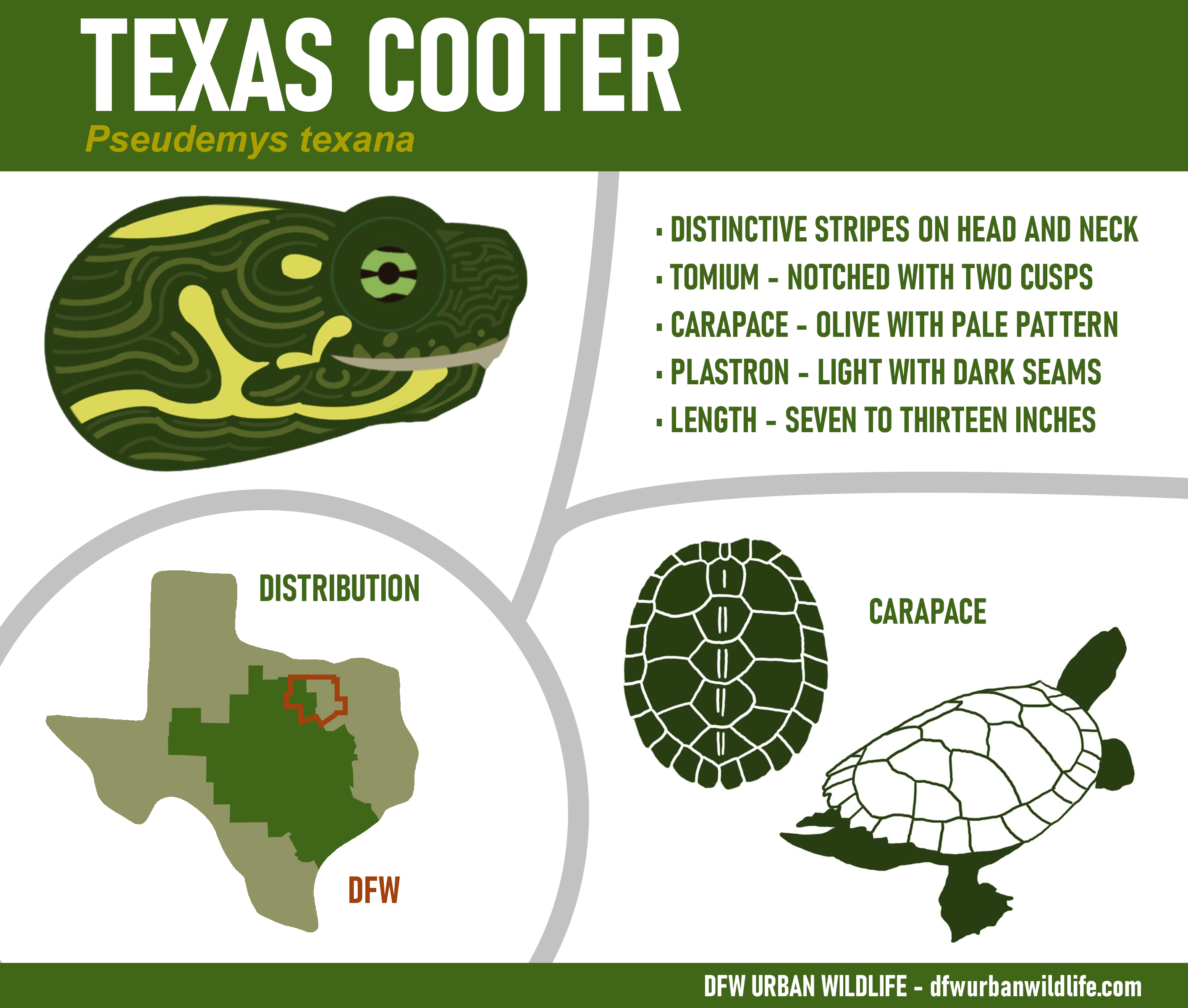
Once again, this turtle shares many superficial characteristics with other species of pond turtles in terms of general appearance. The Texas Cooter’s carapace is flat in profile and roughly egg-shaped–narrow toward the front and broad at the rear. Posterior marginal scutes are serrated. Coloration includes various shades of greens, browns, and yellows. The head, neck, limbs, and tail are dark green with yellow striping. The carapace is dark with a faint light-colored pattern. The plastron is light in color with dark areas along the seams.
Adult Texas Cooters achieve a carapace length of 7 to 13 inches, with females typically being larger than males.
The Texas Cooter has highly variable striping, but there is typical a post orbital dash present, as well as a vertical stripe just behind the mouth. It is differentiated most readily from the very similar River Cooter by noting the Texas Cooter’s beak tomium has two teeth-like cusps on each side of the front notch. These cusps are absent on the River Cooter.
The range of Texas Cooters in Texas includes DFW and areas to the south and west central, down to the gulf coast. Texas Cooters inhabit large and small freshwater bodies across their range in Texas, where they are frequently seen basking. River Cooters are primarily herbivorous as adults , but will occasionally feed on insects and other small aquatic animals.
Map Turtles
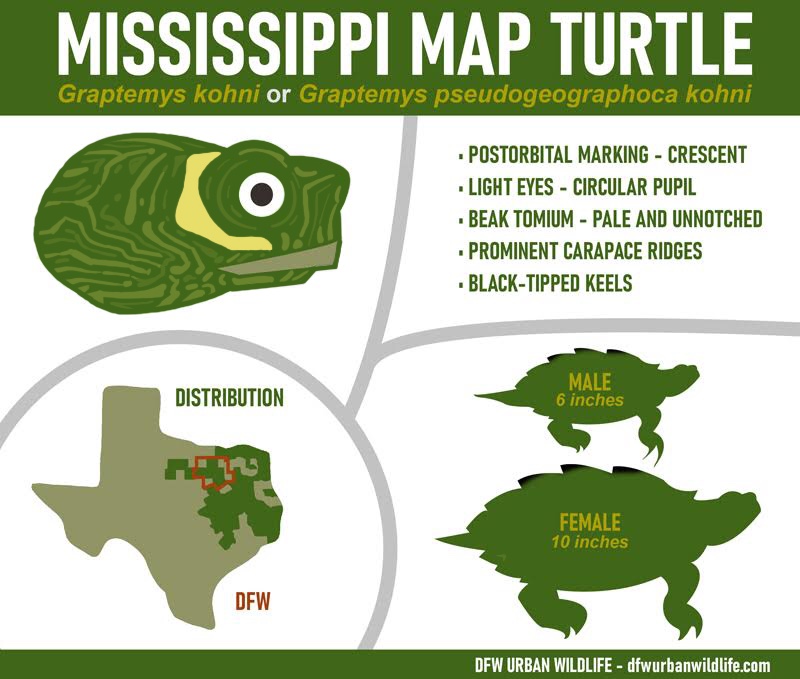
Mississippi Map Turtle

These aquatic turtles will most frequently be found basking in and around the Trinity River, its major tributaries, and reservoirs. The Mississippi Map Turtle is the only map turtle typically found in the metroplex. Important identification considerations includes verification that location and habitat are appropriate and verification of physical characteristics.
The Mississippi Map Turtle is the subspecies of the False Map Turtle found in Texas.
Key physical attributes of the Mississippi Map Turtle include prominent carapace ridges with black-tipped keels, pale and unnotched beak edges (tomium), light-colored eyes with circular pupils, and a distinctive yellow crescent-shaped marking just behind the eye.
Overall coloration includes shades of green and brown. The Mississippi Map Turtle’s head, tail, and legs will be dark in color with pale striping in a variety of patterns. Stripe patterns are not consistent between individual turtles. Even the distinctive post orbital crescent can vary significantly in size in general shape.
Mississippi Map Turtles can live to be 30 years old. Plastron length is 6 to 10 inches. Adult females are decidedly larger than adult males. Diet consists of a variety of aquatic invertebrates and vegetation.
Ouachita Map Turtle
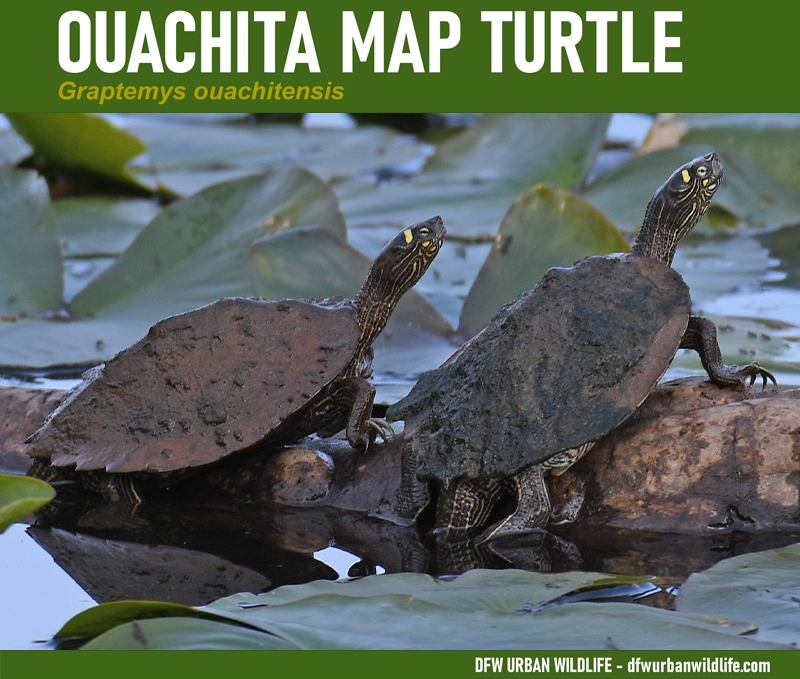
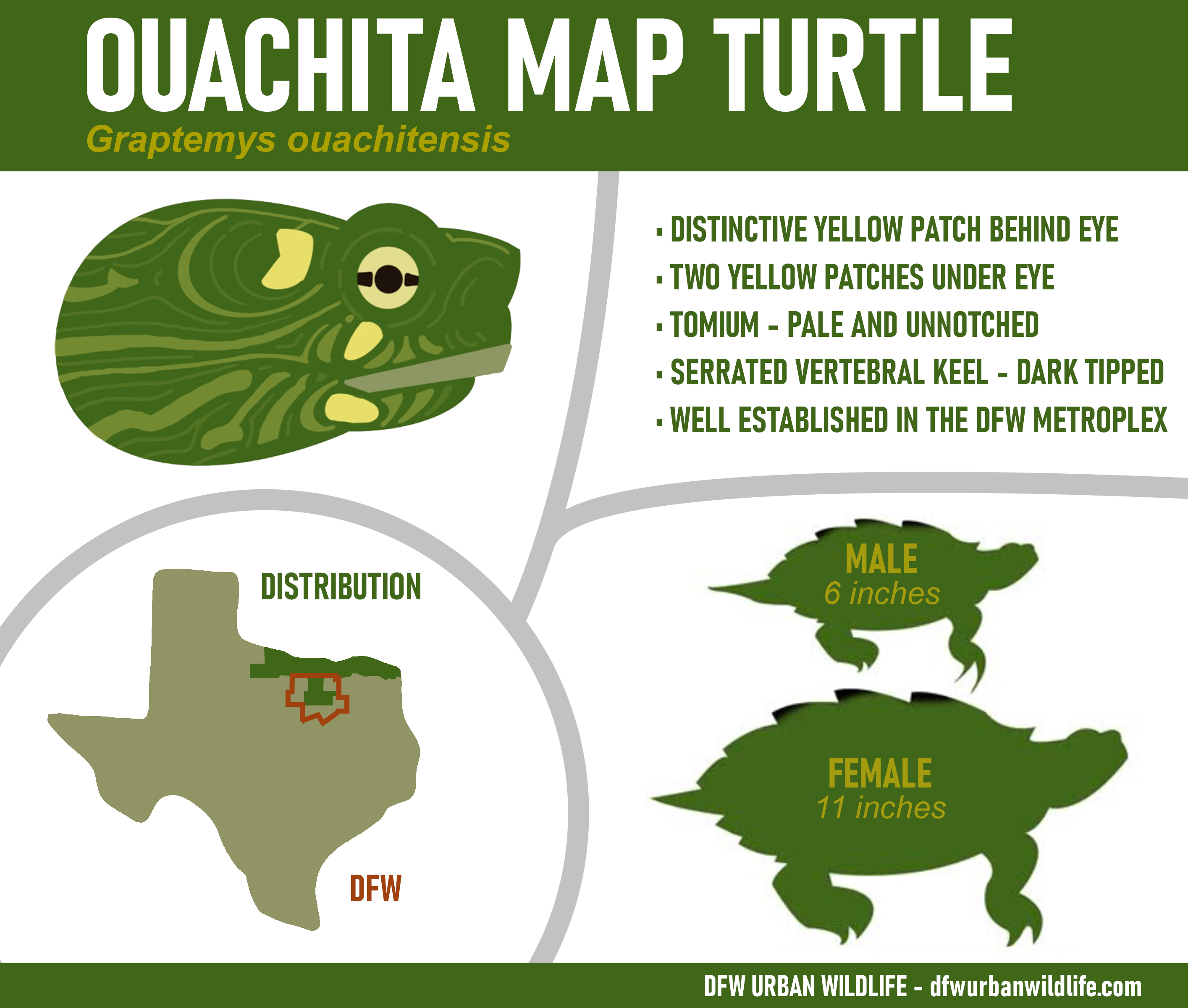
The Ouachita Map Turtle has historically been restricted to the Mississippi River basin. In Texas, that means their range has been understood to be limited to the Red River. Nonetheless, there are now a number of records demonstrating that these turtles can be–and are–found in the Dallas/Fort Worth metroplex.
In general appearance, the Ouachita Map Turtle superficially resembles other basking pond turtles, especially the Mississippi Map Turtle. Coloration includes various shades of greens, browns, and yellows. The head, neck, limbs, and tail are dark green with yellow striping. The carapace is dark with a faint light-colored pattern. The plastron is light in color and sometimes includes dark swirl-patterns.
Key physical attributes of the Ouachita Map Turtle include prominent carapace ridges with black-tipped keels, pale and unnotched beak edges (tomium), light-colored eyes with circular pupils. There is usually a distinctive patch of yellow behind the eye, as well two more under the eye–with one located above the mouth, and the other on the chin.
Mississippi Map Turtles can live to be 30 years old. Plastron length is 5 to 11 inches. Adult females are decidedly larger than adult males. Omnivorous diet consists of a variety of aquatic invertebrates and vegetation.
Mud Turtles
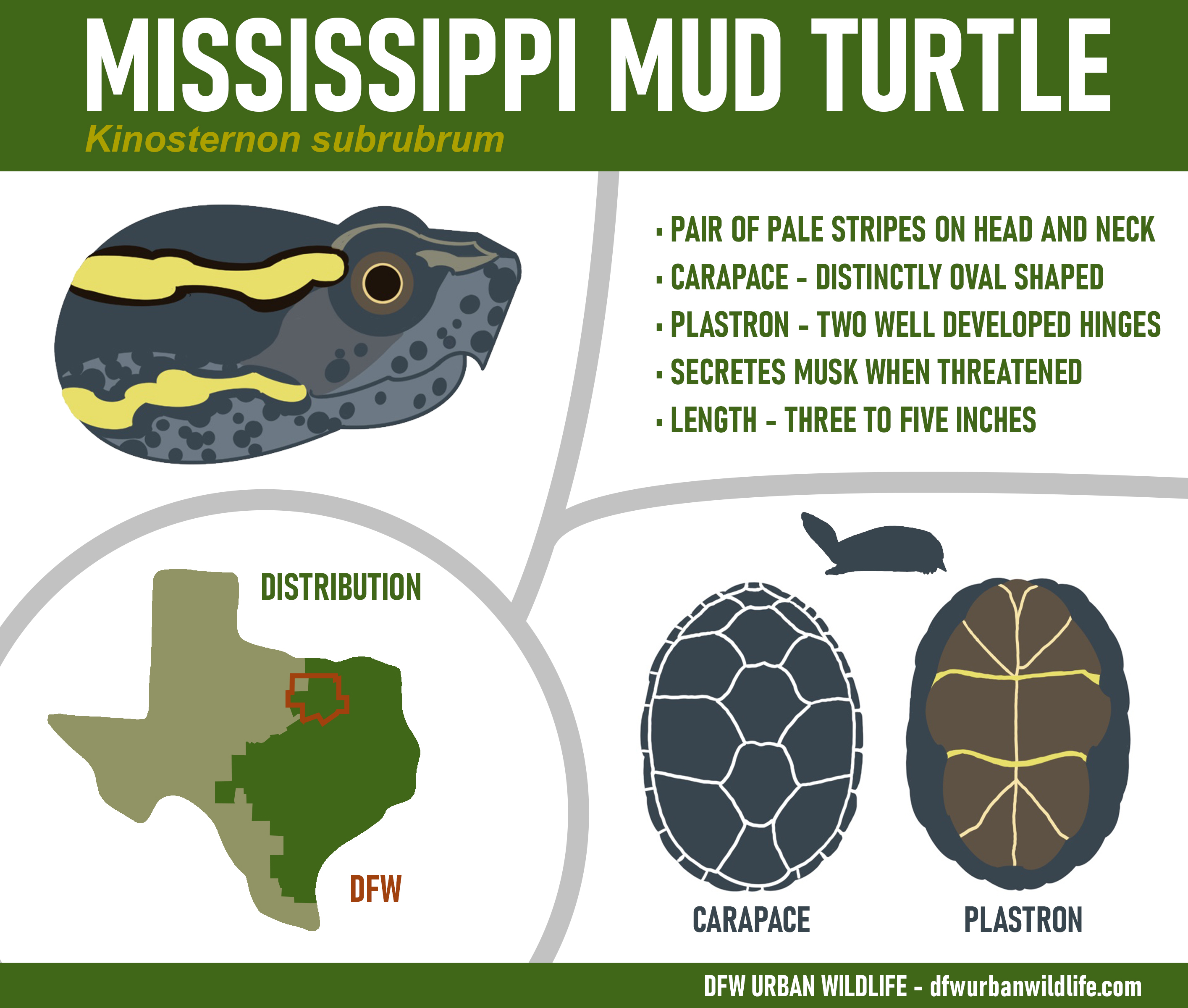
Mississippi Mud Turtle
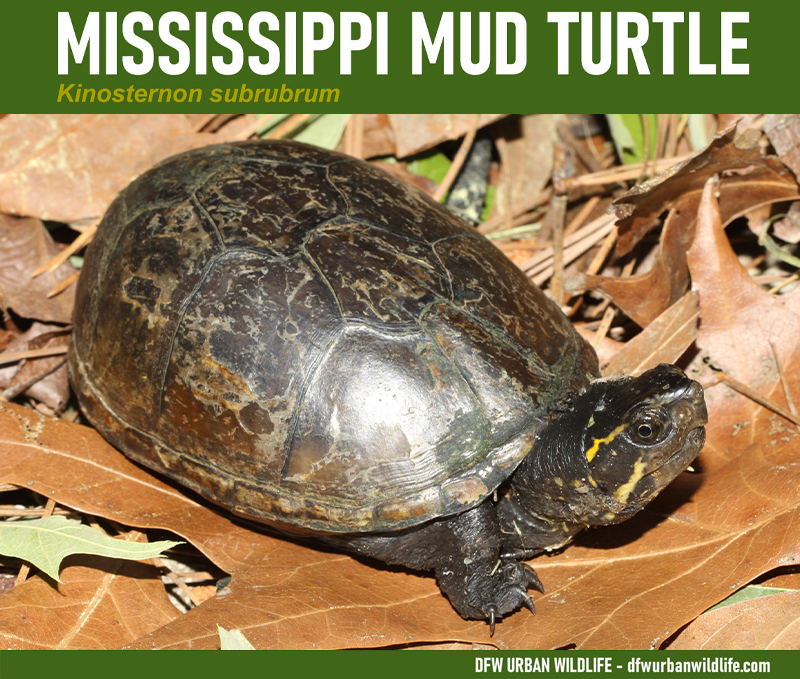
The Mississippi Mud Turtle is the subspecies of Eastern Mud Turtle that occurs in Texas. It is one of four examples of mud and musk turtles that can be found in and around the Dallas/Fort Worth area
This small aquatic turtle shares the same narrow and high domed carapace of others in this family. Coloration of the Mississippi Mud Turtle includes various shades of grays, browns, olives, and yellows.
Adult Mississippi Mud Turtles reach a carapace length of only 3 to 5 inches.
The Mississippi Mud Turtle is recognizable by its distinctly shaped oval carapace, which is darkly colored brown or olive. The plastron on this turtle ranges from yellow to brown in color. The plastron is large and double hinged, which allows this turtle the ability to retreat inside its closed shell, in a manner similar to that of the box turtle. The head and neck of the Mississippi Mud Turtle are mottled gray or brown with a pair of light stripes on each side. One stripe begins at the snout and runs through the eye as it continues down the neck. The second stripe begin at the corner of the mouth and runs along the length of the neck.
The Mississippi Mud Turtle is very similar in appearance to the Common Musk Turtle–another North Texas native. Both turtles share a number of visual characteristics. The most reliable way to differentiate the two is by examining the plastron. The Common Musk Turtle has a much smaller plastron with only a single weak hinge.
Mississippi Mud Turtles prefer slow moving bodies of water with soft bottoms and abundant vegetation. They are diurnal in their behavior–typically restricting their activity to early or late in the day. They are omnivorous and feed on a wide variety of aquatic plants and animals.
Like all turtles in the family, the Mississippi Mud Turtle secretes a foul smelling musk as a defense when threatened.
Yellow Mud Turtle
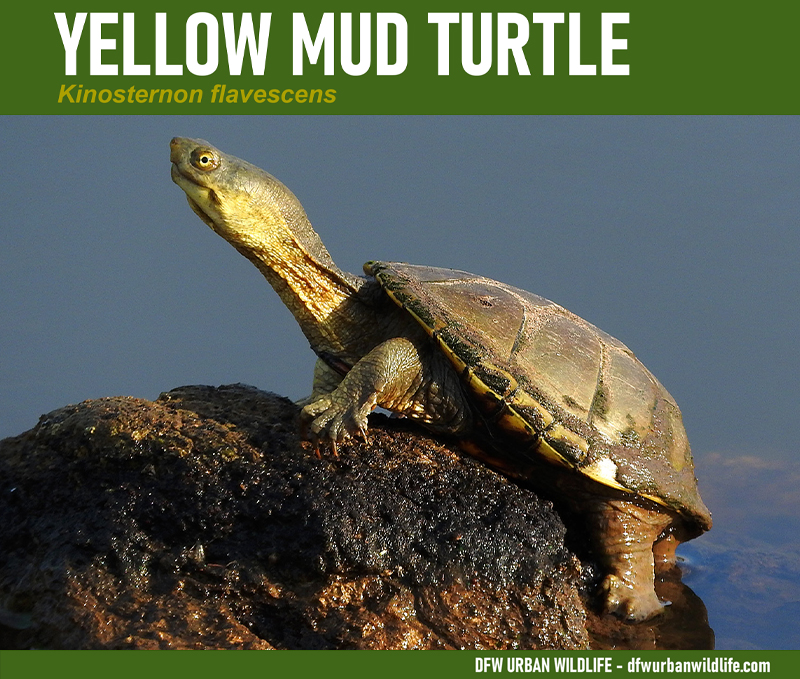
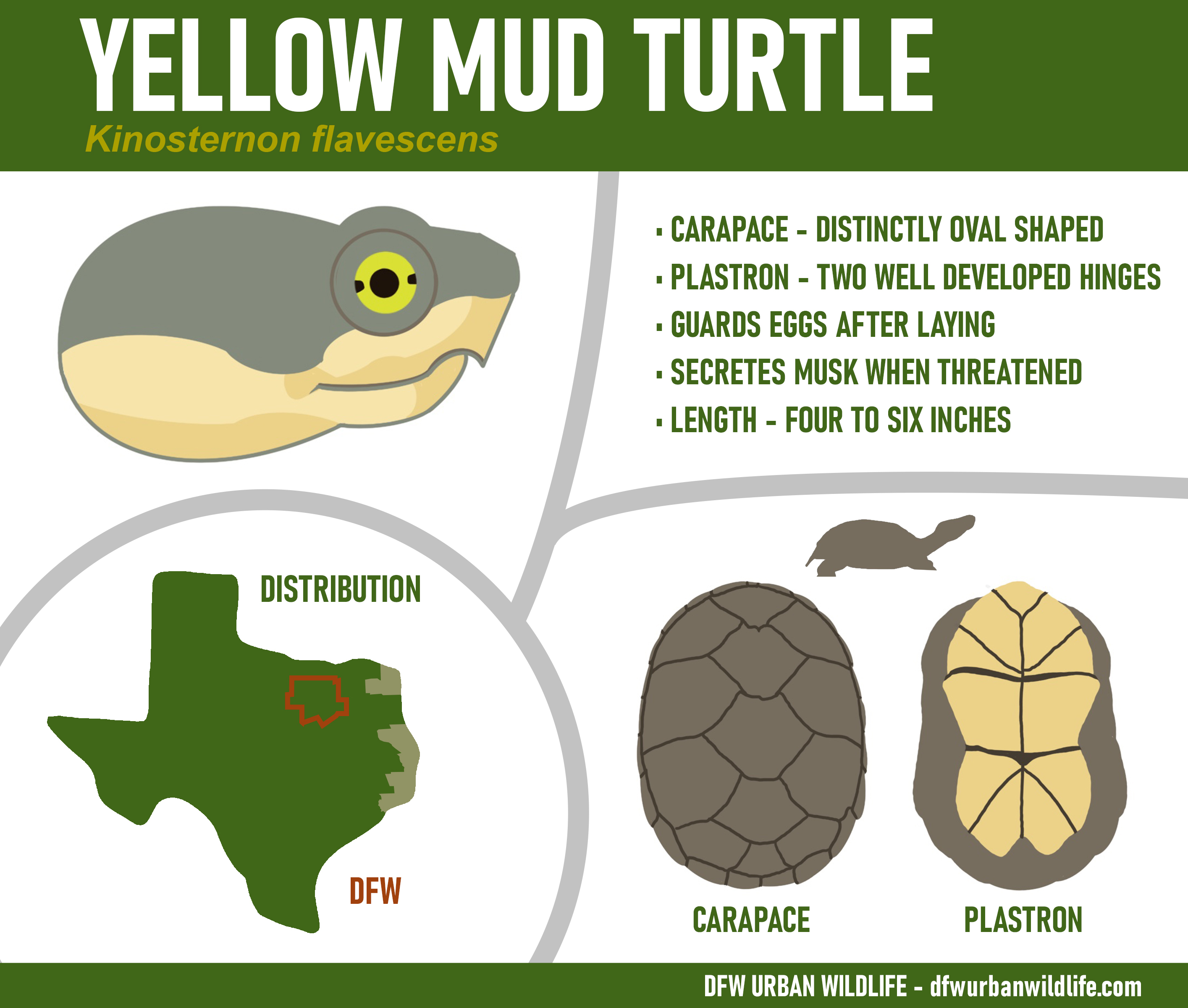
This interesting mud turtle is adapted to arid environments and is found mostly in the western two-thirds of the State of Texas. The Yellow Mud Turtle is only rarely observed in and around the Dallas/Fort Worth area
This small aquatic turtle shares the same narrow and high domed carapace of others in this family. Coloration of the Yellow Mud Turtle includes various shades of grays, browns, olives, and yellows.
Adult Yellow Mud Turtles reach a carapace length of only 4 to 6 inches.
The Yellow Mud Turtle is recognizable by its characteristically shaped oval carapace, which is typically lightly colored brown or olive. The plastron on this turtle ranges from yellow to brown in color. The plastron is large and double hinged, which allows this turtle the ability to retreat inside its closed shell, in a manner similar to that of the box turtle. The head and neck of the Yellow Mud Turtle are colored olive to gray, with the undersurface being a pale shade of yellow. This turtle has no vivid striping.
Yellow Mud Turtles prefer slow moving bodies of water with soft bottoms and abundant vegetation. They are diurnal in their behavior–typically restricting their activity to early or late in the day. Yellow Mud Turtles are consider omnivorous, but is believed that animal matter makes up the bulk of their diet.
These turtle are unique in that they thought to provide extra care and protection for their nests, often burying themselves before producing a clutch of eggs. Reportedly, they will stay buried above their nest of eggs for several hours to months on end.
Like all turtles in the family, the Yellow Mud Turtle secretes a foul smelling musk as a defense when threatened.
Musk Turtles
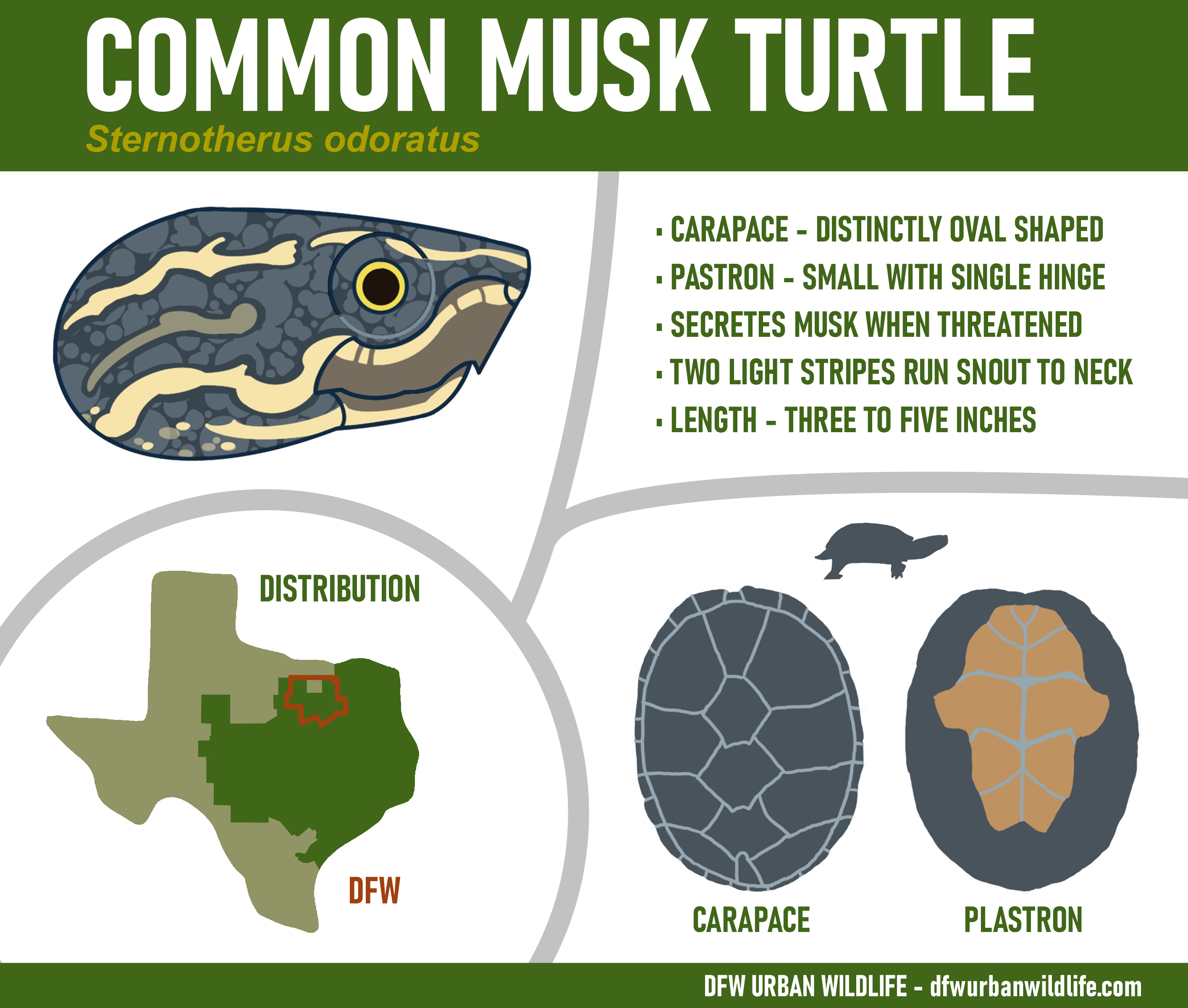
Common Musk Turtle
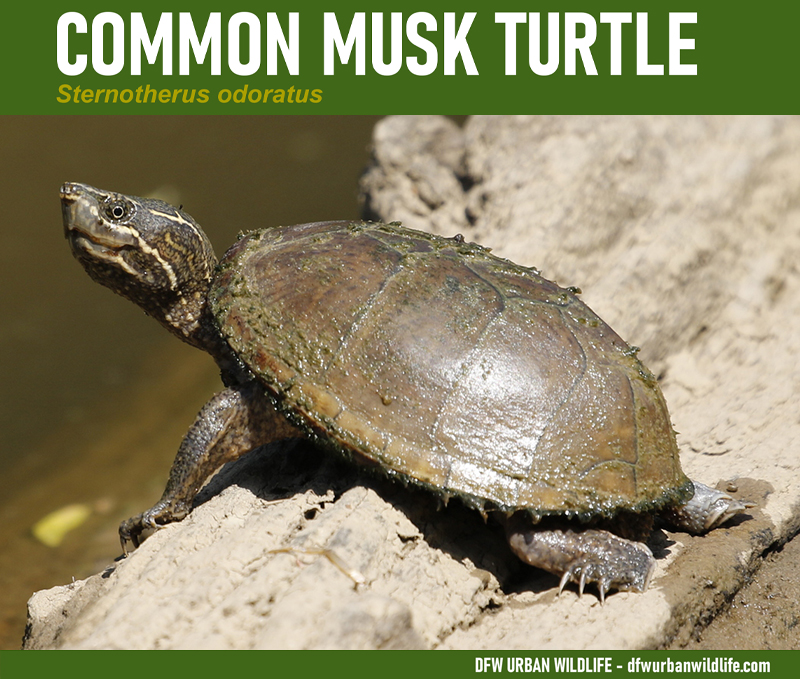
The Common Musk Turtle is also known as the Eastern Musk Turtle and the Stinkpot. It is one of four examples of mud and musk turtles that can be found in and around the Dallas/Fort Worth area
Like all turtles in the family, the Common Musk Turtle secretes a foul smelling musk as a defense when threatened.
This small aquatic turtle shares the same narrow and high domed carapace of others in this family. Coloration of the Common Musk Turtle includes various shades of grays, browns, olives, and yellows.
Adult Common Musk Turtle reach a carapace length of only 3 to 5 inches. Male and female Common Musk Turtles are similar in size, but males generally have larger heads than do females.
The Common Musk Turtle is recognizable by its distinctly shaped oval carapace, which is darkly colored brown or olive. The plastron on this turtle ranges from yellow to brown in color with light colored seams. The plastron is small and only has a single, weak hinge. The head and neck of the Mississippi Mud Turtle are mottled gray or brown with a pair of light stripes on each side.
The Common Musk Turtle is very similar in appearance to the Mississippi Mud Turtle–another North Texas native. Both turtles share a number of visual characteristics. The most reliable way to differentiate the two is by examining the plastron. The Common Musk Turtle lacks the large double-hinged plastron of the Mississippi Mud Turtle.
Common Musk Turtles prefer slow moving bodies of water with soft bottoms and abundant vegetation. They can also be found in rock-bottomed streams. These turtles are accomplished climbers, and can readily haul themselves out of the water on snag branches in order to bask. Common Musk Turtles are omnivorous and feed on a variety of aquatic plants and animals.
Razor-backed Musk Turtle
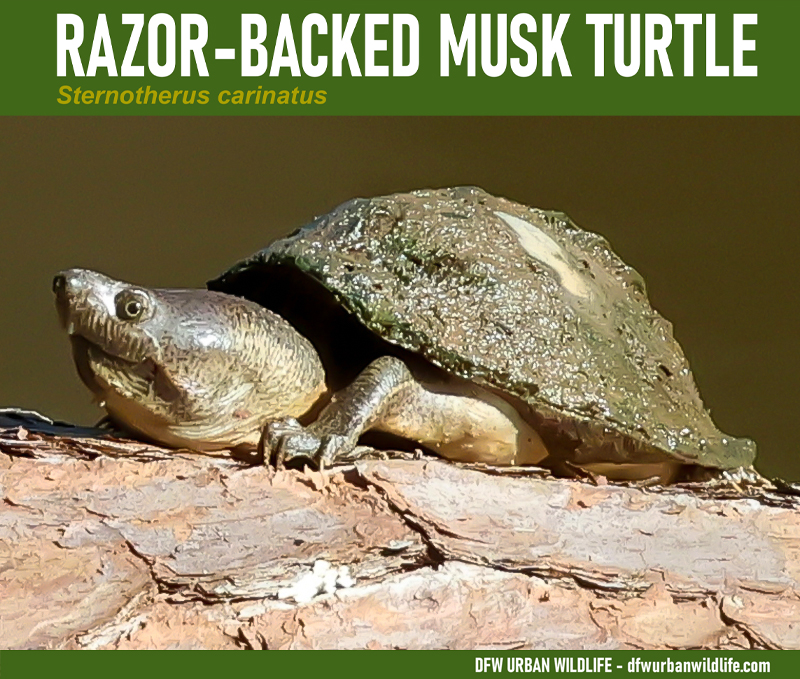
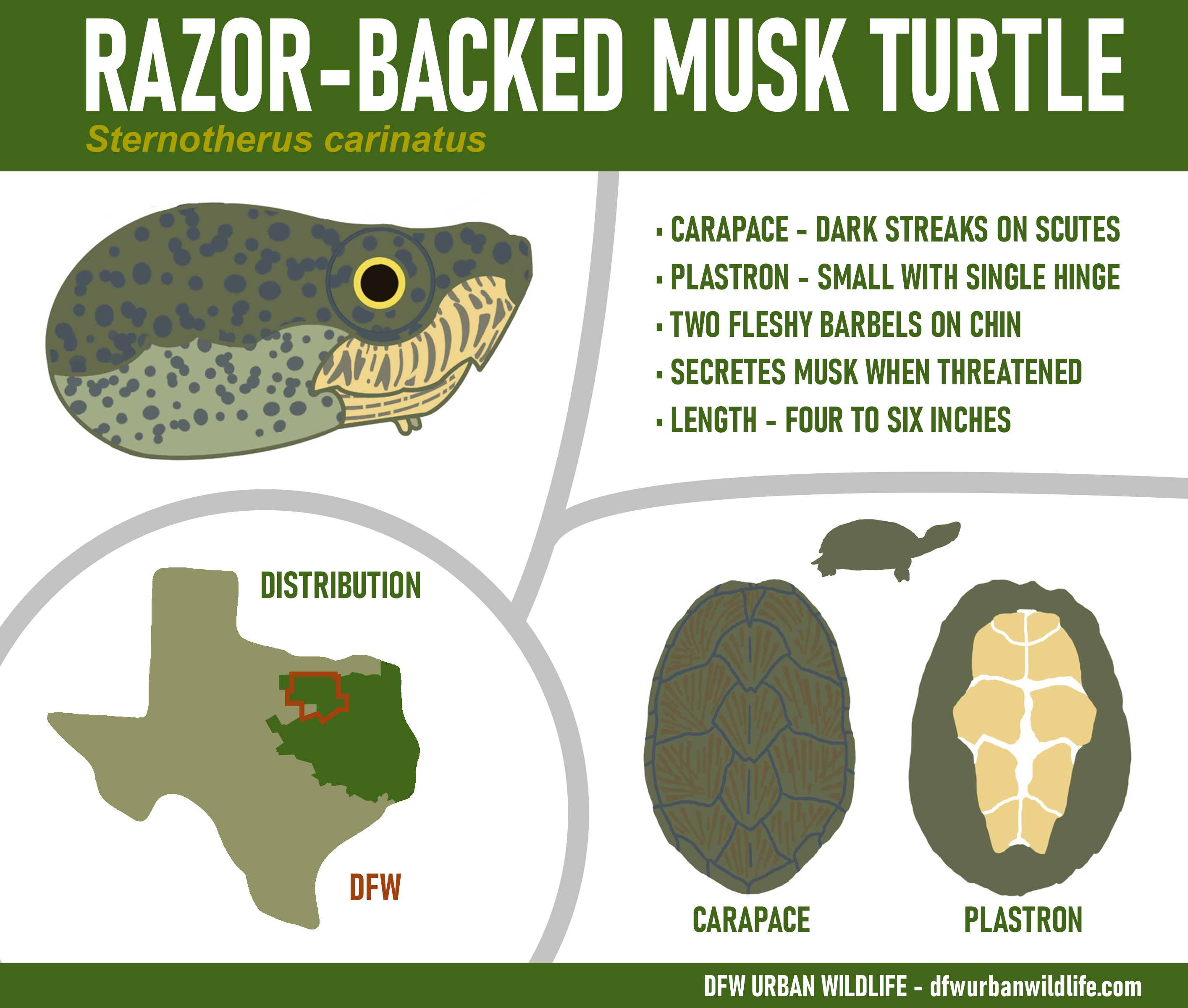
The Razor-backed Musk Turtle has the same narrow and high domed carapace of others in this family, but this turtle’s carapace also include a distinct and namesake ridge.
Coloration of the Razor-backed Musk Turtle includes various shades of grays, browns, olives, and yellows.
Adult Razor-backed Musk Turtles reach a carapace length of only 4 to 6 inches.
The Razor-backed Musk Turtle is distinguishable by its characteristically shaped oval carapace, which includes the namesake ridge. Carapace scutes are decorated with a pattern of darks streaks. The plastron on this turtle ranges from yellow to brown in color. The plastron is small with a single indistinct hinge. The head and neck of the Razor-backed Musk Turtle are colored a mottled shade of olive to gray, with the undersurface being a paler color. The turtle’s beak is marked with a series of small vertical dark stripes. Two fleshy barbels are located on the chin.
Razor-backed Musk Turtles prefer slow moving bodies of water with soft bottoms and abundant vegetation. They are diurnal in their behavior–typically restricting their activity to early or late in the day. They are sometimes seen basking. Razor-backed Musk Turtles are consider omnivorous, and feed on a wide variety of aquatic animals, invertebrates, and carrion. Some plant material is also consumed.
Like all turtles in the family, the Razor-backed Musk Turtle secretes a foul smelling musk as a defense when threatened.
Sliders
Red-eared Slider
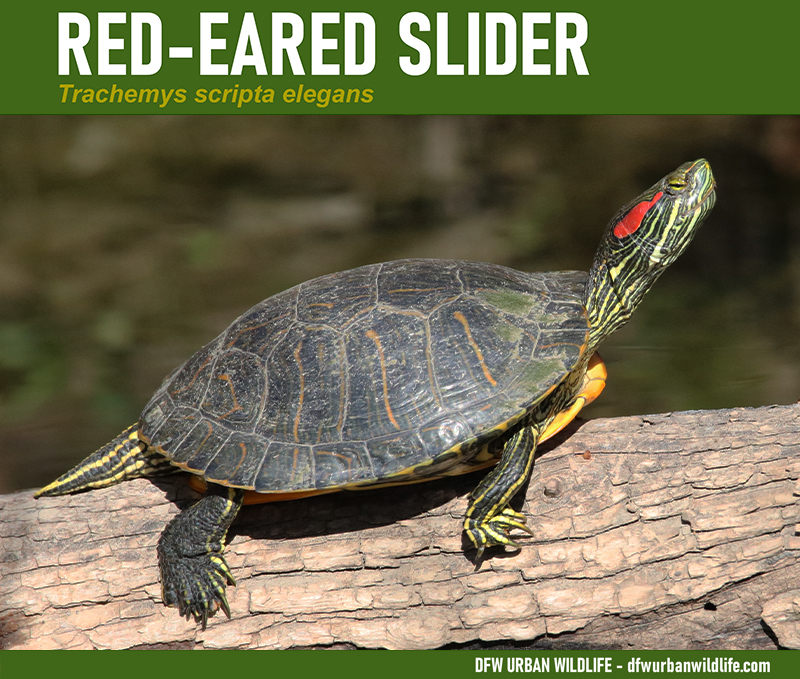
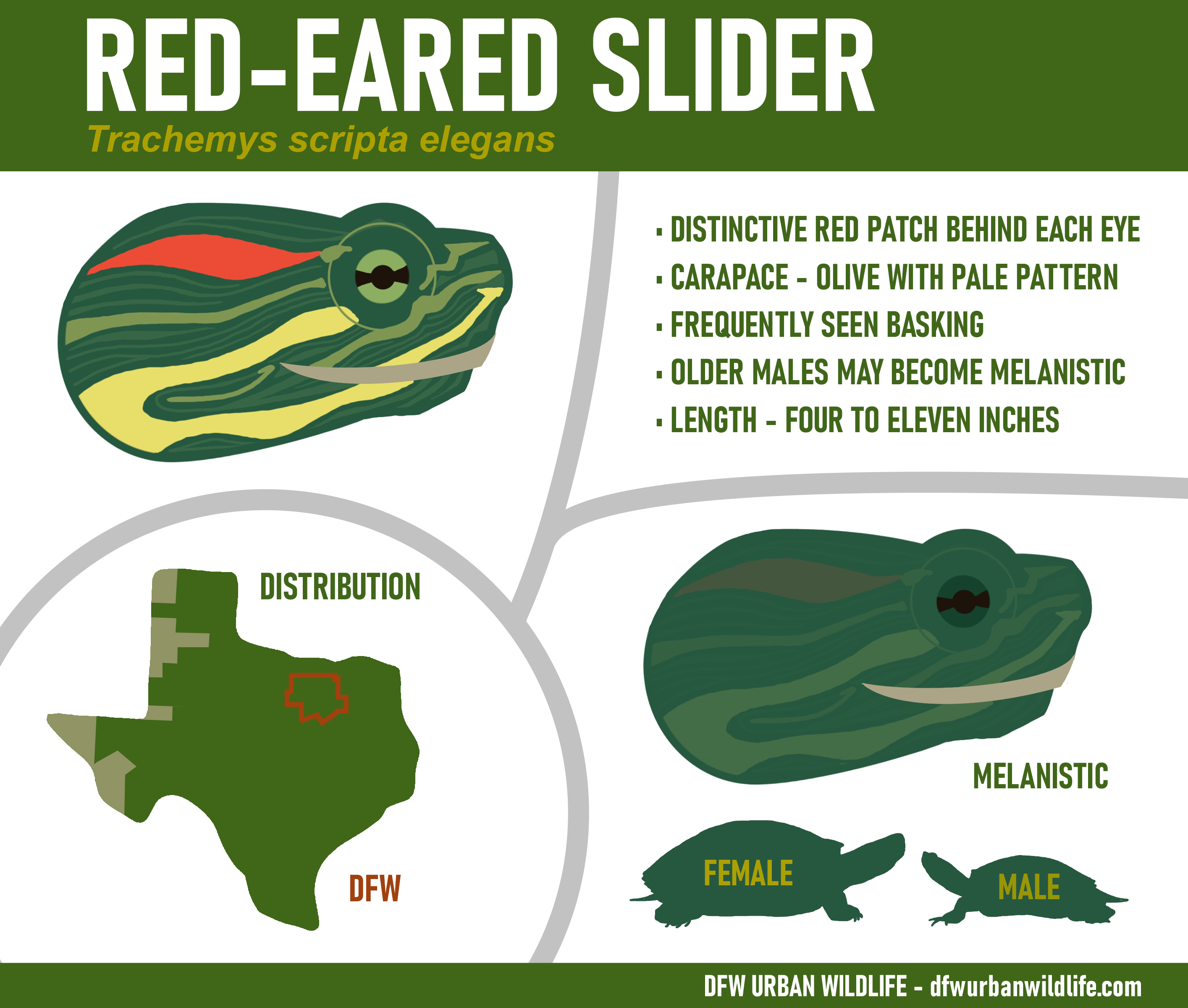
The Red-eared Slider is perhaps the most commonly seen turtle in the Dallas/Fort Worth metroplex. The Red-eared Slider is the subspecies of Pond Slider that is native to Texas. This species of turtle is very common and successful throughout Texas, in the USA, and in places all around the world where it has been introduced. It often has the ability to out compete native species where it has been released out side of North America.
The Red-eared Slider is a relatively large basking turtle, with a carapace length of 4 to 11 inches. Females are generally larger than males.
The Red-eared Slider is similar in many ways to other species of pond turtles in general appearance. The Red-eared Slider’s carapace is flat in profile and roughly egg-shaped–narrow toward the front and broad at the rear. Coloration includes various shades of greens, browns, and yellows. The head, neck, limbs, and tail are dark green with yellow striping. The carapace is brownish with a faint light-colored pattern. The plastron is light in color with variable dark markings.
The Red-eared Slider is most easily distinguishable from other pond turtles by the distinctive patch of red color located just behind its eye. The beak is equipped with a notched tomium. The colors on Red-eared Sliders often mute with age–particularly with males of the species–leaving the turtle uniformly darkly colored, or melanistic.
Red-eared Sliders can be found just about anywhere there is water. Most every large and small freshwater body across the Red-eared Slider’s range in Texas can support a population of these turtles. They are frequently observed basking–often communally. Red-eared Sliders are omnivorous, and feed on a wide variety of foods, such as aquatic vegetation, invertebrates, tadpoles, crayfish, and carrion.
Snapping Turtles
Alligator Snapping Turtle
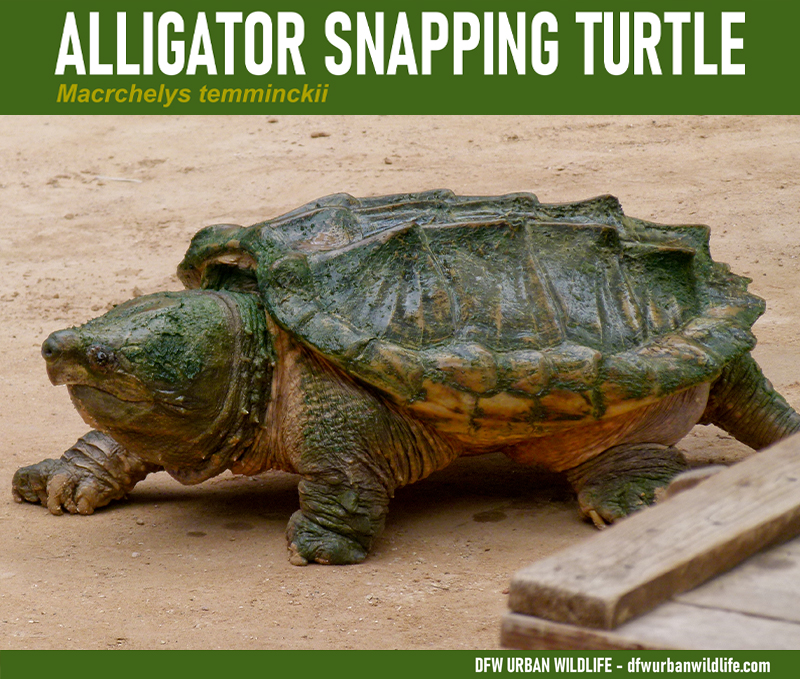
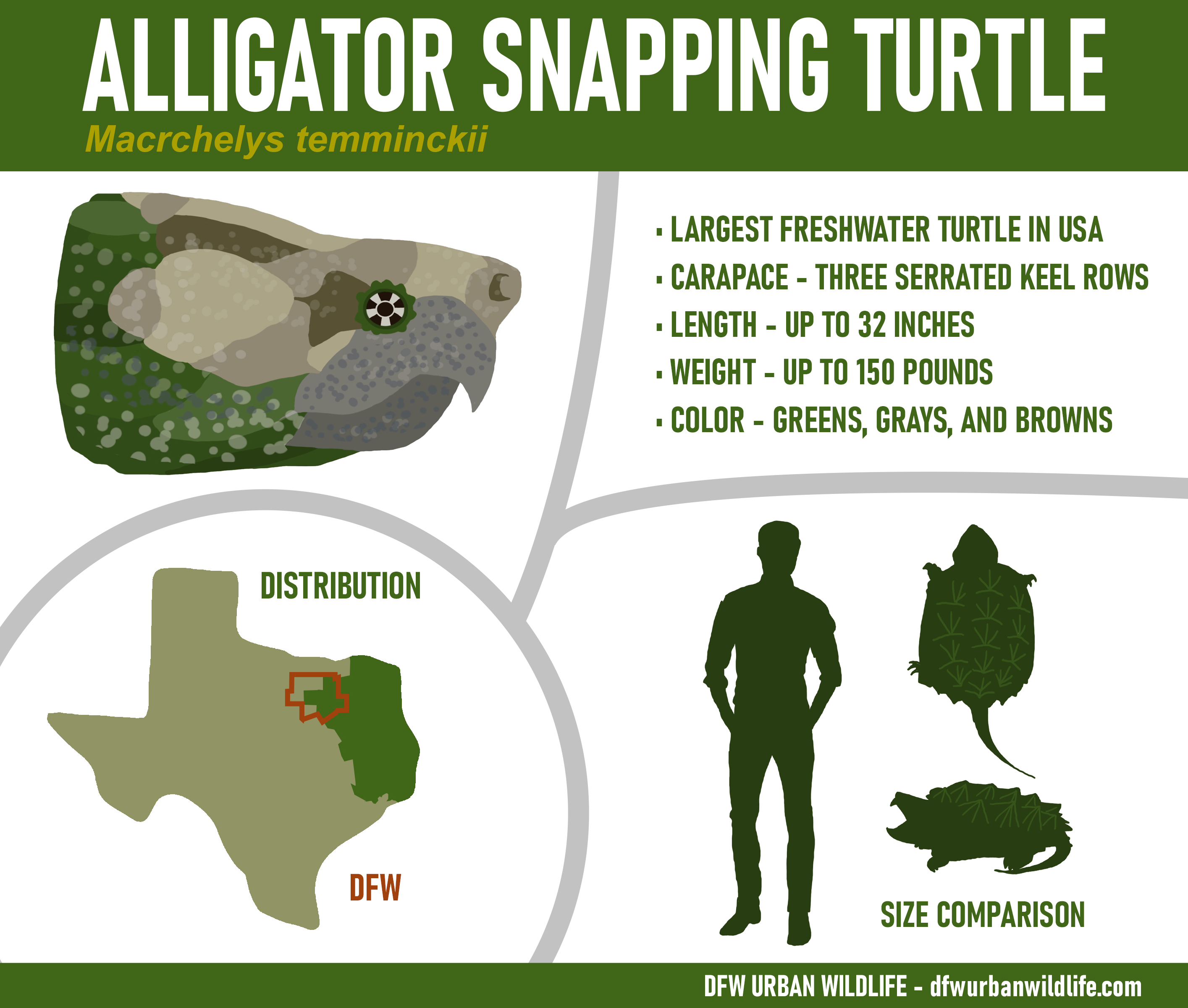
The Alligator Snapping Turtle is the largest freshwater turtle found in Texas–and North America. Carapace length can be a great as 32 inches, with a weight approaching 150 pounds. Males are typically larger than females.
In addition to its large size, the Alligator Snapping Turtle is recognizable by its heavy profile and the three rows of spikes ridges that run along the top of its carapace. The posterior marginal scutes are heavily serrated.
The Alligator Snapping Turtle has a large, imposing head equipped with powerful jaws and a sharply pointed beak. The head appears triangular in shape when viewed from above. The eyes of this turtle are surrounded by fleshy “eyelashes” that are not present on other species. Skin is mottled with colors that can include greens, brown, tans, and grays. The carapace is darkly colored in brown, gray, or black. The plastron is small and may be yellow, brown, or black in hue.
The Alligator Snapping Turtle can be found in large and deep fresh water systems–such lakes, rivers, and expansive wetlands. This turtle spends the majority of its time in the water and is rarely seen–despite being relatively common throughout its range in Texas.
The Alligator Snapping Turtle is carnivorous and feeds on a varied diet that made up primarily fish, but also includes crayfish, mussels, snakes, turtles, small alligators, aquatic birds, and small mammals. The Alligator Snapping Turtle is equipped with a small pink appendage on the tip of its tongue that resembles a worm. The turtle hunts by sitting motionless at the bottom of a river or lake with its mouth wide open. It uses the pink appendage on it tongue as a lure to bring unsuspecting fish within range of its snapping jaws.
Common Snapping Turtle
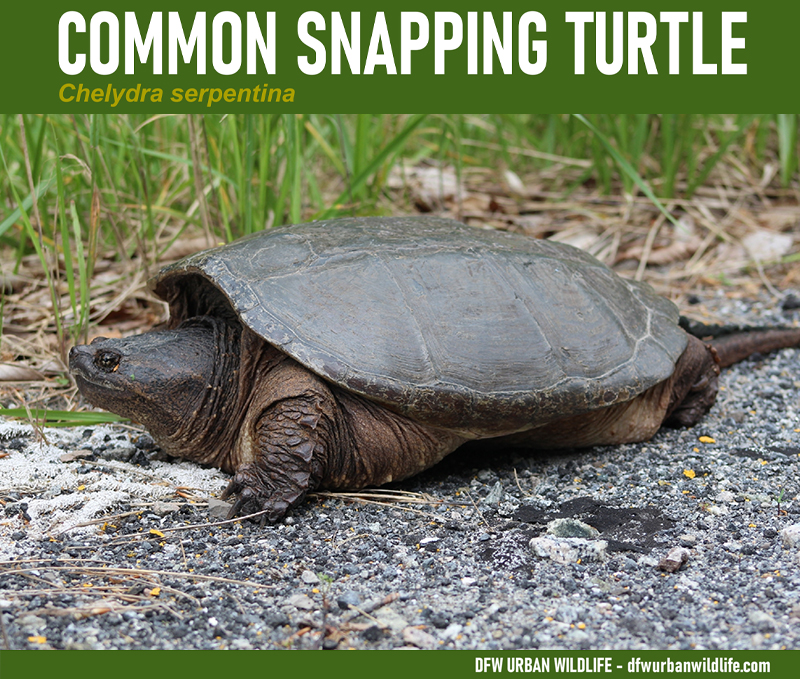
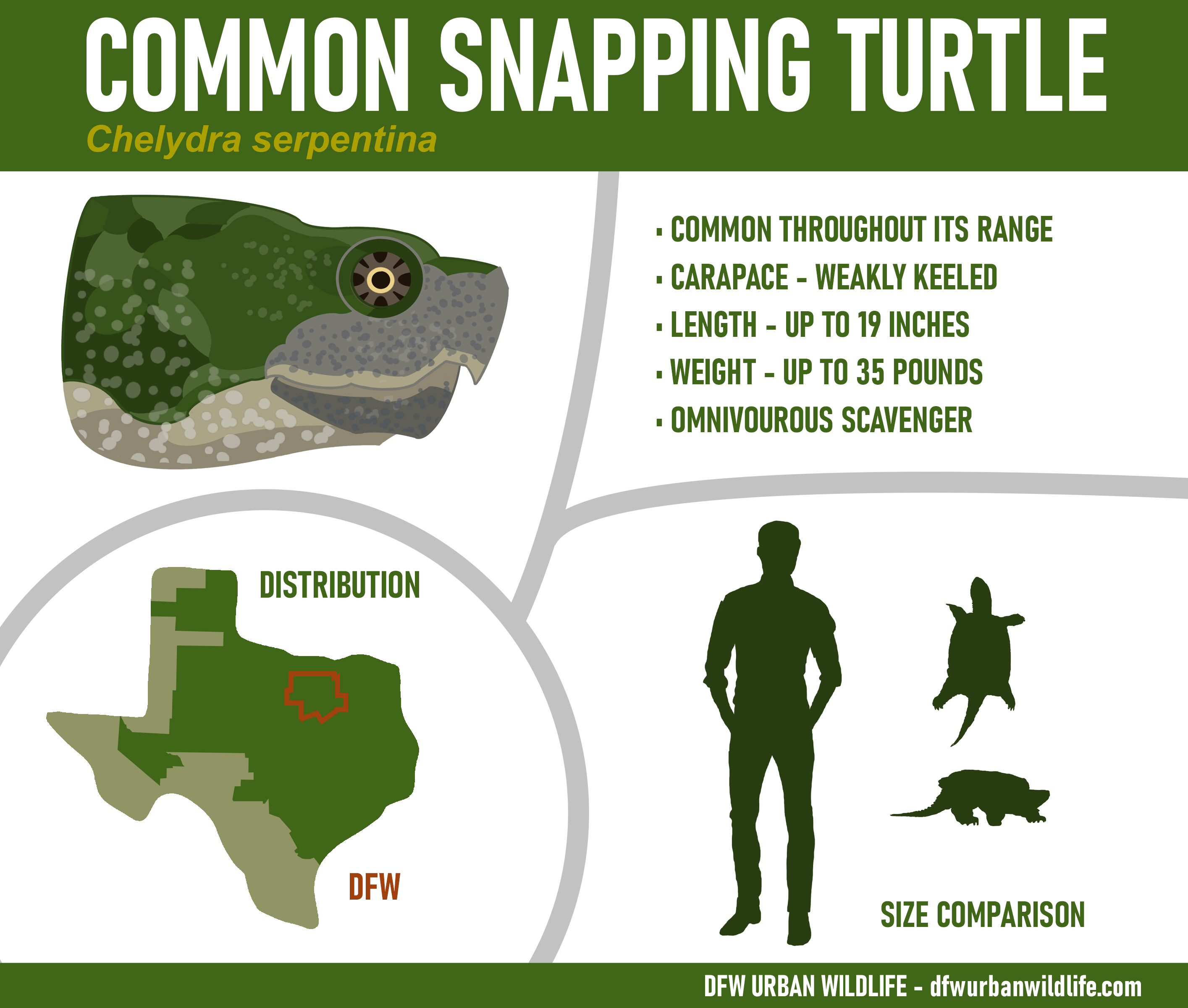
The Common Snapping Turtle is the second largest freshwater turtle found in Texas, after it larger relative, the Alligator Snapping Turtle. Carapace length can be up to 19 inches, and weight can approach 35 pound.
Common Snapping turtles range widely the across the eastern two-thirds of Texas, and are often observed in the Dallas/Fort Worth area
The carapace of the Common Snapping turtle is flat and relatively smooth in profile. It can range in color from tan, to olive, to dark brown, to black. The rear margin is subtly serrated.
The Common Snapping Turtle has a large oval-shaped head, imposing head equipped with powerful jaws and a hooked beak. The eyes of the Common Snapping Turtle do not include the fleshy “eyelashes” found on the Alligator Snapping Turtle. Skin color can include greens, brown, tans, and grays and is often mottled with spots. The plastron is small and cross-shaped. It may be yellow, brown, or black in color. The tail is nearly as long as the carapace and features a prominent keel.
The Common Snapping Turtle can be found in almost any fresh water system. Lakes, rivers, ponds, streams, marshes, and drainage ditches all can make suitable homes. This turtle spends the majority of its time in the water and can often be spotted with just the tip of its beak exposed above the surface.
The Common Snapping Turtle is carnivorous and feeds on a range of aquatic animals and carrion. This turtle will also readily consume a variety of vegetable matter.
Softshell Turtles
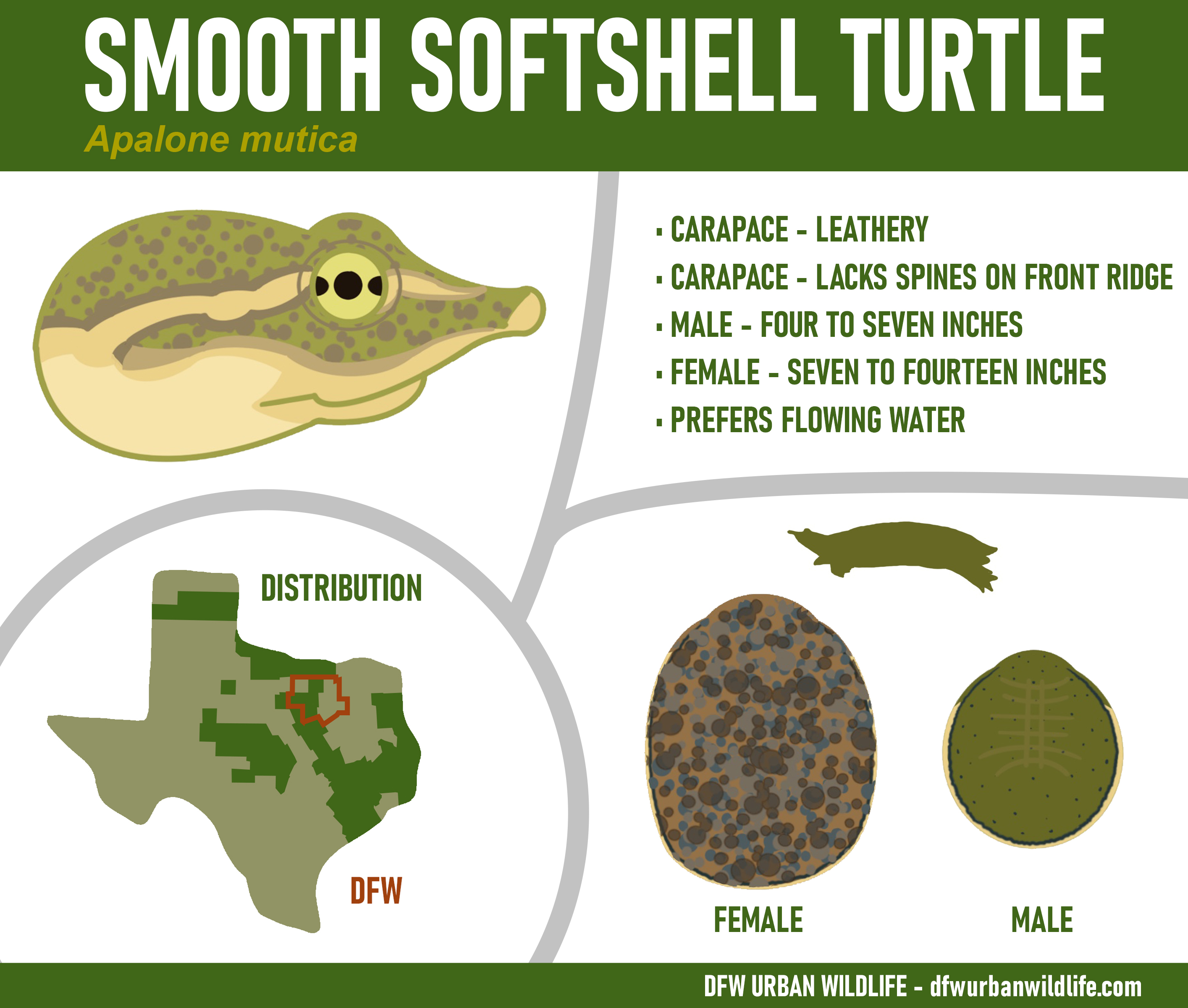
Smooth Softshell Turtle
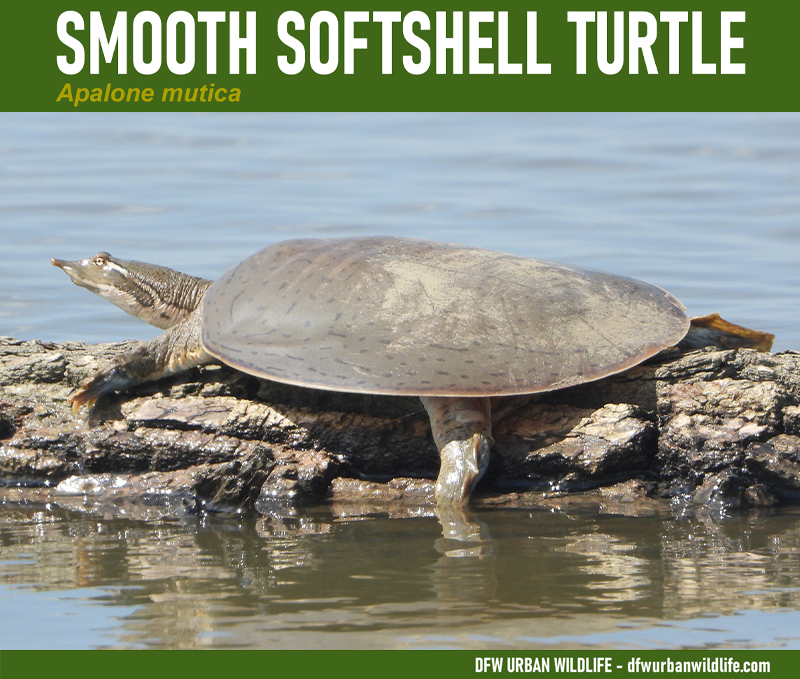
The Smooth Softshell Turtle is one of two species of softshell turtles found in the DFW metroplex. The Spiny Softshell Turtle is the other species, and both are superficially similar to each other in general appearance and behavior.
Softshell turtles are well adapted to aquatic life and are accomplished swimmers. They are recognizable by their round soft and leathery plastrons, which present a relatively flat profile. These turtles have long necks and distinctive tubular snouts.
Female Smooth Softshell Turtles are decidedly larger than their male counterparts. Females typically have plastron length ranging from 7 to 14 inches, while males are usually in the 4 to 7 inch range.
The Carapace of the Smooth Softshell Turtle is typically colored olive or gray. A light marginal band with a narrow dark border is present. The carapace of male Smooth Softshell Turtles is decorated with dark dots, while the female’s plastron is mottled with a variety of light and dark patches. Coloration of the head and neck ranges over various shades of olive and gray. The underside of this area is light in color. A pale stripe begins at the snout, runs through the eye, and merges with the light throat color further back along the neck. The plastron of the Smooth Softshell Turtle is small and light in color.
The Smooth Softshell Turtle is differentiated from the related Spiny Softshell Turtle most readily by its lack of namesake spine (bumps) along the forward edge of the plastron. The absence of these spines is the pretext for the inclusion of the word smooth in the species’ name.
The Smooth Softshell Turtle’s distribution in Texas is not well understood. This turtle seems to have a preference for rivers with sandy or soft bottoms. It is most commonly documented in the Canadian, Red, Sabine, Neches, Trinity, and Brazos. The Smooth Softshell Turtle is diurnal in its activity, and is frequently observed basking.
The Smooth Softshell Turtle is primarily carnivorous, and consumes a diet mostly made up of aquatic animals, invertebrates, and carrion. It will occasionally supplement its diet with plant material.
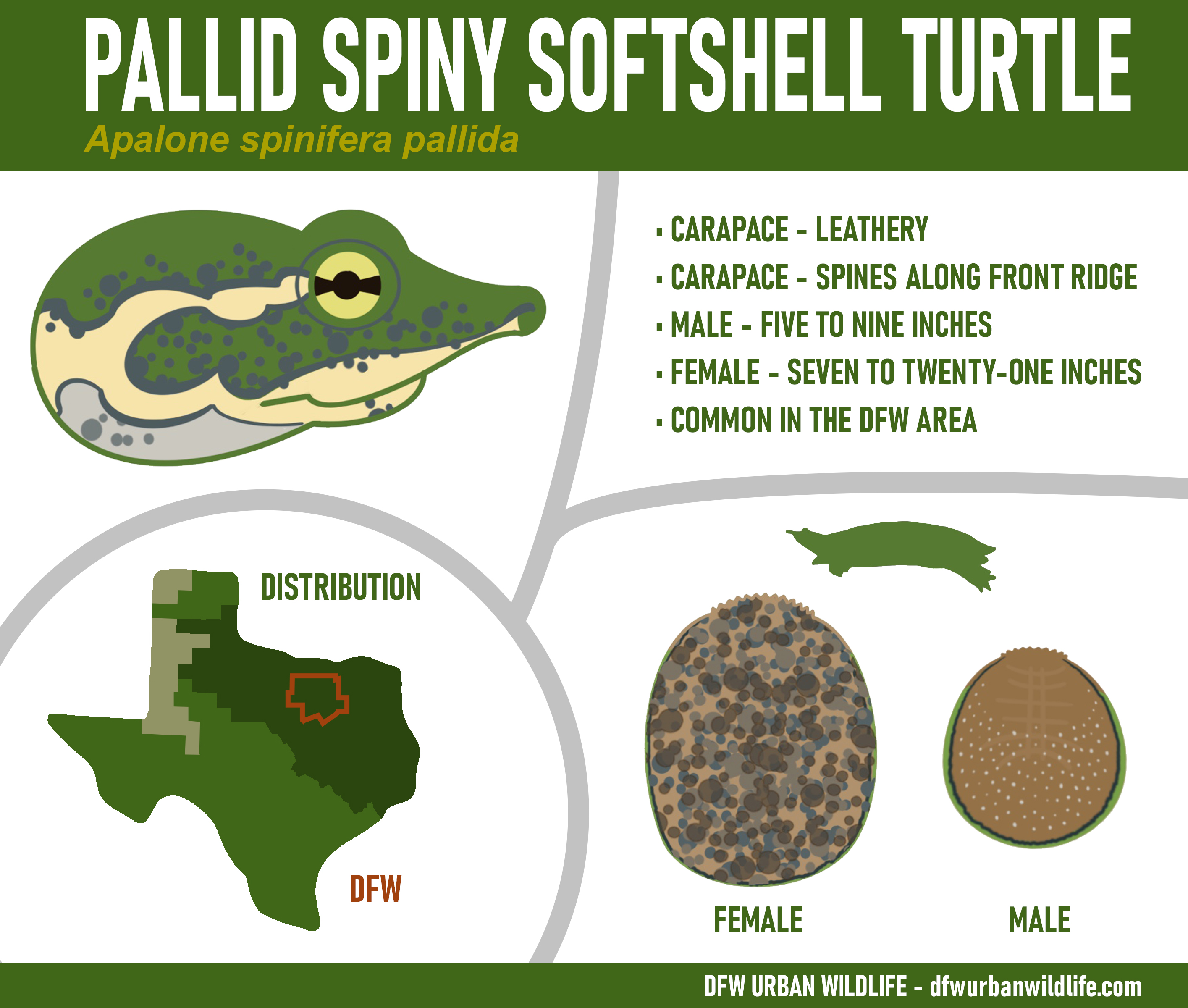
Pallid Spiny Softshell Turtle
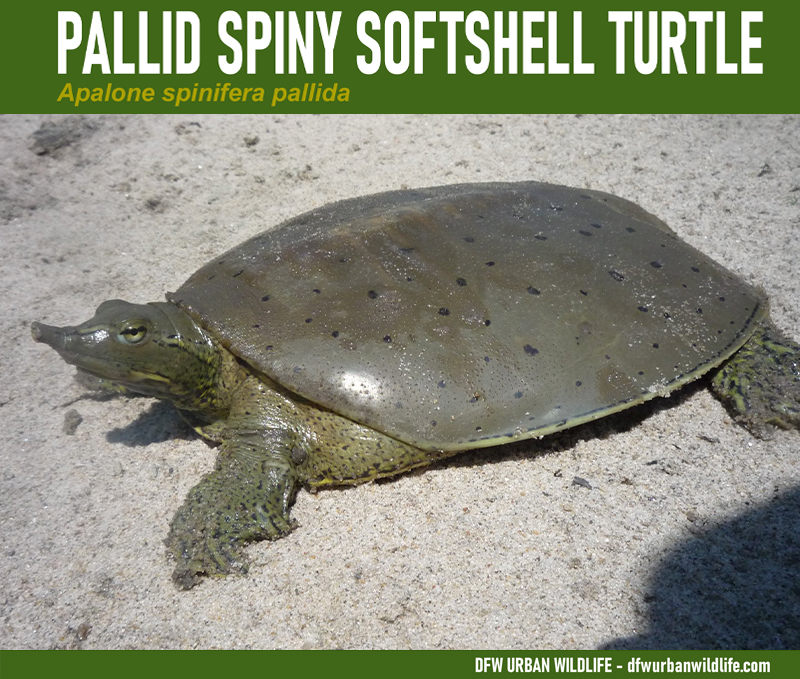
The Spiny Softshell Turtle is one of two species of softshell turtles found in the DFW metroplex. The Smooth Softshell Turtle is the other species, and both are superficially similar to each other in general appearance and behavior.
Softshell turtles are well adapted to aquatic life and are accomplished swimmers. They are recognizable by their round soft and leathery plastrons, which present a relatively flat profile. These turtles have long necks and distinctive tubular snouts.
The Pallid Spiny Softshell Turtle is the subspecies that is present in and around North Texas. Two other subspecies of the the Spiny Softshell Turtle are present in Texas–the Texas Spiny and the Guadalupe Spiny. Both are native to areas far south and west of the Dallas/Fort Worth area.
Female Pallid Spiny Softshell Turtles are decidedly larger than their male counterparts. Females typically have plastron length ranging from 7 to 21 inches, while males are usually in the 5 to 9 inch range.
The Carapace of the Pallid Spiny Softshell Turtle is typically colored olive or gray. A light marginal band with a narrow dark border is present. The carapace of male Smooth Softshell Turtles is decorated with pale dots on the rear two-thirds. The female’s plastron is mottled with a variety of light and dark patches. Coloration of the head and neck ranges over various shades of olive and gray. The underside of this area is light in color. One pale stripe– with a dark border–begins at the eye, and merges along the neck with a second stripe that originates at the mouth. The plastron of the Pallid Spiny Softshell Turtle is small and light in color.
The Pallid Spiny Softshell Turtle is differentiated from the related Smooth Softshell Turtle most readily by the presence of namesake spine (bumps) along the forward edge of the plastron. The presence of these spines is the pretext for the inclusion of the word spiny in the species’ name.
The Pallid Spiny Softshell Turtle can be found in most any suitable freshwater body in its distribution range. The Smooth Softshell Turtle is diurnal in its activity, and is frequently seen basking. it is a commonly observed turtle in the Dallas/Fort Worth metroplex.
The Smooth Softshell Turtle is primarily carnivorous, and consumes a diet made up of aquatic animals, invertebrates, and carrion.
Non-native Turtles
Western Painted Turtle
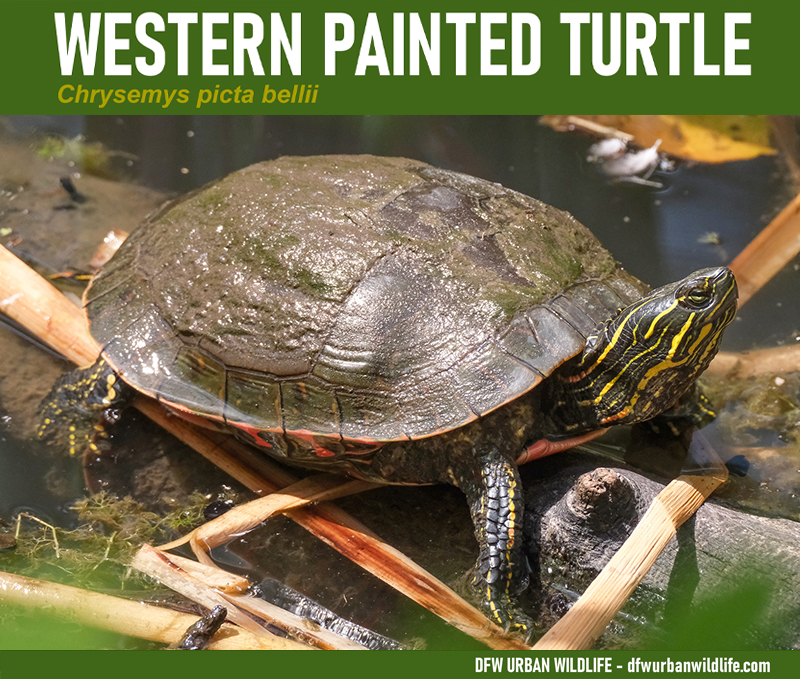
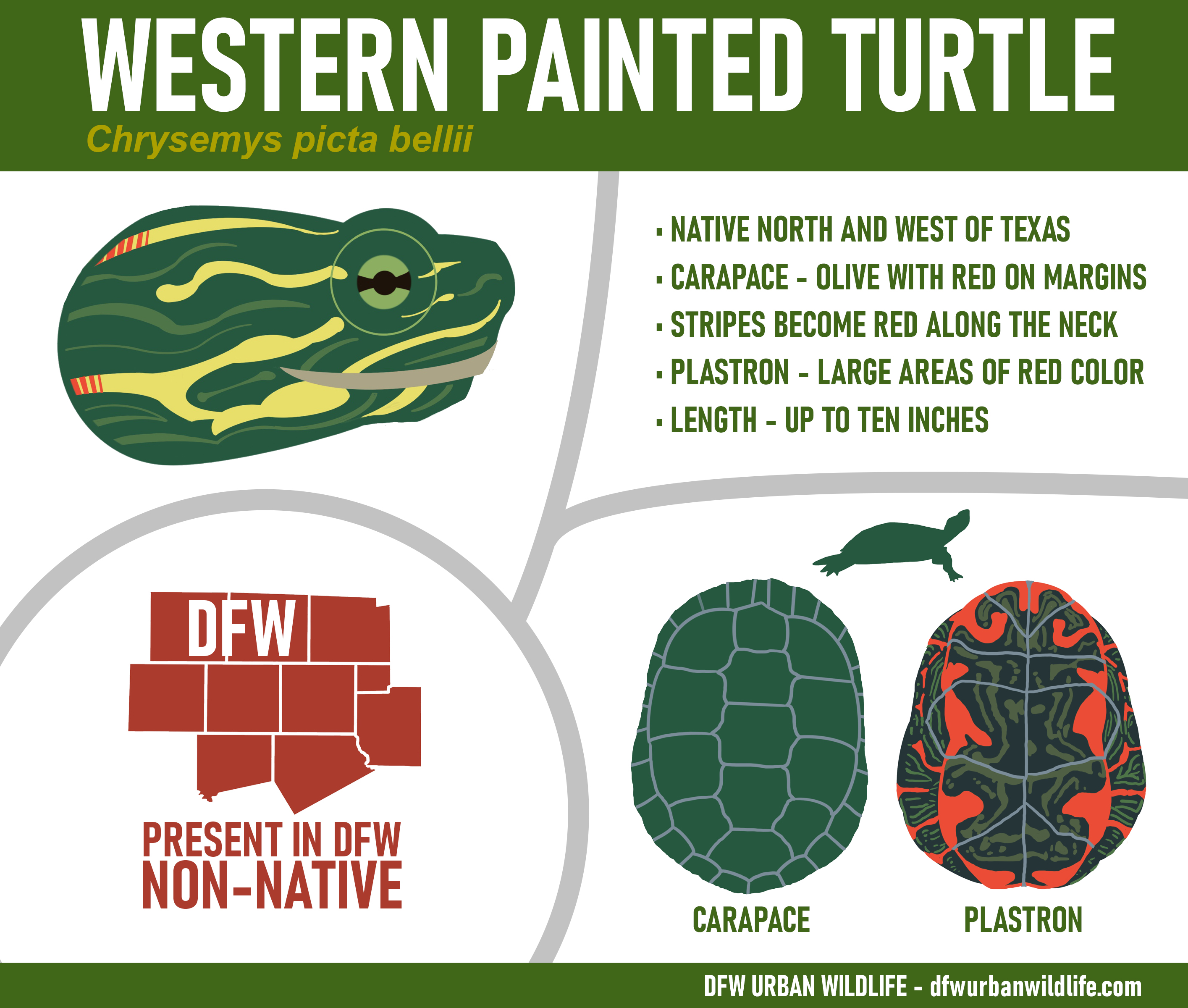
The Western Painted Turtle is not native to Texas or the Dallas/Fort Worth metroplex. Nonetheless this subspecies has been introduced into Texas–likely as released pets–and can now be found in many places across North Texas. The Western Painted Turtle is the the subspecies of Painted Turtle that is most commonly found in Dallas/Fort Worth.
The Western Painted Turtle is similar in many regards to most other species of pond and basking turtles. The Western Painted Turtle is a relatively large basking turtle, with a carapace length up to 10inches. Females are generally larger than males.
The Western Painted Turtle’s carapace is flat in profile and roughly egg-shaped–narrow toward the front and broad at the rear. Coloration includes various shades of greens, browns, yellows, orange, and reds. The head, neck, limbs, and tail are dark green with yellow striping that becomes orange and red as they approach the body. The carapace is brownish with a faint light-colored pattern and hints of red along the margin. The plastron is light in color with variable dark markings and large areas of vivid red or orange.
The Western Painted Turtle is most easily distinguishable from other pond turtles by the the transition of yellow to orange-red of its striping, as well as the hints of red and orange on it carapace, and large areas of vivid red or orange on its plastron. The beak is equipped with a notched tomium.
In Dallas/Fort Worth, Western Painted Turtles can be found most often in park-like settings, or in other similar places that are unfortunately convenient for releasing pets that are no longer wanted. Western Painted Turtles are omnivorous, and feed on a wide variety of foods, such as aquatic vegetation, invertebrates, tadpoles, crayfish, and carrion.
Yellow-bellied Slider
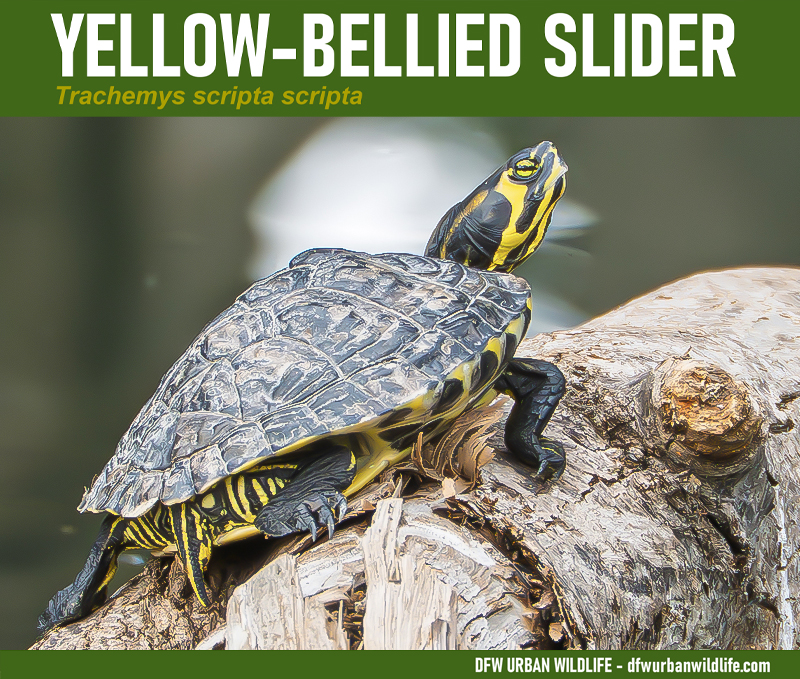
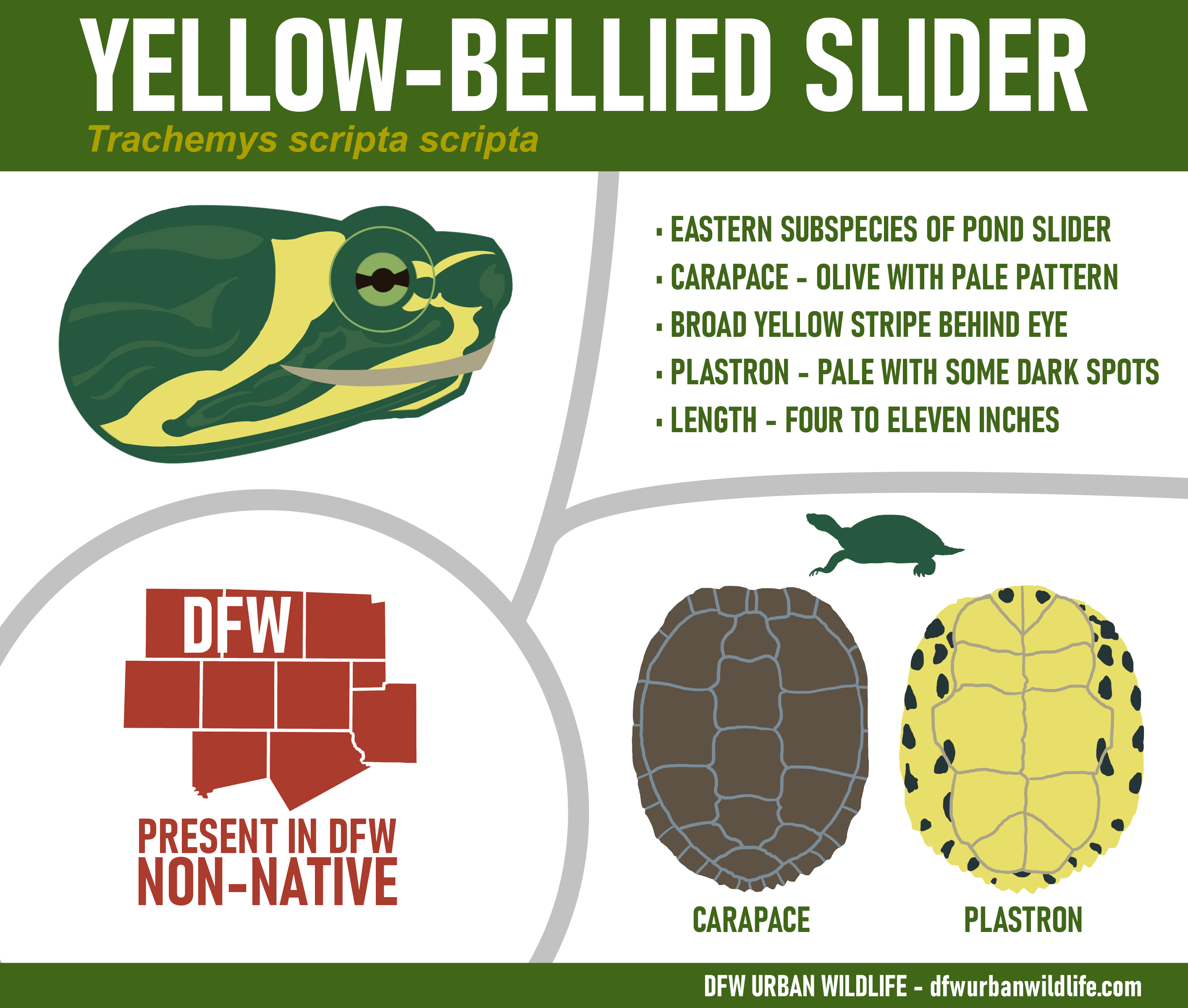
The Yellow-bellied Slider is not native to Texas or the Dallas/Fort Worth metroplex. The Yellow-bellied Slider is the the subspecies of Pond Slider that is native to southeast United States–Alabama, Georgia, parts of Florida and the Carolinas. Nonetheless this subspecies has been introduced into Texas–likely as released pets–and can now be found in many places across North Texas.
The Yellow-bellied Slider is similar in most regards to the other subspecies of Pond Slider turtles. Individuals can be expected to have the same high level of adaptability and tenacity as the closely related Red-eared Slider.
The Yellow-bellied Slider is a relatively large basking turtle, with a carapace length up to 10inches. Females are generally larger than males.
The Yellow-bellied Slider’s carapace is flat in profile and roughly egg-shaped–narrow toward the front and broad at the rear. Coloration includes various shades of greens, browns, and yellows. The head, neck, limbs, and tail are dark green with yellow striping. The carapace is brownish with a faint light-colored pattern. The plastron is light in color with variable dark markings.
The Yellow-bellied Slider is most easily distinguishable from other pond turtles by the large patches of yellow color located just behind its eye, under its throat, and running along the length of its neck. The beak is equipped with a notched tomium. The colors on Yellow-bellied Sliders often mute with age–particularly with males of the species–leaving the turtle uniformly darkly colored, or melanistic.
Yellow-bellied Sliders can be found just about anywhere there is water. Most often in Dallas/Fort Worth they will be observed in park-like settings, or in other similar places that are unfortunately convenient for releasing pets that are no longer wanted. Yellow-bellied Sliders are omnivorous, and feed on a wide variety of foods, such as aquatic vegetation, invertebrates, tadpoles, crayfish, and carrion.


I am new to Dallas and in a neighborhood with ponds and small lakes. During my walks I am taken my the numbers of turtles I am able to observe. I am looking to education myself on these creatures. Recently I was able to observe a very large turtle under water in a somewhat shallow lake. My guess is 24” in diameter. My husband guesses it’s a snapping turtle, since he was raised in central Florida and is familiar with the appearance of them. Can you help me better identify this amazing turtle? It’s is now my mission to spot it again and and study it better.
Hi Dianna,
24 inches is likely an over estimation… but not by much. We have a couple of common turtles in DFW that can grow to be quite large. The Common Snapping Turtle is one, and the Spiny Softshell Turtle is the other. Links to more information about both below…
Common Snapping Turtle:
https://en.wikipedia.org/wiki/Common_snapping_turtle
Spiny Softshell Turtle:
https://en.wikipedia.org/wiki/Spiny_softshell_turtle
I live in Riveroaks condominiums on Cedar-springs creek. North of this property was the location of the first flour mill in Dallas county. The mill stone is near the damn that makes Exall lake in highland park. The property used to be the location of a Tudor mansion built in the late teens or early 20s by TL Bradford, he’s was elected Dallas mayor in 1931 his daughters donated the house for a school for the deaf in 1947 was a school until 1968 and in 1969 Lincoln Property Company built the current structures on the property. The Bradfords landscaped 20 acres of the property and the creek into formal gardens. The creek was terrace into four pools, some have silted in quite a bit but couple have sections of the pool at least 6 ft deep. I have seen several soft shell turtles in the pools. I can identify large individuals that stay in certain pools. The largest I have seen i would say was between 8-10 inches across two years ago. I saw probably the same turtle sunbathing on the sandy bank last week 4/28, I would say 10-12” across. I know there are sliders, snappers and 1 large alligator snapper ( his shell has more ridges and groves than the other snappers) some dark color turtles with faint yellow lines. Is there someone that would be interested in this population or would it be considered unimportant?
Giant alligator turtle.
I thought it was an ornament .
Until it swam away.
The one i saw was in 2015.
The shell looked a little different from an alligator turtle?
I found a turtle roaming the streets. Where can I put the turtle so it will be safe
I have 2 red eared sliders that I am looking to give a new home to. They are quite large now and need more space to grow. Do you know where I can safely release them within the DFW area?