
DATELINE – May 6, 2026 – Carrollton, Texas
It seems like every time I spend a little time outdoors, I find something unusual and interesting. Sometimes these discoveries take the form of new or rare wildlife observations. Other times, it may be unique or novel behaviors I witness.
Other times still, I stumble across something very akin to a crime scene–a mystery to be solved.
Nobody likes to find a deceased animal, but death is an unavoidable part of nature. If you spend enough time outside, you will eventually come across a carcass or two. Sometimes, when a discovery like this is made, an explanation for what happened is ready and apparent. Other times, the answer is not so clear. But in either case, there is an opportunity to learn more about nature and how it works.
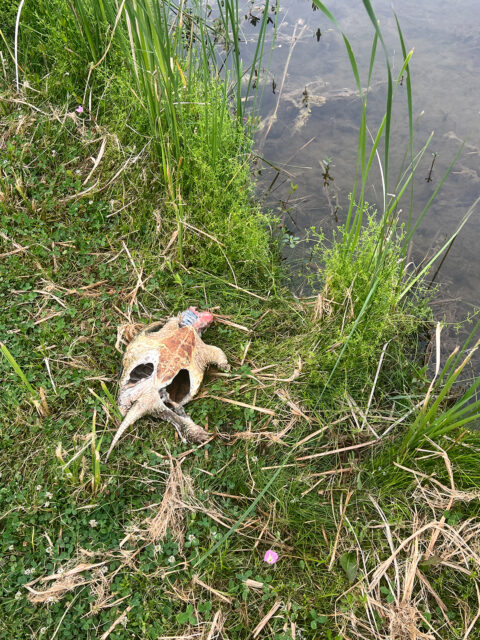
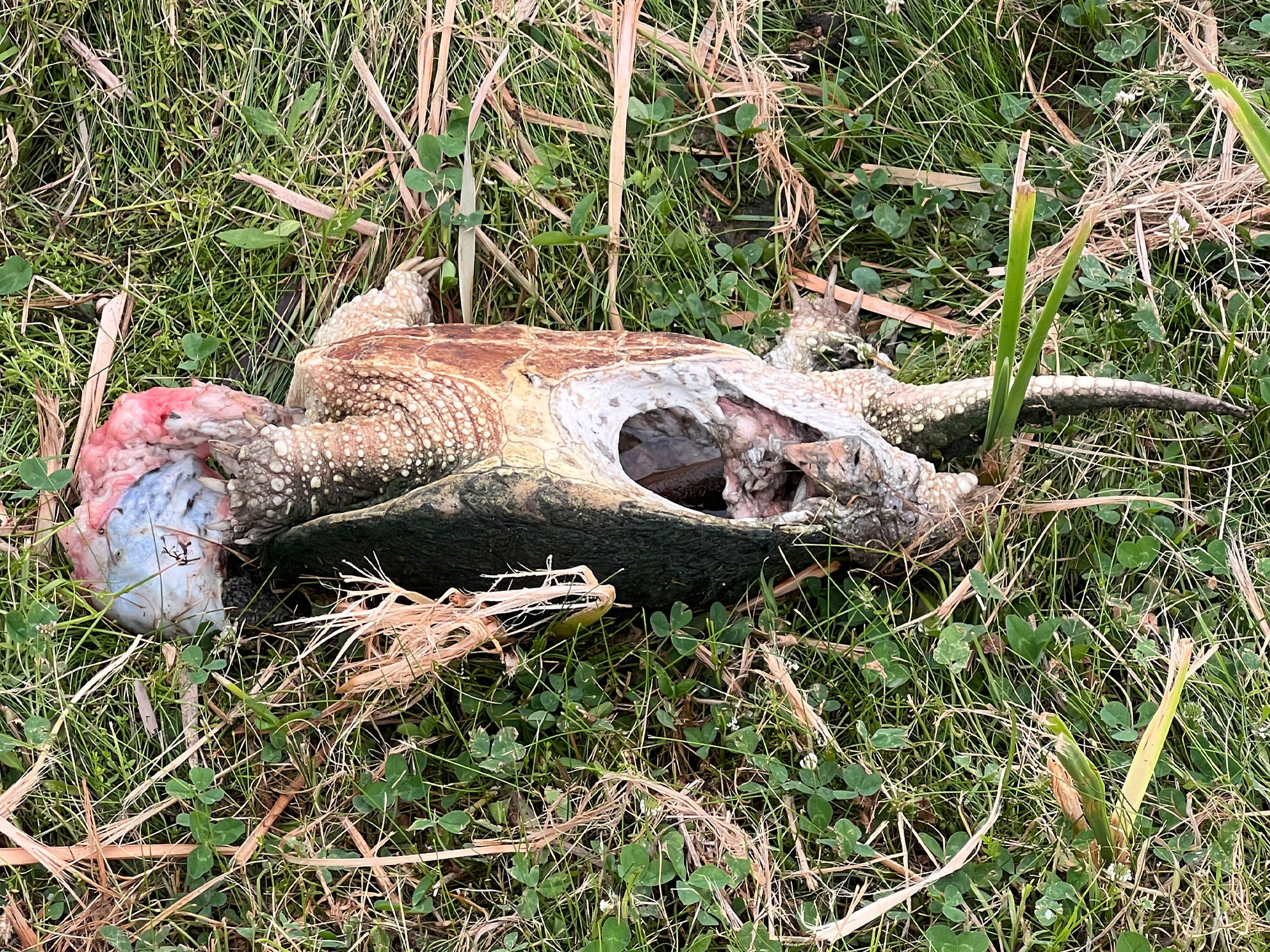
found on the bank of a small pond.
Often, a deceased animal represents an unwitnessed wildlife drama. It’s a chance to pull back the curtain and take a look at aspects of nature we don’t normally get to see. With a little sleuthing and reflection, sometimes the story of what happened can be drawn out from the clues left behind.
Such was the case one morning in early May when I noticed an unusual patch of color near the water’s edge of a local pond. The patch of white stood out starkly from the verdant spring vegetation and was clearly out of place. But the object was at such a distance that I couldn’t be sure what I was seeing. I suspected a carcass of some kind, but it could just as easily have been a plastic grocery bag. A closer inspection would be required to be sure.
As I approached, the true nature of the find revealed itself. This was the carcass of a fairly good-sized Common Snapping Turtle. The deceased turtle had been dragged out of the water and then worked over pretty thoroughly–or vice versa.
The Common Snapping Turtle is one of the largest turtles found in North Texas–second only to the truly giant Alligator Snapping Turtle. And while Alligator Snapping Turtles generally haunt our larger waterways, the Common Snapping Turtle can be found almost anywhere there is water. As the name implies, they are very common in our part of the state.
Common Snapping Turtles are very adaptable and feed on almost anything edible. They eat everything from vegetable matter to carrion. What’s more, in most of the waterways they inhabit, Common Snapping Turtles are located very near the top of the food chain. They are very capable predators.
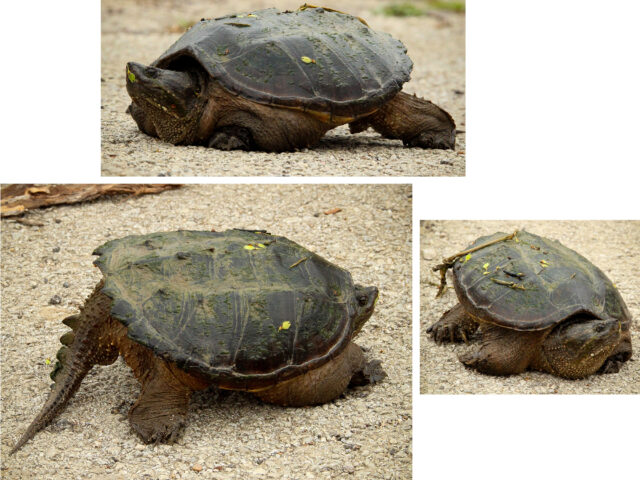
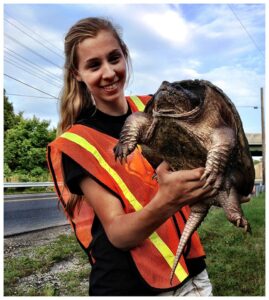
It is best not to handle these animals, as they can deliver a serious bite!
These turtles typically hunt by lurking at the bottom of a pond or creek, and use stealth and camouflage to get within range of their intended prey. When an unsuspecting animal comes close enough, Common Snapping Turtles will quickly extend their long necks and grab their victims in their powerful jaws.
Common Snapping Turtles hunt a wide variety of animals. Any aquatic critter of manageable size may be on the menu. Common Snapping Turtles are known to feed on fish, crayfish, amphibians, small mammals, and birds. If you’ve ever noticed a large brood of ducklings dwindle away to only one or two over the course of a few days, the loss may be due to the work of Common Snapping Turtles. Young waterfowl are particularly vulnerable to these stealthy hunters, as they cannot fly and are easily pulled under water.
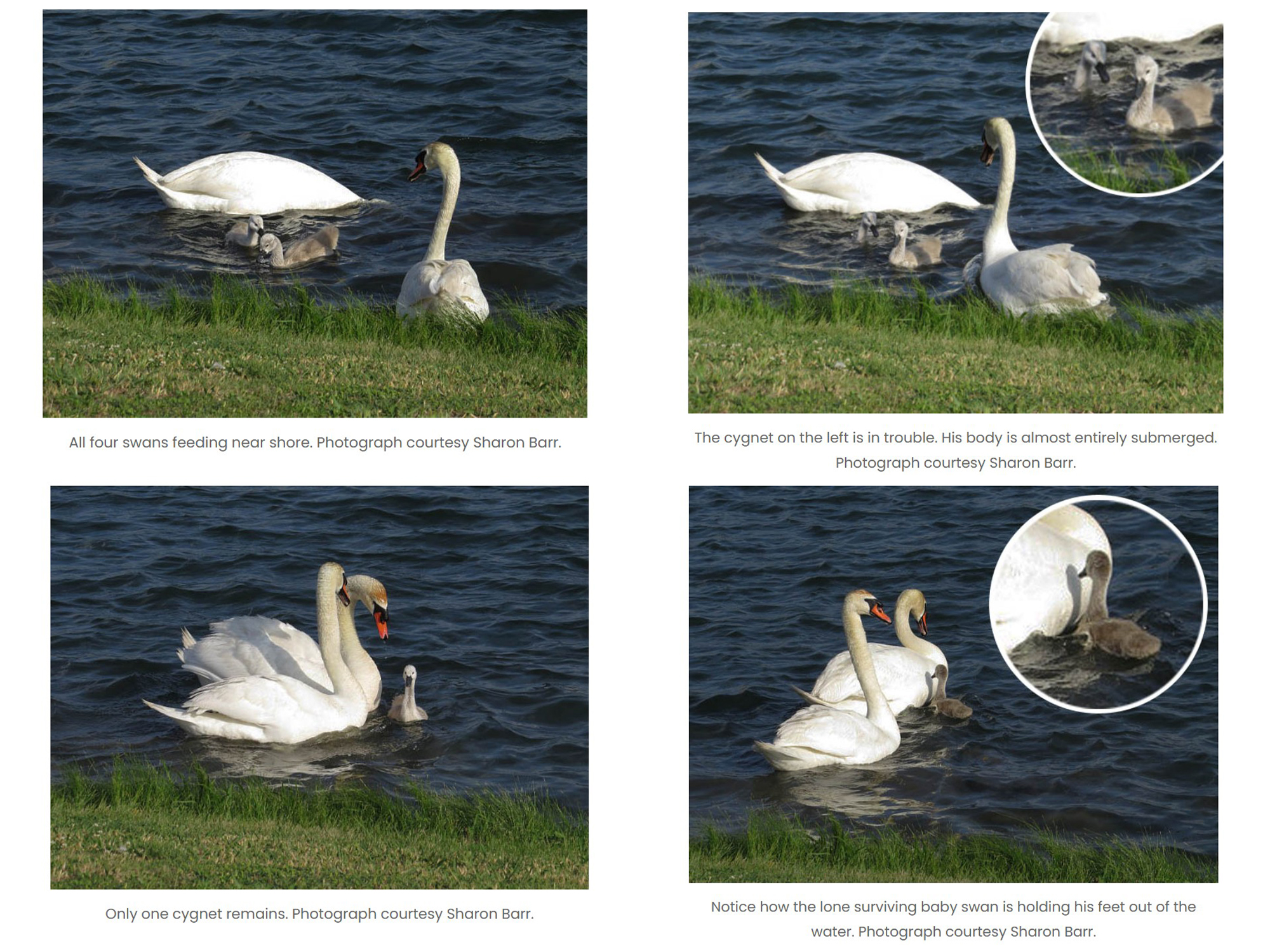
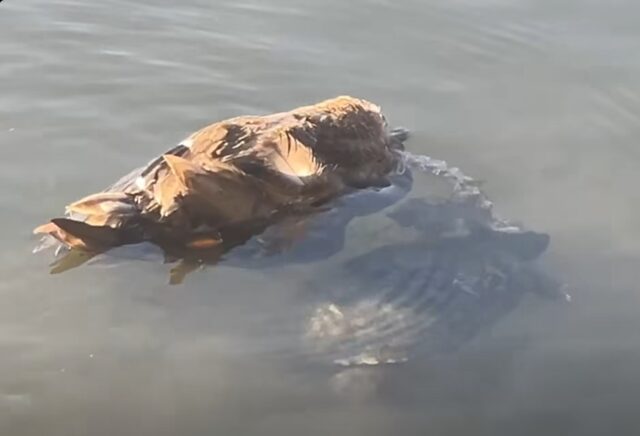
In shallow water, Common Snapping Turtles will position themselves just under the surface. When a duckling, gosling, or cygnet comes near, the unseen turtle will grab the hapless baby by the legs and pull it under water to be devoured. Below is a sequence of pictures illustrating exactly this sort of thing happening to a baby Mute Swan. The photographer did not even realize what she had recorded until she returned home and reviewed her photographs later in the day.
So, after recognizing that Common Snapping Turtles are top predators, the question then becomes: what could have happened to the turtle I found by the water’s edge? There are a couple of animals in North Texas that are capable of taking on a Common Snapping Turtle when an advantageous situation presents itself. We’ll talk about those a little later. For now, let’s imagine a few more pedestrian possibilities.
This big snapper may have died from an injury or other natural causes. If the turtle expired in the water, then its carcass would surely be subject to a number of different scavengers. Fish of various sizes will readily feed on the body of a deceased animal. Other species of swimming turtles will do so as well. I’ve witnessed pond sliders and softshell turtles eating carrion on a number of occasions.
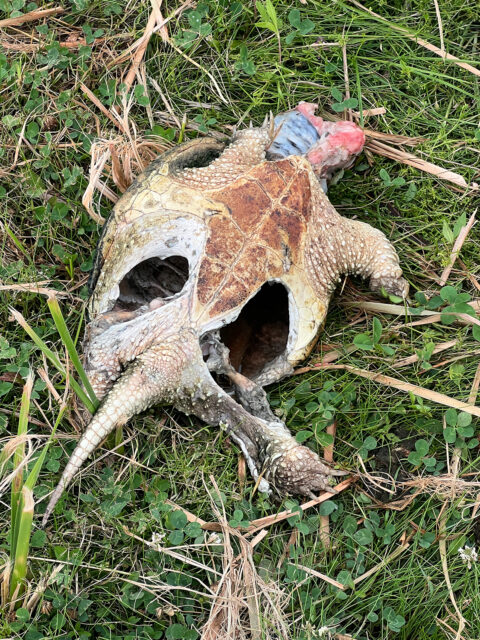
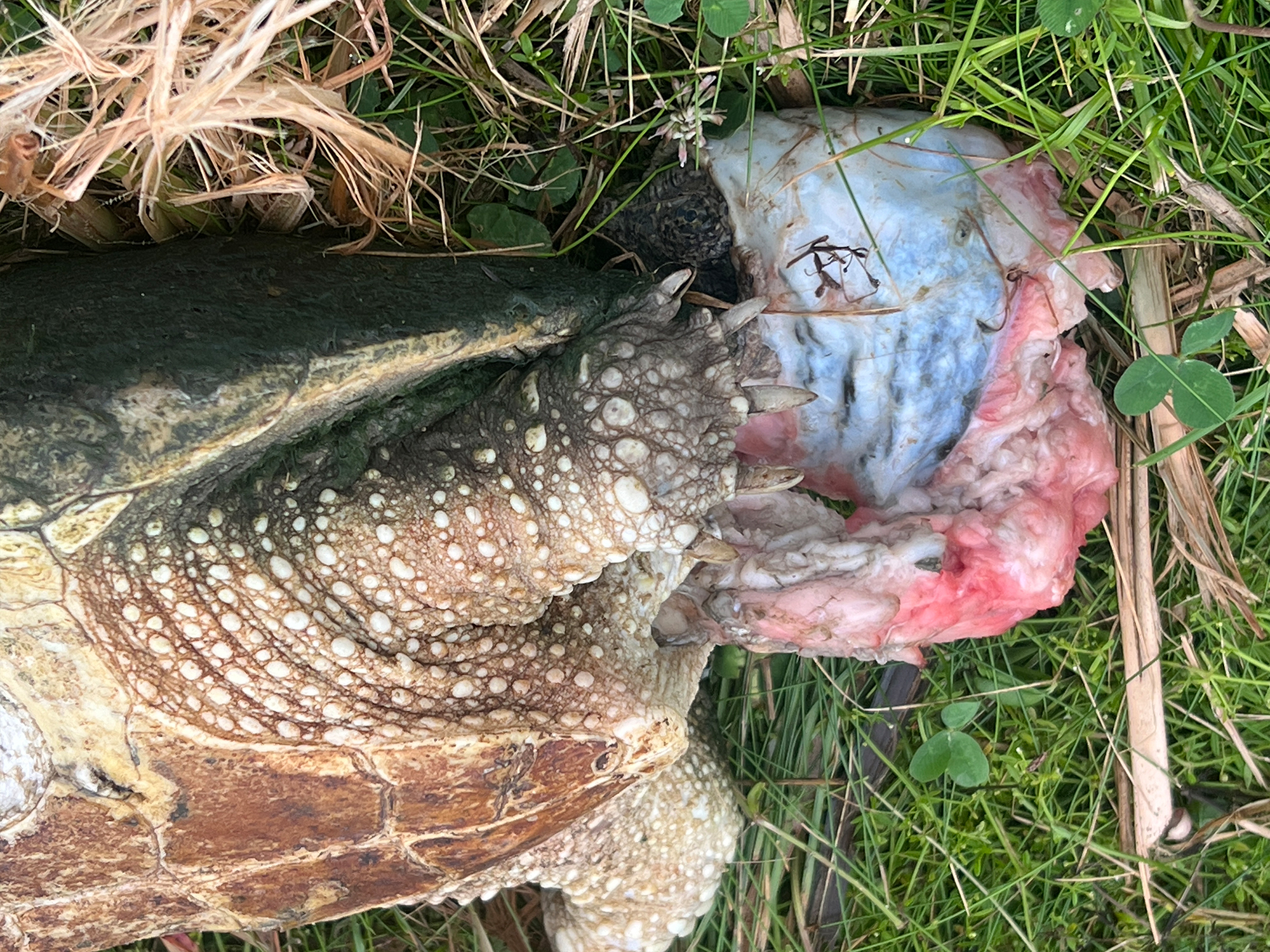
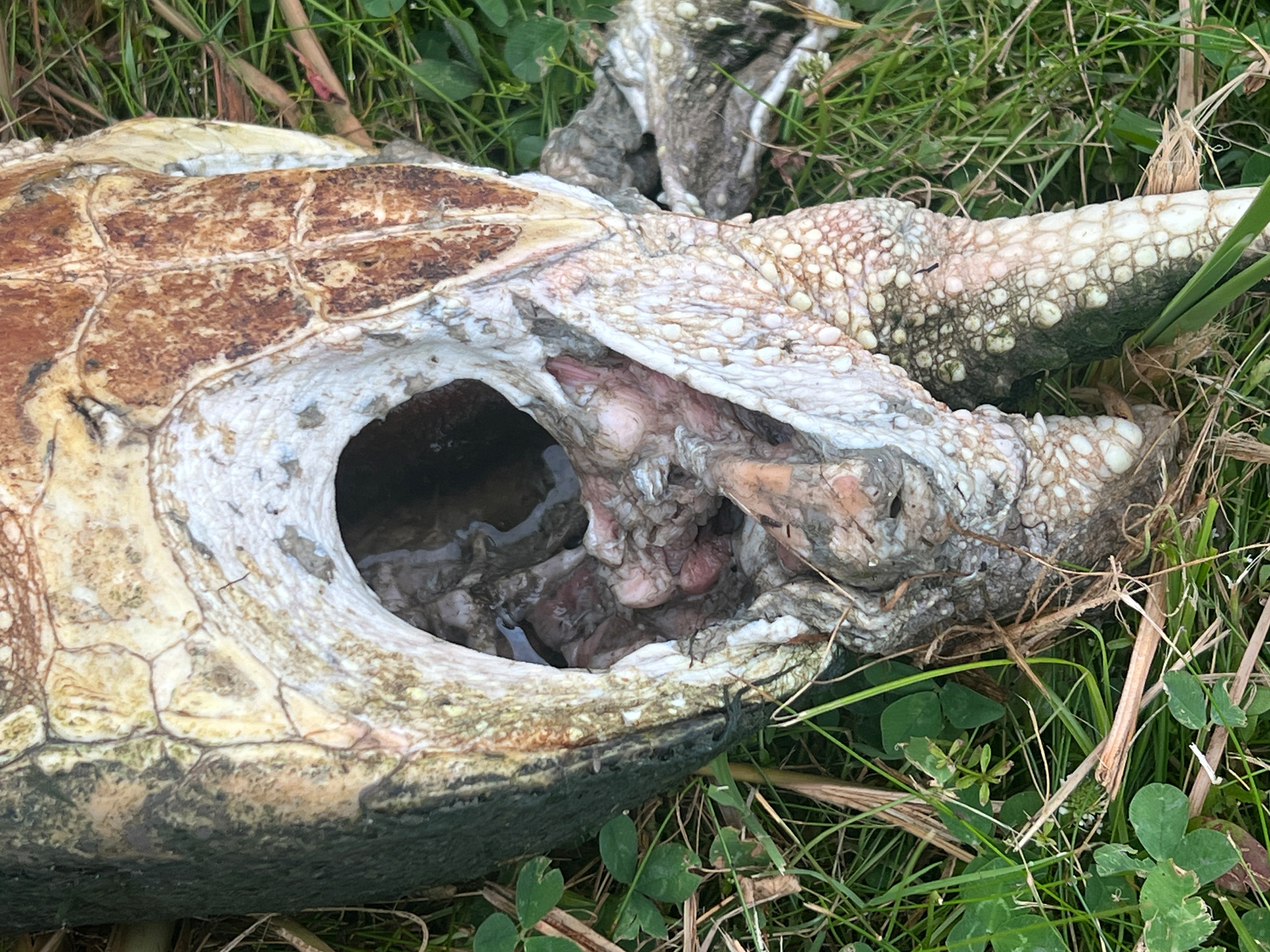
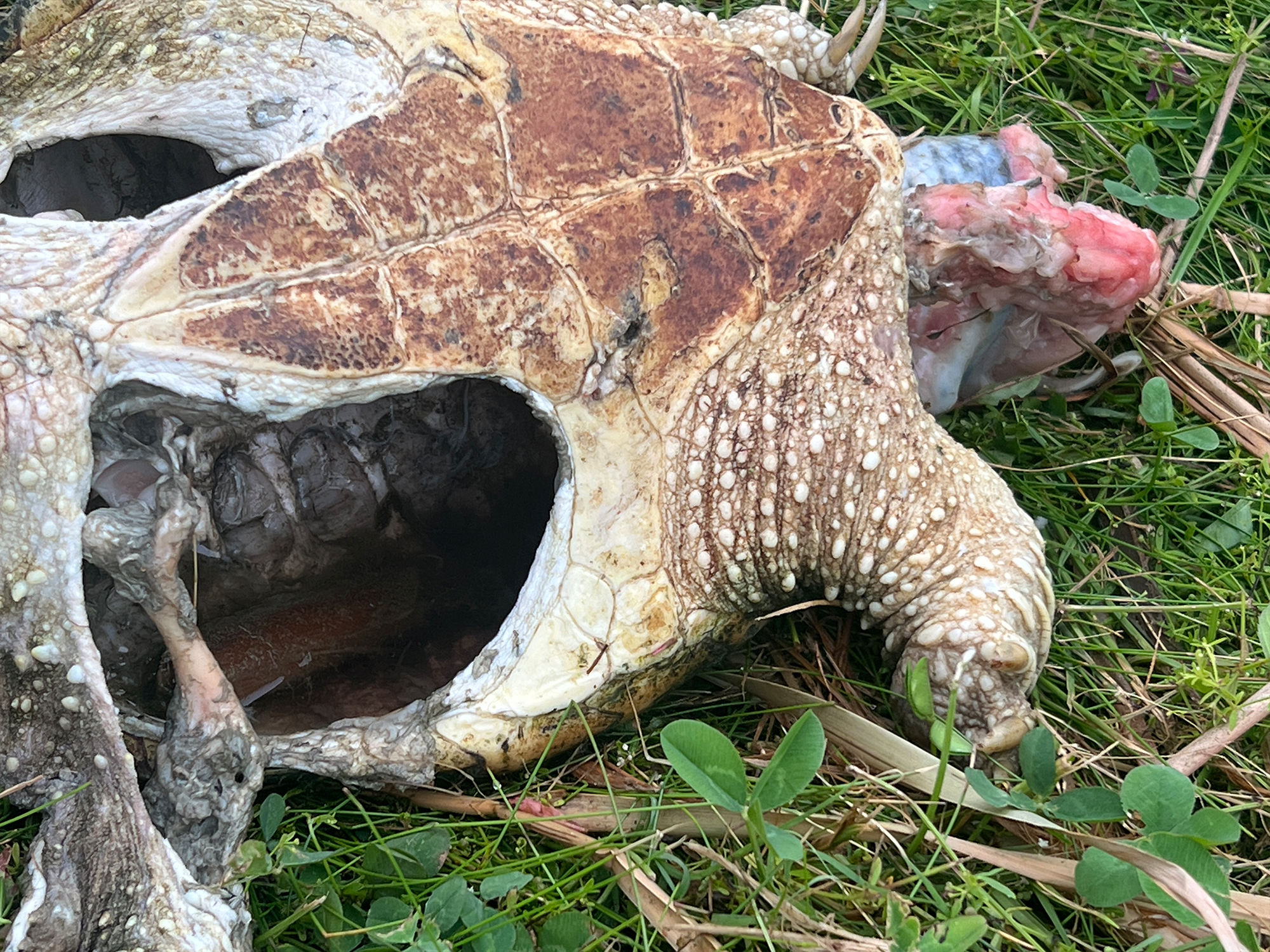
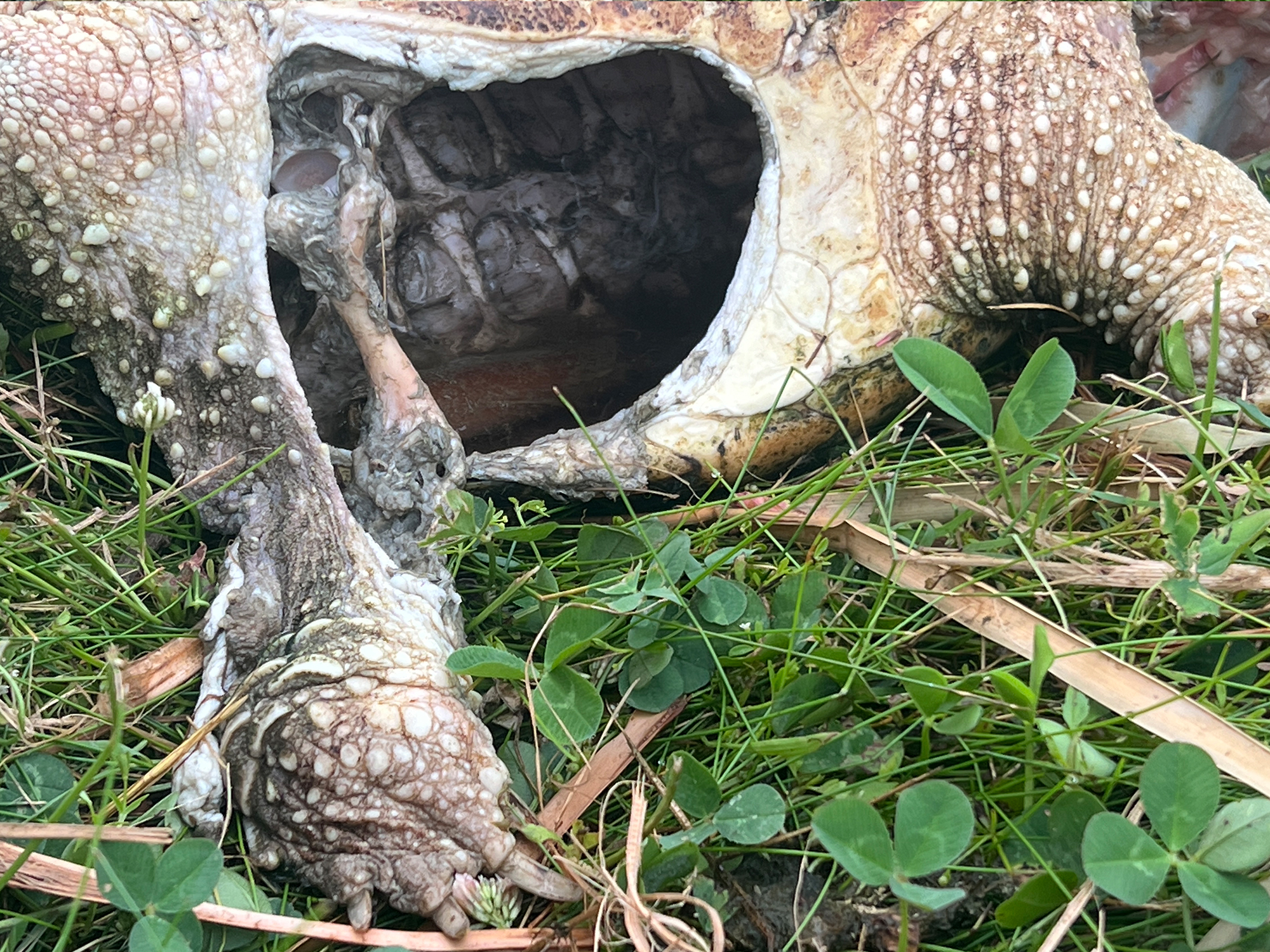
A closer examination of the Common Snapping Turtle carcass showed that the reptile had been largely cleaned out–its shell was empty and hollow. The turtle’s innards may have been consumed, but except for the upper part of its hind legs, the musculature was still mostly intact.
The turtle’s neck had been worked over pretty thoroughly as well, but not to such an extent that bone was exposed. The state of the carcass as we found it certainly could have been the work of aquatic scavengers, such as fish and/or turtles.
But this deceased Common Snapping Turtle was found on dry land. So if it did expire in the water and was consumed there, something else would have had to drag it onto the shore. What could have done that?
If the turtle carcass had been moved to the shallow water near the pond’s edge by the work of aquatic scavengers, a reasonably large and determined land animal could have dragged the dead turtle from the water onto dry land. Likely candidates might include Raccoons, Coyotes, or vultures.
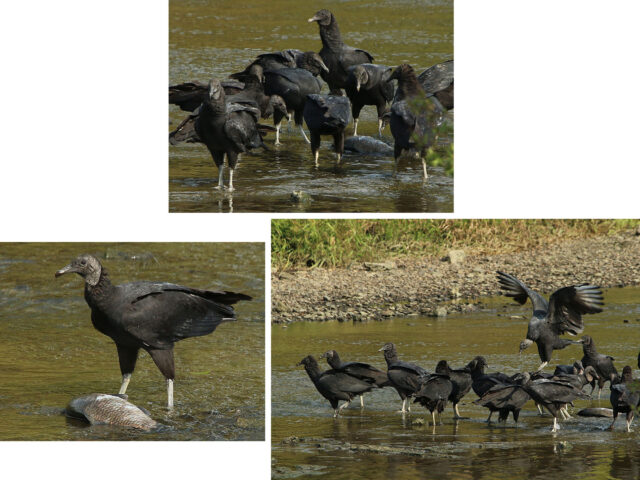
There have been many times when I have seen congregations of Black Vultures feeding on fish that died in shallow water. It’s also not uncommon to see vultures move a carcass to a safer and more conducive place for consumption. This is true whether the big birds are moving a carcass from the street onto a sidewalk, or from the water’s edge to the shore. Vultures also have long necks that allow them to probe deep inside the carcasses they feed on.
Taken all together, many of the clues surrounding this find support the idea that this turtle somehow expired in the water, was fed on by fish and other turtles, and then dragged ashore by some kind of scavenger. But are there any other possibilities?
Common Snapping Turtles do occasionally exit the water of their own volition. Sometimes they leave the water in search of a suitable place to lay eggs. Other times, they are just looking for a new creek or pond to call home. In either instance, turtles can and do travel long distances across dry land. Common Snapping Turtles are most vulnerable to dangers–such as automobile traffic and predation–at these times.
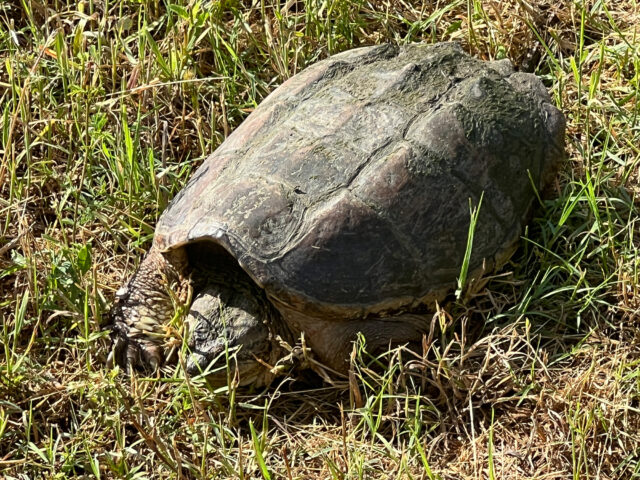
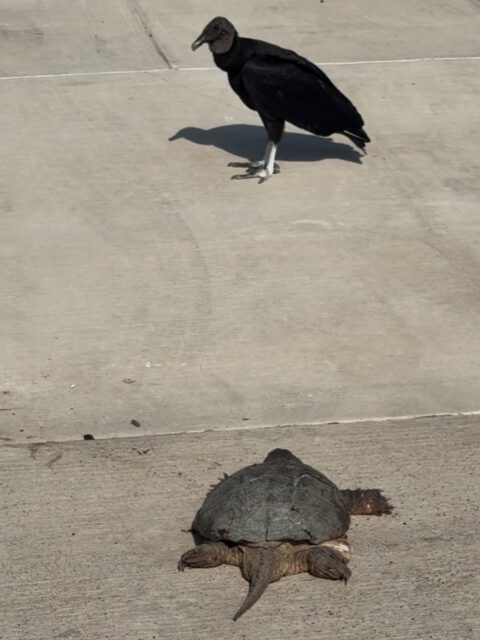
considered by a hungry Black Vulture
In this case, an automobile can be eliminated as the cause of death. There was no road nearby, so this turtle would have been killed by a predator. But Common Snapping Turtles of this size are not defenseless. Their hard carapaces provide ample armored protection that can only be foiled by flipping the turtle onto its back. This can be accomplished by a skilled and determined predator, but the maneuver requires time and repeated attempts to succeed.
Meanwhile, the predator would have to contend with the Common Snapping Turtle’s powerful jaws. One well-placed bite could completely flip the script on a careless hunter. Further, the turtle had a ready retreat in the pond just a few feet away–it should have been able to escape a land predator by returning to the water. This turtle carcass was found so close to the pond that it seems unlikely that it was killed after it exited the water–even if a capable predator was waiting in ambush.
There may yet be another possibility worth considering. We do have at least one common aquatic predator in North Texas that is intelligent and resourceful enough to take on a big snapping turtle. This animal is a sleek and powerful swimmer. On land, they are quick and agile. They have a mouthful of catlike teeth and paws that can manipulate objects. They are very capable hunters and have been observed in the vicinity of this particular pond a number of times.
The animal I’m referring to is the North American River Otter, by any account a very charming critter!
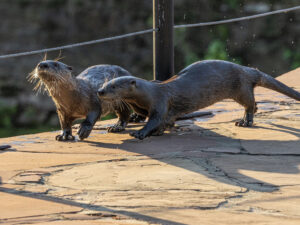
As it turns out, River Otters are very common all across the Dallas/Fort Worth metroplex. We have many more of these interesting animals in our local waterways than is commonly recognized.
All of the clues now seemed to fit. A River Otter would likely attack a snapping turtle from below to exploit the vulnerability of the plastron and soft underbelly.
This kind of attack could be initiated in the water and then continued on dry land as the turtle became incapacitated. A River Otter would have little trouble dragging an injured turtle out of the pond. The only question left is, do otters really hunt and eat turtles?
A quick Google search provided the answer. I not only found video evidence that River Otters do hunt and eat turtles, it seems possible that they even have a preference for Common Snapping Turtles!
YouTube had a couple of videos showing River Otters tangling with big snapping turtles. I’ve embedded one of these below, and provided a link to second–longer and more explicit–video just after. Both are a little gruesome, so consider your sensitivity level carefully before watching!
If you would like to see another example, a second–longer and more explicit–video of a different incident can be viewed by following the link below…
YOUTUBE – River Otter vs Snapping Turtle (warning…disturbing content)
We will wrap this article with a few more close-up pictures of the turtle carcass as it was found. These images are certainly graphic and are for your information only. Be forewarned if you are of a sensitive nature; This may be the place to stop reading! Otherwise, maybe these pictures will help you develop your own theories about what happened here. You can click the images for a larger view. If you come up with a good theory, be sure to leave it in the comments below!