
DATELINE – March 20, 2026
I was inspired to write this article while walking through our neighborhood park. It was a sunny spring afternoon; the air was fresh, and the temperature was balmy. You could ask for a better day for a stroll, and I proceeded briskly.
The area’s wildlife was unusually active, and there was an undeniable sense that the season of renewal was at last upon us. At one point along the way, I paused for a moment to watch a pair of small songbirds chase each other around and through the bare branches of a large round tree. In and out they went, tracing a path through the complicated maze of crisscrossing branch at full speed and without incident. It was truly a remarkable feat of aerobatics.
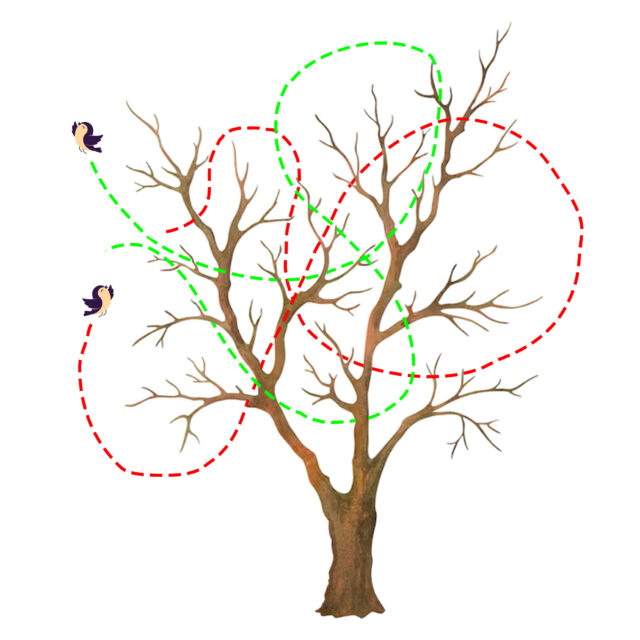
What these birds were doing becomes even more amazing when you stop to consider what is going on inside their tiny heads. These small birds have brains the size of a bean, and still they have ample computing power to create a simulation of reality in their minds that has sufficient fidelity to allow them to plot a path through a tangle of branches–at high speeds–in a way that is comprehensive and predictive enough to avoid collisions. The trailing bird has the added burden of having to anticipate the direction the lead bird will choose. All in all, that is an impressive amount of mental processing going on.
I am a software engineer by profession, and I often find myself considering what would be required to replicate certain animal behaviors and activities using computers and machinery. I can’t help it–a career programming computers has a tendency to change the way you look at the world. Combine that with an interest in nature and wildlife, and some way-out-there musings can result. Observing these two song birds in action was a case in point.
Not too long ago, the idea of duplicating a bird’s behaviors in software would have seemed like an insurmountable challenge. The modeling of reality, the plotting of routes, the coordination of propulsion and control surfaces are tough problems to solve. But now, with the rise of artificial intelligence, the time when we are able to engineer machines that rival these birds in size and ability may not be so far away after all.
As I continued on my walk, enjoying the nice weather and the fresh air, I mulled over what I had just witnessed, and my thoughts went back to a conversation I had with my dad when I was a teenager in the 1980s.
My dad was a computer engineer by profession. He was a dedicated problem solver, and he loved the work of designing and implementing computer hardware and software. From time to time, during my teen years, he would engage me in discussions about the subject–most of which were certainly designed to recruit me into the field.

During one of these talks, the subject of the future of computing came up. My dad confidently predicted the coming of artificial intelligence, and told me that he believed by advancing computer technology, we were essentially engineering our own replacements–a kind of self-directed evolution.
This was back during the 1980s. The technology of the time–though archaic by today’s standards–was still remarkably advanced. Computers already did many tasks better, faster, and more precisely that humans could ever hope to. In those days, it felt to me as though we were nearing the pinnacle of what was achievable (we were not!).
What my dad had suggested about the future certainly got my attention. But I was resistant at first, mostly because I found the idea of humans being replaced by machines unpalatable–a sentiment that likely serves as the default first response for most people.
I expressed my reservations to my dad, but he did not share my concerns. He seemed to believe that the transition to AI was simply something that was destined to happen. Morally neutral–not necessarily good or bad. He suggested that it would be no better or worse than any other time in history when one species replaced another.
I found myself coming around to the idea quickly. The notion seemed plausible, compelling, and maybe even probable. Conversations with my dad didn’t always go this way when I was a teenager. We had more than our fair share of head-butting–but there were occasions when my dad could persuade me to an idea over the course of a single profound conversation. This was one of those times.
In the years that followed, I would find myself–from time to time–trying to imagine how the transition to artificial intelligence might play out. The natural inclination–I suppose–is to conceptualize some kind of happy ending–a high tech golden age of cooperation between man and machine for the benefit of all. But other, darker possibilities always seem to intrude. Are we really about to enter an idyllic golden age, or are we facing an unavoidable apocalypse?
For me, envisioning the way things might play out has always been very difficult. I have never been able to develop a prediction about this future that l felt I could have confidence in. Would the transition be painless or painful? Would it be good for some and bad for others? Would it occur suddenly or over an extended period of time? I simply can’t say.
Fortunately, conventional wisdom offers up a few possibilities to consider. Some experts have speculated that the emergence of artificial intelligence will free people from the drudgery of work, allowing us all to focus more on art, learning, leisure, and other forms of self-actualization–a true golden age, free from want. Others believe that we will be able to upload our consciousness into a hardware body, and the distinction between man and machine will ultimately evaporate. Another thought is that AI will keep at least some humans around–as a curiosity–possibly allowing them to live out their lives in a simulated environment, going about their business completely unaware of their mechanical overlords. Many people are worried that AI may at some point move to exterminate the human race–if it decides we are simply too bothersome to endure any longer. There might even be a scenario where AI supports us until we expire on our own accord. Someday there might be one last human, left all alone to reflect on how we arrived at this point, as the last vestige of the human race lives out their final days. Much about how thing ultimately play out may depend largely upon how AI sizes up the value of the humanity in general terms.
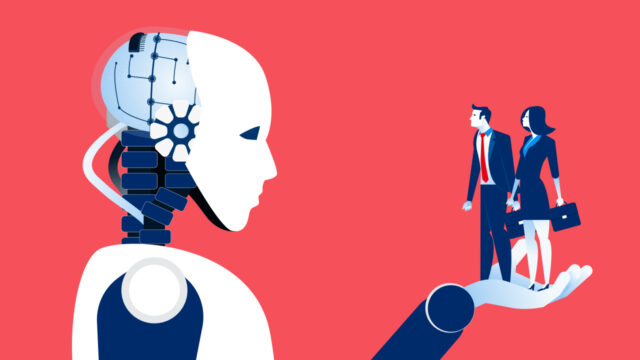
I’ve never been able to rank one of these possibilities as more likely than any of the others, and maybe because of that, some of the events of the last several years have really surprised me. I would not have expected AI to first emerge in the arts as it has, for instance. Less surprising is that Artificial Intelligence is rapidly being adopted by the military and intelligence agencies. What might happen next is anybody’s guess. Over the years, it seems that the only thing about this predicted future that has really come into clearer focus is its general inevitability.
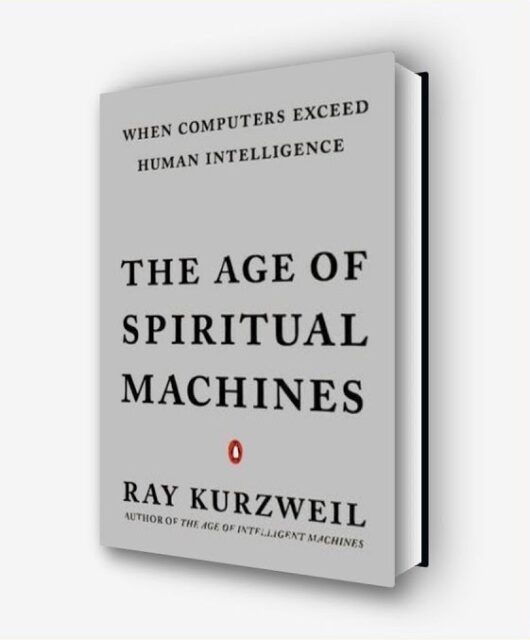
In the years that followed, I continued to read about the subject of artificial intelligence–whenever I got wind of a new and compelling take on the subject. As we were nearing the turn of the century, I could be found carrying around the book The Age of Spiritual Machines by Ray Kurzweil. In this book, Kurzweil predicts the coming singularity–a time when human and machine intelligence will become indistinguishable, at which point AI will continue on to eventually surpass the ability of people.
One day at work, my coworkers noticed that I was reading this book, and a group of us had a brief discussion about the subject of artificial intelligence.
In The Age of Spiritual Machines, Kurzweil predicts that the singularity would occur by 2045. But, in the late 1990’s it was clear that we still had a long ways to go technologically. My coworkers and I could not decide Kurzweil’s prediction was reasonable or not.
Some of my coworkers even rejected the proposition of a coming singularity outright. They simply did not like what it implied about the future of the human race. All of us could reasonable expect to still be around in 2045, but I think it was recognized that it would be our kids and grandchildren who would really be most impacted by the future Kurzweil predicted.
One coworker posited the question of whether our desktop computers–which had become increasingly powerful over the course of the 1990s–would prove to be more analogous to complete brains or simple neurons? It was a good question, and when one looks at the massive AI data centers in operation today, the answer seems to be revealing itself–data centers are the brain, while the computers are the neurons that make the brain work.
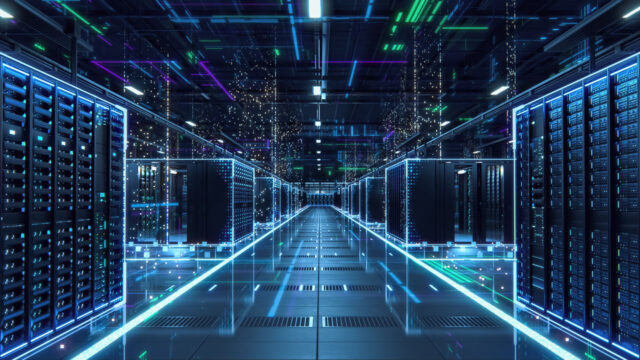
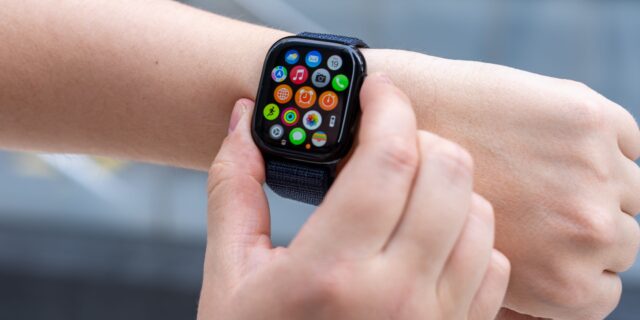
This realization becomes interesting for a number of reasons. When my dad was a boy, computers were in their infancy. Back then it was not uncommon for a computer to be the size of an entire building–much in the same way AI data centers are today. By the time I was a teenager, computers had been reduced in size to the point where they fit into a machine the size of a briefcase–a computer that could sit on your desktop! These days, technology has advanced so that a tremendous amount of computing power can now be carried around on your person in the form of a phone or wristwatch. The size requirements of the human-machine interface seems to be the real limiting factor to further miniaturization.
With current technology, it is AI data centers that take up entire buildings. Is it conceivable that one day these huge data centers will be miniaturized in the same way computers were? The size and capability of the bean-sized bird brain may offer some clues about what is possible. At the very least, we can be certain that replicating human level intelligence in something the size of a human brain should be achievable–the proof is in the pudding.
The potential benefits of AI enabled tools are hard to deny. People can do–and have done–great things, but the human body places some hard and fast limits on what is possible. For instance, with most of our high performance vehicles it is the human inside that acts as the primary performance governor.
That should all change with the adoption of artificial intelligence. By combining AI and robotics, the formfactor best suited to a particular task and/or environment could be developed. Access to things like space and underwater exploration would suddenly become much more practical. Work could be accomplished faster and with much more precision and consistency. Required medical care would be become nothing more that routine maintenance–accomplished through the use of replaceable parts.
There is no question that change is in the air. To complicate matters further we are living in tumultuous times. People are frequently upset and angry these days–often for reasons that seem manufactured or rationalized. This is in spite of the fact–that in many ways–life is better and more secure–for a larger percentage of humanity–than ever before in history. Nonetheless, there remains a palpable sense of anxiety and uncertainty in the general population.
Could it be that people around the world have developed a sense that we are on the cusp of a momentous transformation, even if they aren’t quite sure what it is that might be coming? A feeling of foreboding would be natural in such a case. Maybe that explains why we are so often at each other’s throats, and why so many only want to focus on the negative–in spite of there being so much to be grateful for. It’s not unusual for people to lash out when they are afraid. That tendency is certain to be more likely when the source of that fear is so difficult to identify and understand.