

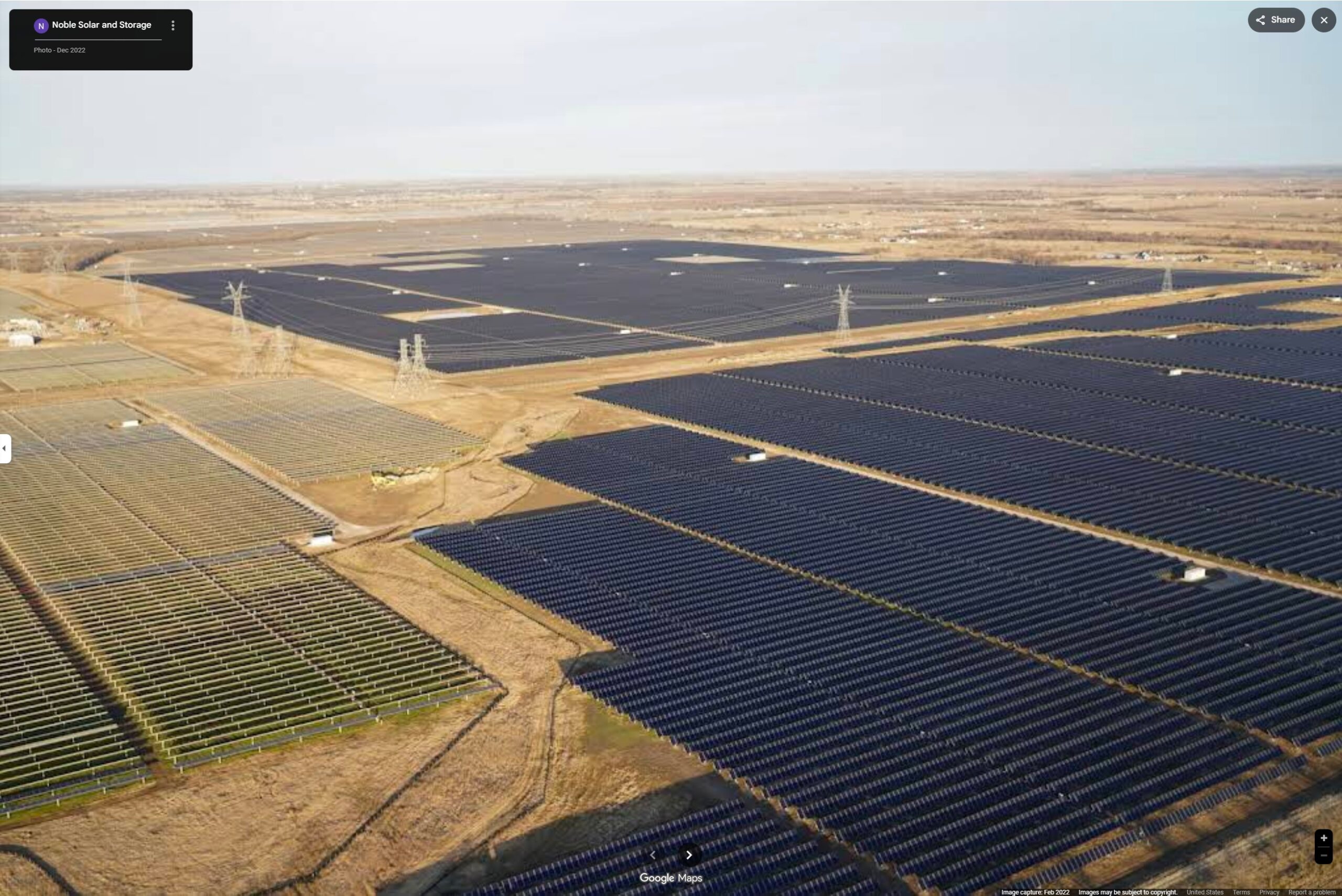
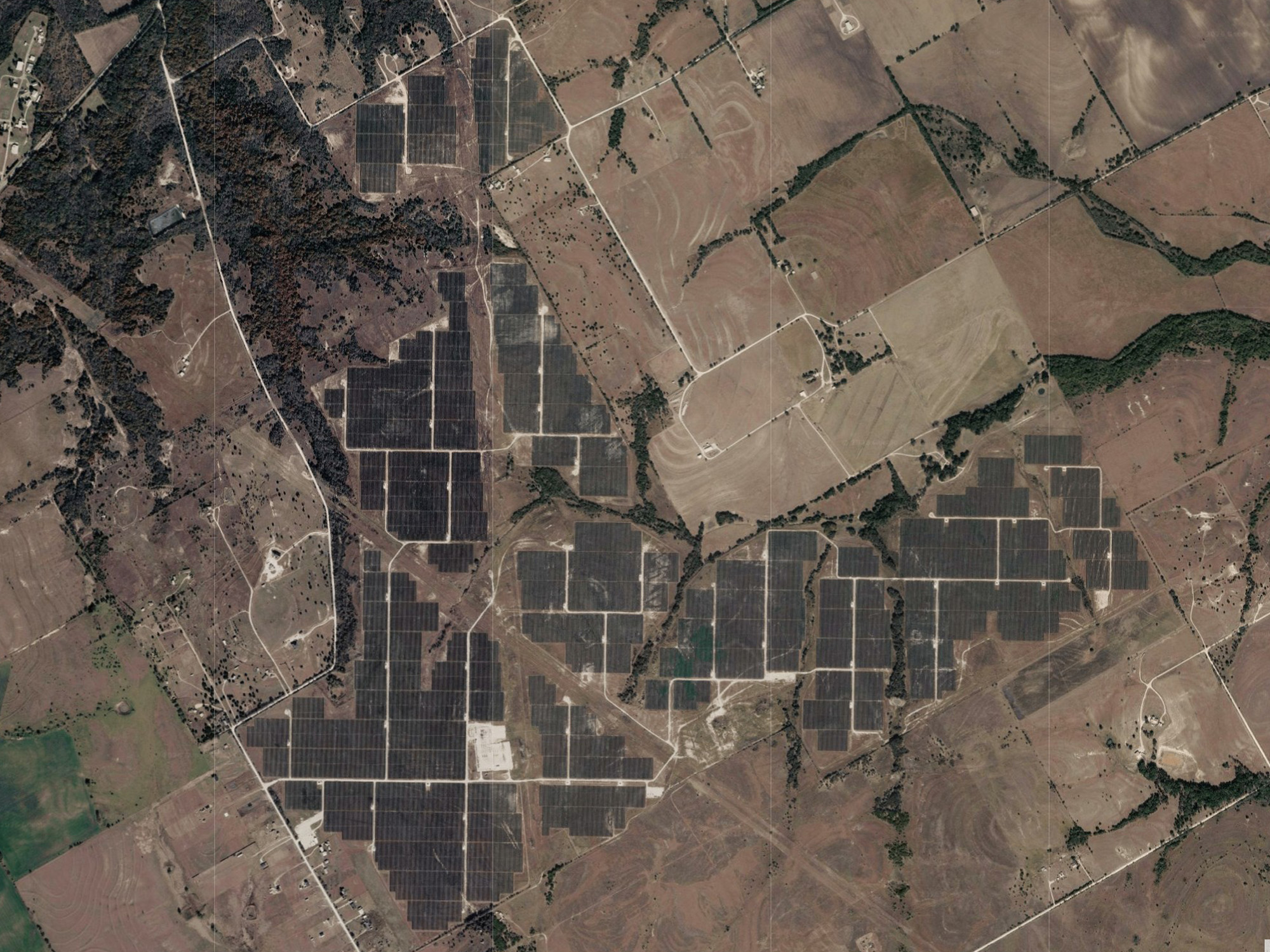
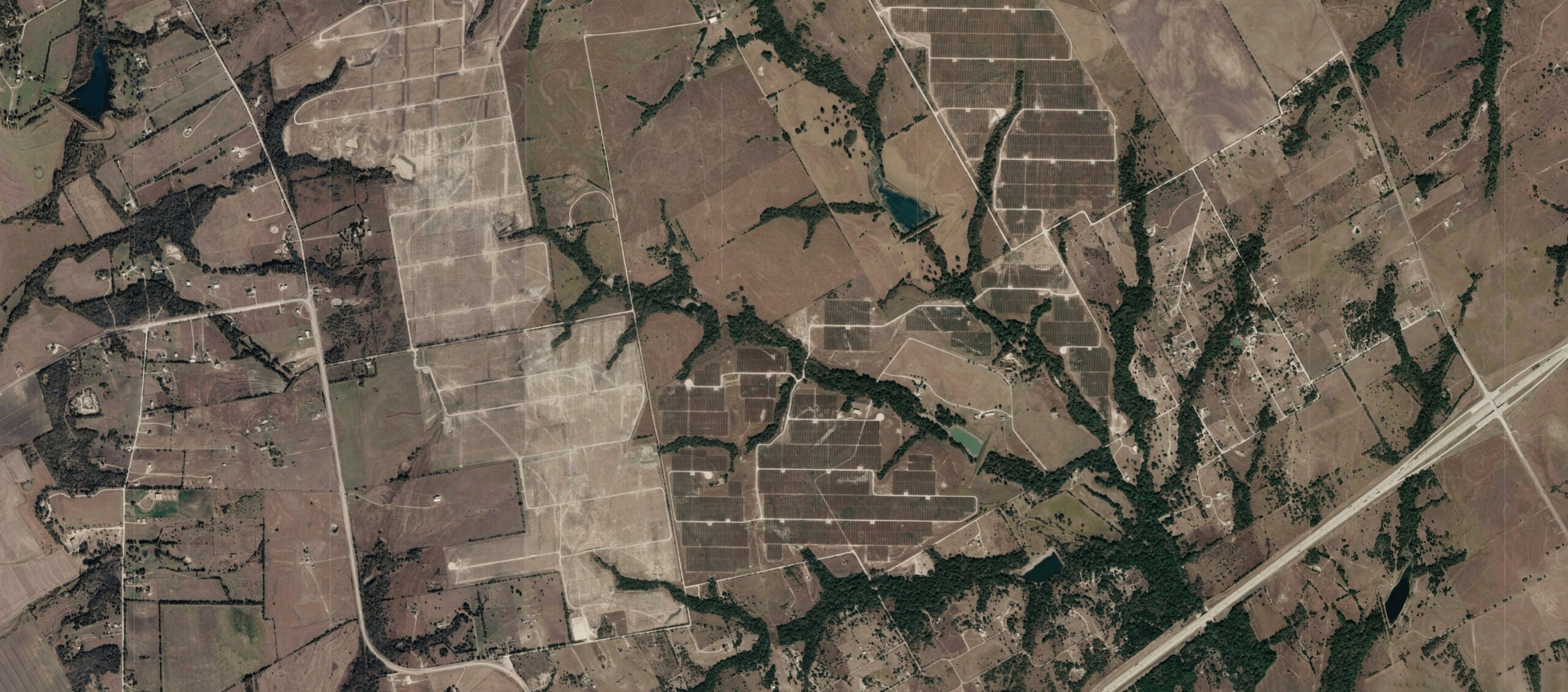
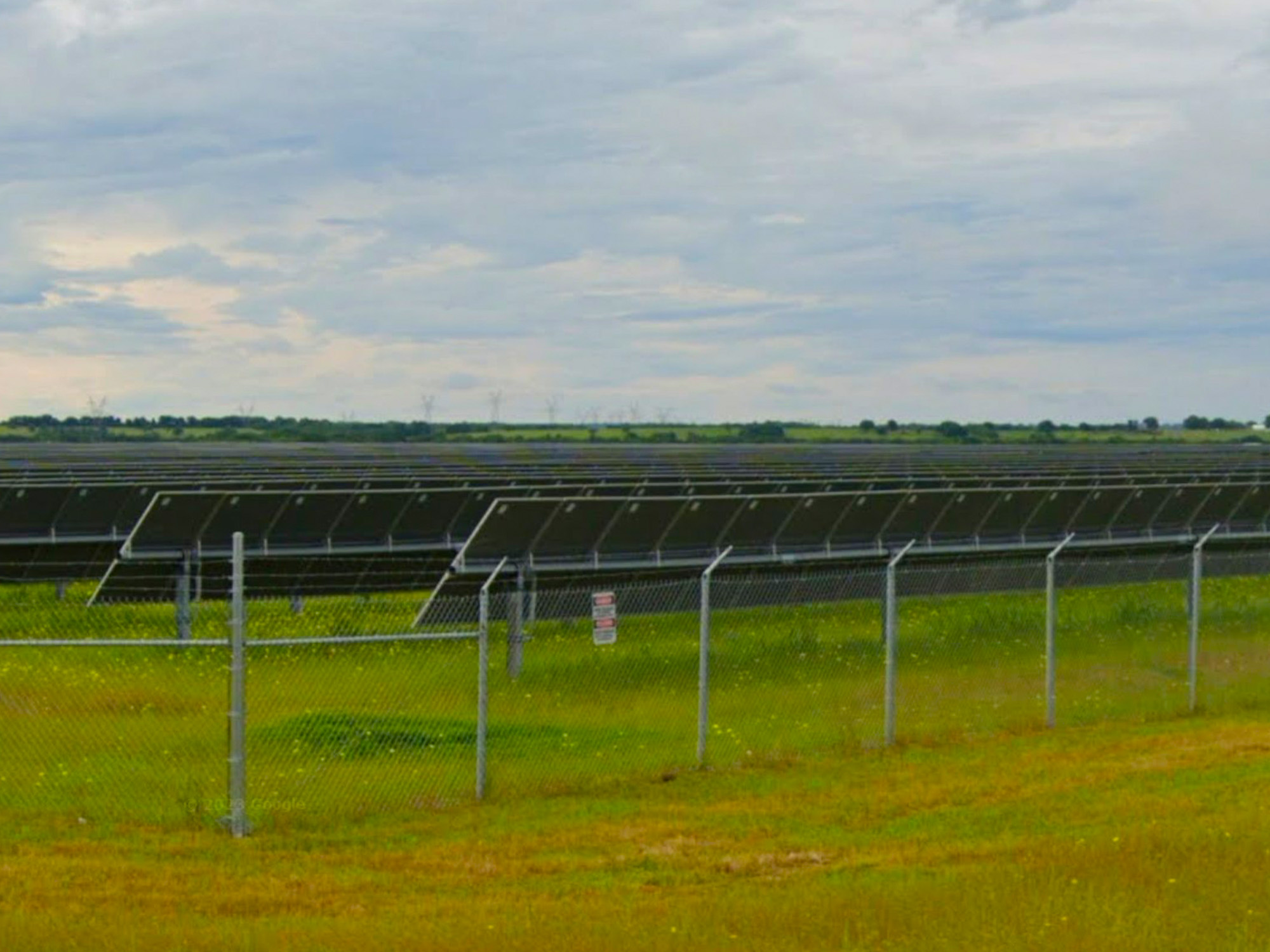
For many decades now, solar power has been promoted as a green, sustainable, and ecologically friendly solution for many of our important energy needs. After years of promise, solar power has at last been firmly established in North Texas. There are dozens of solar farms–in various stages of completion–to be found in the North Texas area, and hundreds across the entire state. As of this writing, several hundred thousand acres of rural land are now covered by concrete, glass, and steel, with much more destined to follow suit. Throughout this article, you will find a collection of satellite imagery illustrating what large-scale solar power installations actually look like in our part of Texas.
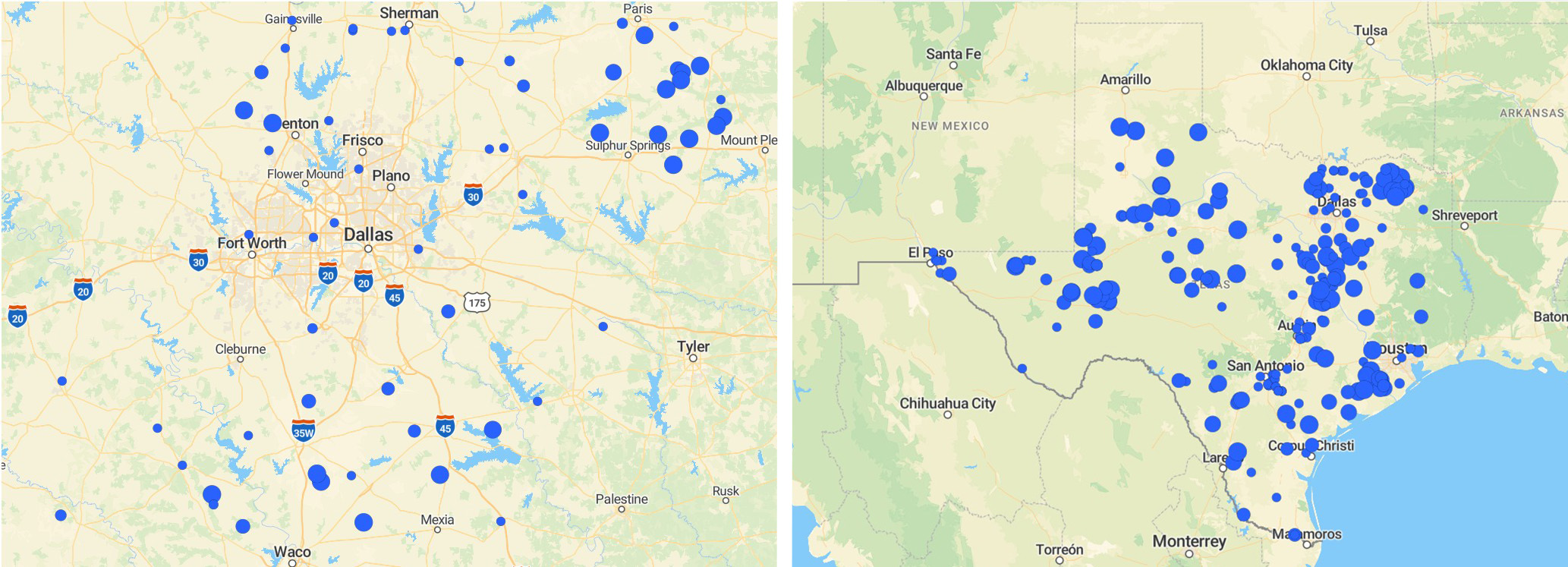
The size of each circle represents the relative acreage of each solar farm
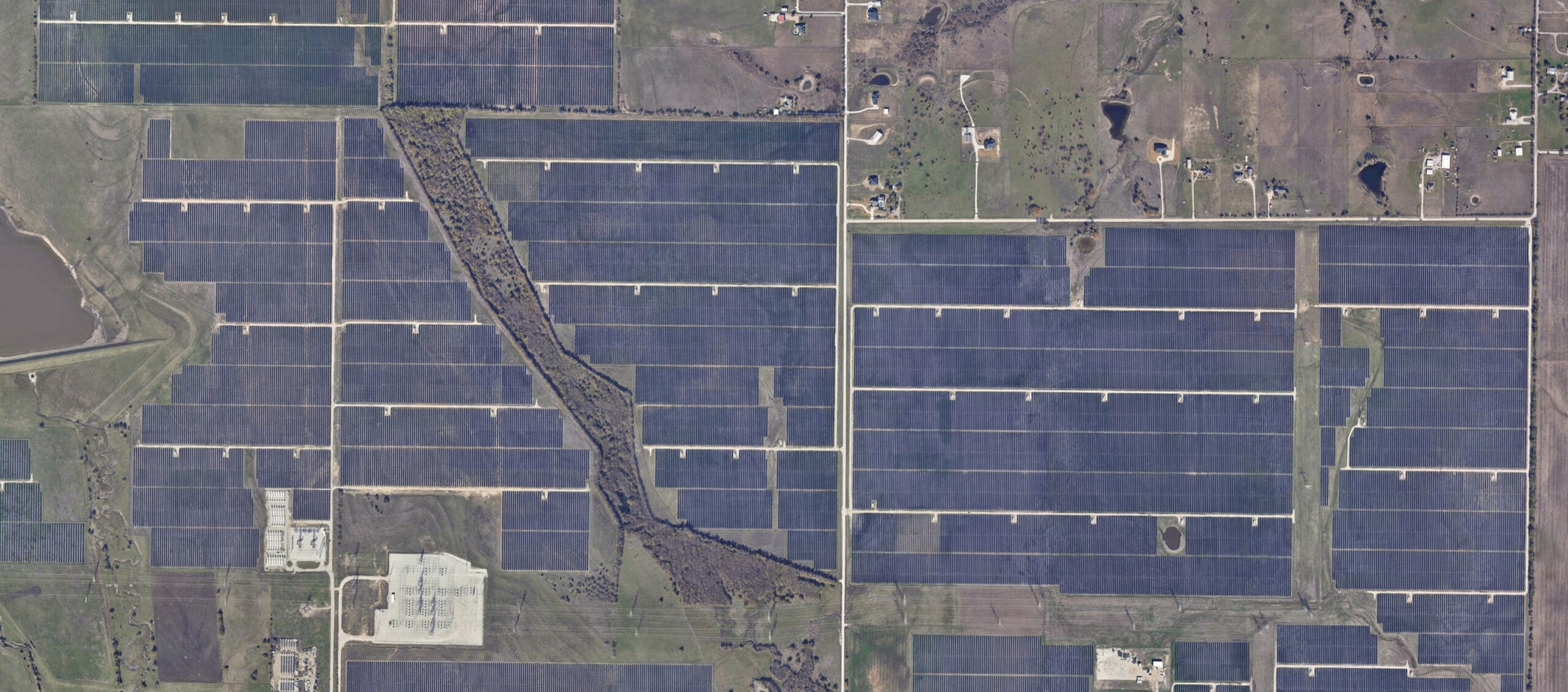
Earlier in the year, I shared a subset of these pictures on our Facebook Page–in a neutral post, without commentary–to get a better feel for how people would react. It did not take long for our readers to begin leaving comments. As might be expected, many folks expressed objections to the solar farms in the same way they might to any other large-scale urban development project. Another group was inclined to describe them as government-subsidized boondoggles.
Other people liked the idea of solar power but felt that these large-scale installations should be placed in areas already impacted by development, by mounting them over roads and parking lots, and on the rooftops of buildings.
There were also a number of folks who offered up their support for the solar farms, and others still who came to the defense of the projects, sometimes offering lengthy posts explaining their reasoning. The arguments in favor of solar farms typically fell into four or so different categories…
- Some minimized the issue as only a conversion of historic farmland, rather than a disruption of truly wild and undeveloped areas.
- Some suggested that solar power is much preferable to the continued use of hydrocarbon-based energy sources.
- Some noted that current oil and gas production has a similar footprint in terms of acreage used, but is less noticeable because it is not concentrated in localized areas the way solar is–and also because we are more accustomed to seeing it.
- Others referenced studies that have indicated that large scale solar farms have no impact on wildlife diversity.
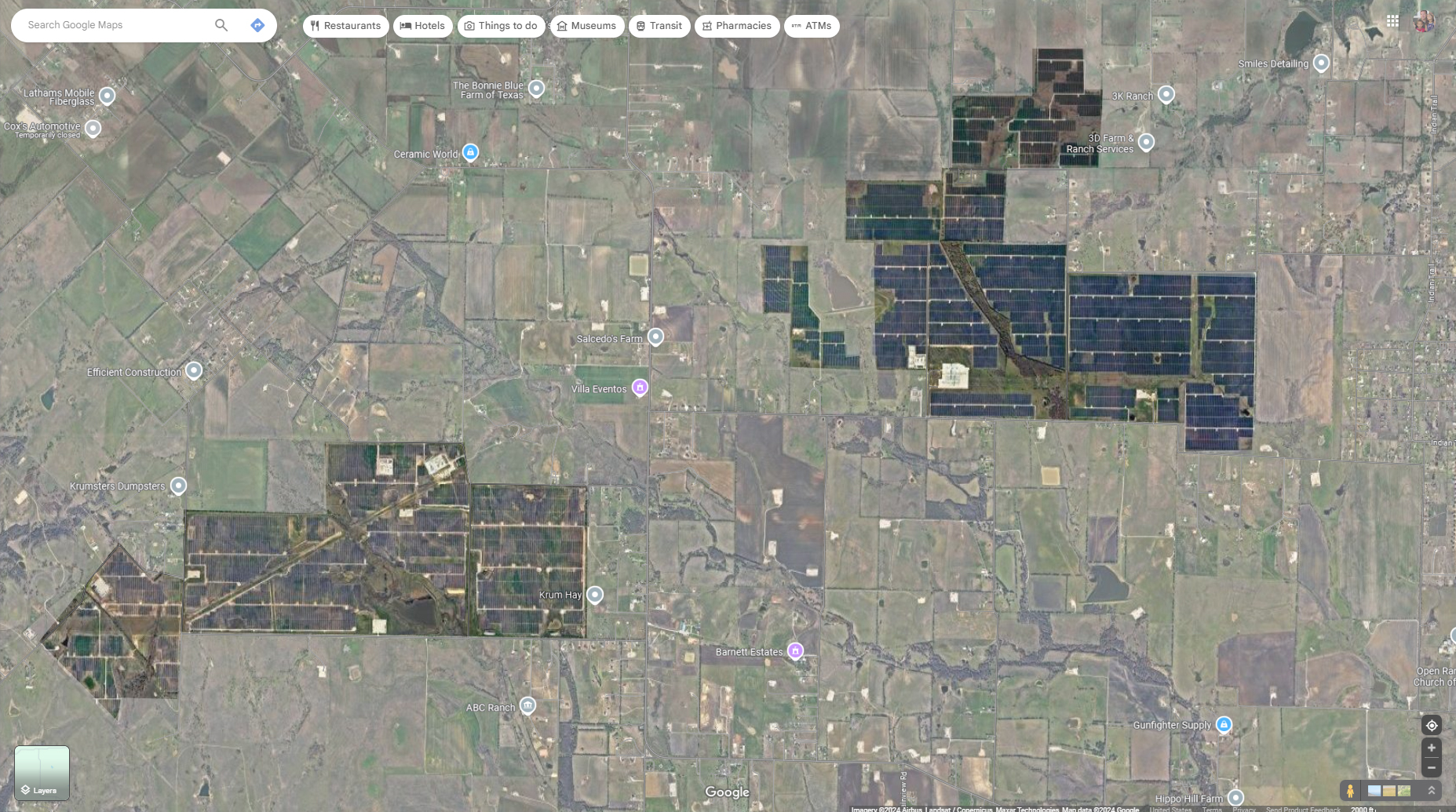
Together, they cover roughly 3600 acres of countryside
At some point along the way–and maybe not surprisingly–the interactions began to get testy, so I closed the post for comments and deleted all that had been left.
Afterwards, I took to Google’s Gemini AI Assistant and asked it a few questions about the state of solar farm development in North Texas. Gemini bases its answers on what it can glean from existing information on the internet, and for solar farms, much of that information comes from marketing and promotional literature. Those sources are obligated to emphasize the positive and minimize the negative, and that was reflected in some of the answers I received. Sometimes it required a little finesse to tease out relatively unvarnished answers.
Q: What are solar farms used for in North Texas?
A: Solar farms in North Texas are primarily used to generate large-scale, utility-grade renewable energy for the Texas power grid, supporting rapid growth in demand. These installations use massive solar arrays to feed electricity to communities, while also offering landowners consistent lease income and facilitating agricultural activities like sheep grazing (agrivoltaics).
Q: What percentage of electricity is provided by solar farms in north Texas?
A: As of late 2025, solar farms (utility-scale) in Texas accounted for approximately 14% of the total generation mix on the Electric Reliability Council of Texas (ERCOT) grid. This marks a significant increase from 6% in 2022, with solar now often outpacing coal generation in Texas, the nation’s leader in solar capacity growth.
Q: How much does it cost to build a solar farm in North Texas?
A: Building a utility-scale solar farm in North Texas typically costs between $800,000 and $1.3 million per megawatt (MW), with 1-acre installations often ranging from $400,000 to $680,000. Total costs are heavily influenced by site-specific factors, including land preparation, labor rates, and grid interconnection, typically averaging about $0.80 to $1.36 per watt
Q: How were North Texas solar farms paid for?
A: North Texas solar farms are primarily financed by private developers, Wall Street investors, and energy corporations, often utilizing federal tax credits and long-term Power Purchase Agreements (PPAs) to ensure profitability. These projects, which often lease land for 25–40 years, are backed by investors capitalizing on the Investment Tax Credit (ITC).
Q: Did the government subsidize North Texas solar farms?
A: Yes, North Texas solar farms and residential projects have been heavily subsidized by federal tax credits, specifically the 30% Investment Tax Credit (ITC) from the 2022 Inflation Reduction Act. While the state of Texas does not offer direct grants, local governments have provided tax abatements, and federal programs like USDA REAP grants help rural projects.
Q: Are North Texas solar farms profitable?
A: Yes, North Texas solar farms are generally profitable, driven by high solar irradiance and strong demand. Landowners can earn roughly $450–$1,200 per acre annually through leasing, which often provides more stable income than traditional agriculture. Utility-scale projects are booming, with projections indicating billions in revenue and landowner payments over their lifetimes.
Q: Do North Texas solar farms require government subsidies to be profitable?
A: While government subsidies have historically accelerated the growth of solar farms in North Texas, utility-scale solar is increasingly able to be profitable and compete on its own merits due to Texas’ high solar irradiance, open land, and rising energy demand.
However, the industry heavily utilizes federal tax credits to improve returns, and the removal of these incentives, such as through the proposed “One Big, Beautiful Bill” which aims to end credits by 2027, could make some projects less economically viable
Q: Are there any North Texas solar farms that did not rely on government money?
A: It is highly unlikely that any utility-scale solar farms in North Texas operate without government money. Almost all major projects rely on federal investment tax credits (ITC), accelerated depreciation, or local tax abatements (such as Chapter 312/313 agreements) to be financially viable
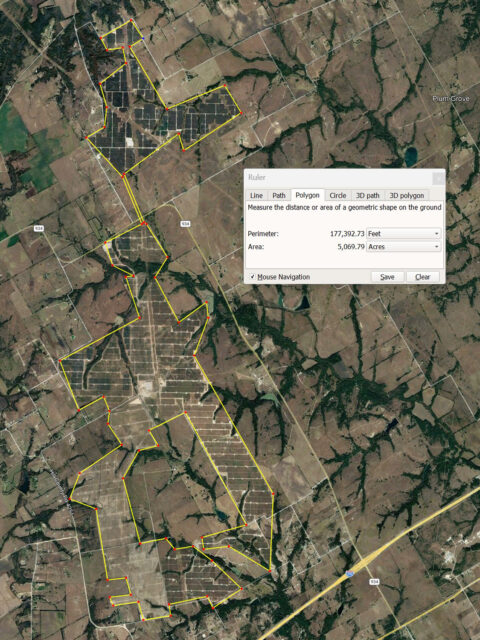
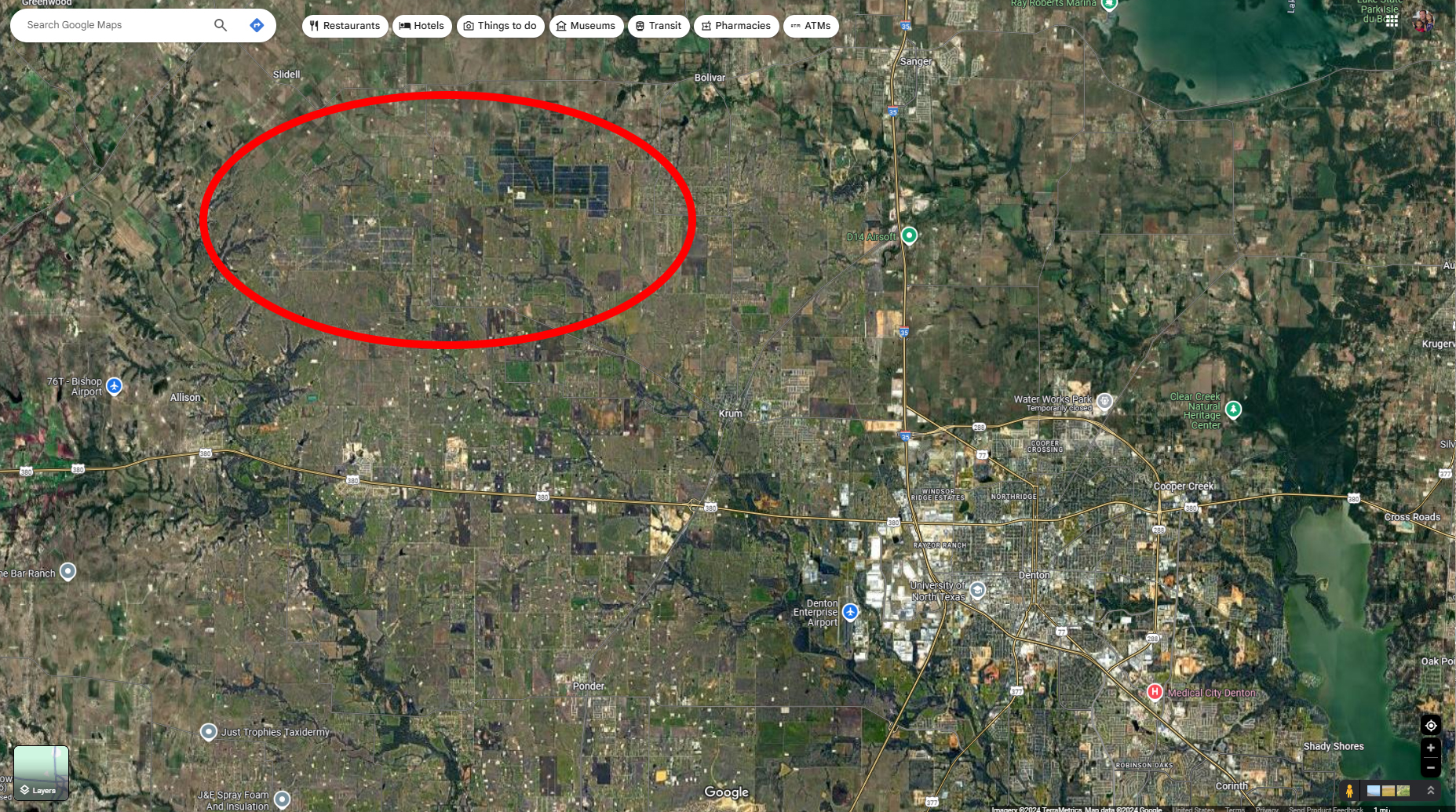
The Samson Solar Energy Center near the
Red River is nearly four times larger.
Click Image to Enlarge
Q: What is the largest solar farm in North Texas?
A: The 1,310-megawatt (MW) Samson Solar Energy Center, located in Franklin, Lamar, and Red River counties in Northeast Texas, is the largest solar farm in the region and one of the largest in the country. Developed by Invenergy, this project was completed in 2023 and spans three counties near the Oklahoma border.
Q: How many acres of solar panels are there in the Samson Solar Energy Center solar farm?
A: The Samson Solar Energy Center in northeast Texas spans approximately 18,000 acres of land across Lamar, Red River, and Franklin counties. Developed by Invenergy, this 1.31-gigawatt (GW) project is one of the largest solar installations in the United States, utilizing this massive footprint for its five-phase construction.
Q: How much did it cost to build the Samson Solar Energy Center?
A: The Samson Solar Energy Center, developed by Invenergy in Northeast Texas, represents a total capital investment of approximately $1.6 billion to nearly $2 billion. The 1,310-megawatt project is one of the largest solar farms in the U.S. and was constructed in phases, with completion fully realized around 2023–2024.
Q: How many acres of solar farms are there in the state of Texas?
A: As of late 2025, Texas hosts over 220,000 acres of developed solar facilities. This footprint is rapidly expanding, with projections suggesting an additional 1.5 million acres could be developed soon. The state leads in national solar growth, with 31,292 megawatts (MW) of operating utility-scale solar capacity by April 2026, spanning numerous large-scale projects.
Q: Where are solar panels used in North Texas assembled?
A: While many solar panels in Texas are imported, significant assembly and manufacturing occur in the state, particularly near Houston and in East Texas. Priefert manufactures tracking systems and panels in East Texas, and Elin Energy opened a facility in Brookshire (west of Houston). Other manufacturers include GAF Energy (near Austin) and Sirius PV (near Houston).
Q: Are parts for North Texas solar farms manufactured in China?
A: Yes, a significant portion of components for North Texas solar farms are manufactured in China or by Chinese-owned companies. China dominates over 80% of the global solar supply chain, including polysilicon, wafers, and cells. While some, like T1 Energy, operate Texas factories, they often rely on Chinese components or investment.
Q: Do North Texas solar farms supply power for oil and gas production?
A: Yes, solar farms in Texas—particularly in West and North Texas—increasingly supply power for oil and gas production. Major energy companies, such as Occidental Petroleum, utilize solar-generated electricity to power enhanced oil recovery operations in the Permian Basin, aiming to reduce costs and carbon emissions.
Q: What is the life expectancy of a solar farm in North Texas?
A: Solar farms in North Texas are typically designed for an operational life of 25 to 30 years, though many can continue to operate beyond this timeframe. While some solar projects in the region are built with a projected 20-to-25-year lifespan, advancements in technology have made 30-to-40-year lifespans more common for newer, large-scale utility projects.
Q: How long do solar panel last?
A: Solar panels typically last 25 to 30 years. Rather than stopping abruptly, they slowly degrade, with most panels still producing over 80% of their original output after 25 years. High-quality panels can last 30–40 years, while inverters usually require replacement every 10-15 years.
So, now with a little more context, let’s try to address some of the assertions made in the comments on the original Facebook post.
It’s easy to sympathize with the view that solar farm installations detract from rural areas in significant ways. They are, after all, large-scale urban-type developments located in the country, far from our urban centers. It’s not surprising that some people object to these kinds of developments suddenly encroaching on their familiar rural landscapes. It’s also easy to understand why some folks may not see these facilities as being as environmentally friendly as promised. If a person cares about the environment and ecology, it’s not hard to imagine that they might feel a bit betrayed by this aspect of solar power.
The perception that Texas solar farms might be large-scale government boondoggles seems to be a legitimate concern as well. Managing money well is not one of our government’s strong suits. The government has a long and sordid history of wasting huge sums of money on both projects with and without merit.
The idea that solar farms might be more appropriately located in already urbanized areas and on top of existing infrastructure might appear to be a good idea at first glance. But, if you take just a moment to consider the impact of road construction and maintenance now–without solar panel installations, you might expect that the inconvenience would be much, much worse if solar panels and their associated infrastructure had to be accommodated throughout the process as well. The other proposals present similar challenges. Homeowners who have installed solar panels on their roofs might be surprised to see the hoped-for recoupment of original investment reset when their roof needs replacement after a severe hailstorm. The solar panel will have to be uninstalled and reinstalled at that time–a costly extra expense.
Other arguments in favor of solar farms included the premise that these installations are tolerable because they were installed on existing farmland rather than on truly wild, undeveloped land. But, even though farmland is not the same as feral property, it is still much closer to a natural state than is a solar farm made of concrete, glass, and metal. To people living in the immediate area, farmland presents a rural aesthetic, while solar farms are undeniably more technological in their appearance. Farmland also provides at least an annual opportunity for reversion to a feral condition. Solar farms represent a long-term commitment that will impact a property for decades. Reverting a solar farm back to farmland–or the land’s natural state–would require a massive and expensive cleanup effort.
Another defense of these installations is that solar farms are preferable to the continued use of hydrocarbon fuels. But this is also a disingenuous premise, as the choice is not binary. We are not in a position to choose solar power over hydrocarbon power–we use both. And currently, it appears that we are increasing use of one, without a corresponding reduction in the other. All indications are that hydrocarbon production and use has gone up steadily in Texas, even as solar farms have been installed all across the state.
Other commenters noted that oil and gas production in Texas requires a similar amount of land use and thus leaves a footprint comparable to solar power. They suggest that oil and gas use goes largely unnoticed because we have become accustomed to seeing it. There may be some truth to this observation. The Texas countryside is littered with oil and gas production sites. It is crisscrossed with buried pipelines. But none of these operations are concentrated in a single, huge area the way solar farms are. Oil and gas operations are typically much more spread out. The resulting aesthetic and environmental impact is just not the same as with solar farms.
Perhaps the most questionable defense of solar farms came in the form of claims that scientific studies have indicated that solar farms have zero impact on biodiversity. This is a remarkably bold claim that most people will instinctively recognize as suspect. Further, it’s a great example of how science can be manipulated for political purposes.
Solar farms certainly have the same general impact on biodiversity as any other large-scale development project. To assert anything different is insincere. Whether the impact is detectable or not depends on the level at which a scientific study is conducted. If the study is conducted at the state level, or even at the county level, a single solar farm is unlikely to show an impact on the region’s biodiversity. The same is true for a single super highway, or a massive parking lot, or a giant new football stadium.
But if the study is done at the acre level, the story will be dramatically different. At this resolution, the biodiversity impact of a super highway, or a parking lot, or a sports arena, or a solar farm will be very close to the same–in all of these cases, biodiversity will be dramatically reduced to a point approaching zero. At some critical point, the consequences of habitat loss and fragmentation resulting from the construction of multiple large-scale solar farms in rural areas will become undeniable.
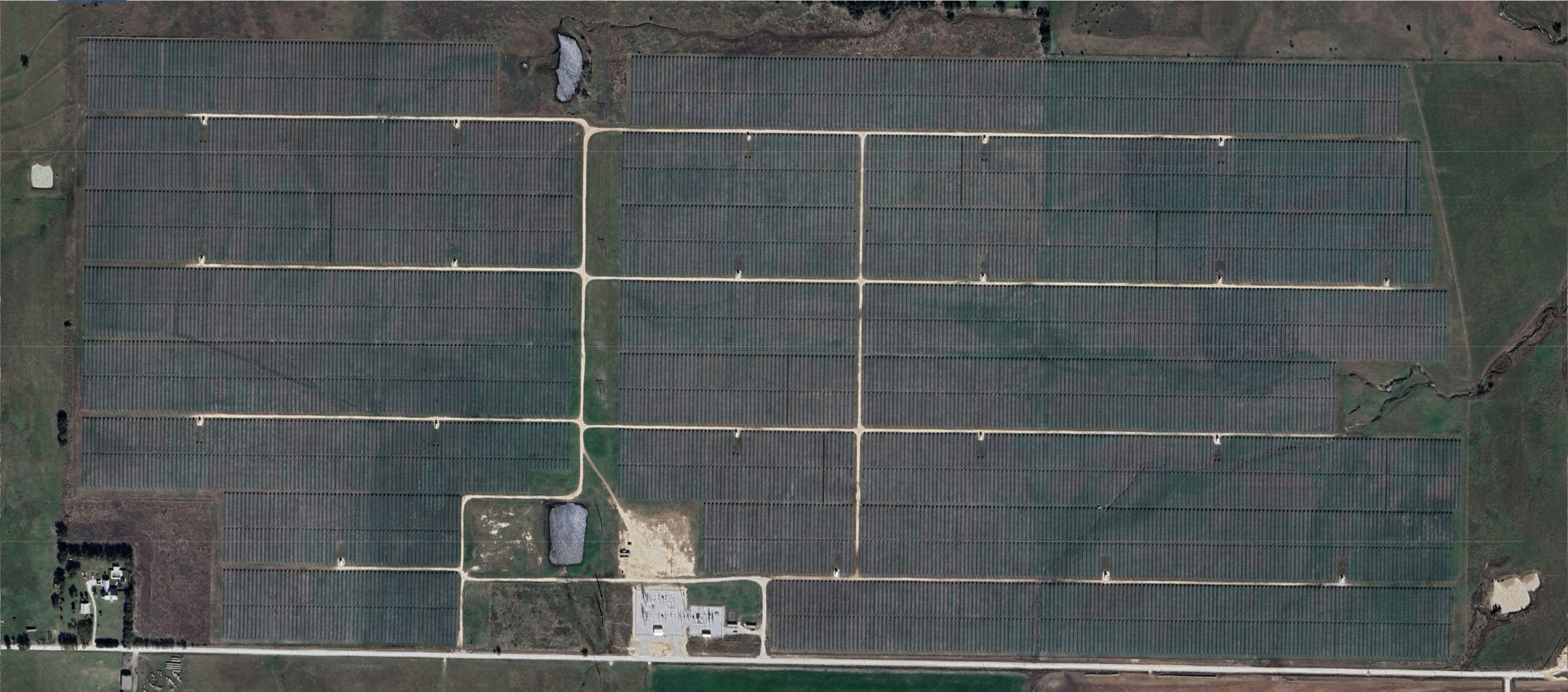
In addition to the concerns addressed above, there are also many nontrivial expenses associated with solar power that must be considered. First, there is the design and manufacture of the solar panels themselves. Large quantities of plastic, metal, and glass are needed for their construction. The solar panels must be packaged and shipped for delivery to their installation sites. Property to be used for solar farms must be purchased or leased. The remote locations chosen for solar farms must be prepared for solar panel installation. Heavy equipment must be brought in, and acre upon acre of land must be cleared of vegetation. Service roads must be constructed, and fencing must be installed. Rows and rows of metal and concrete are required as platforms for mounting solar panels. Utility right-of-ways must be created across private lands, and transmission towers, with miles of cables, must be run to reach remote rural solar farms.
Solar panels have an expected lifetime of 20 to 40 years. At the end of this time period, the panels in a given solar farm must be replaced, or the solar farm must be mothballed. The expense of deconstructing a derelict solar farm will be substantial. Much of the resulting refuse would likely end up in a landfill.
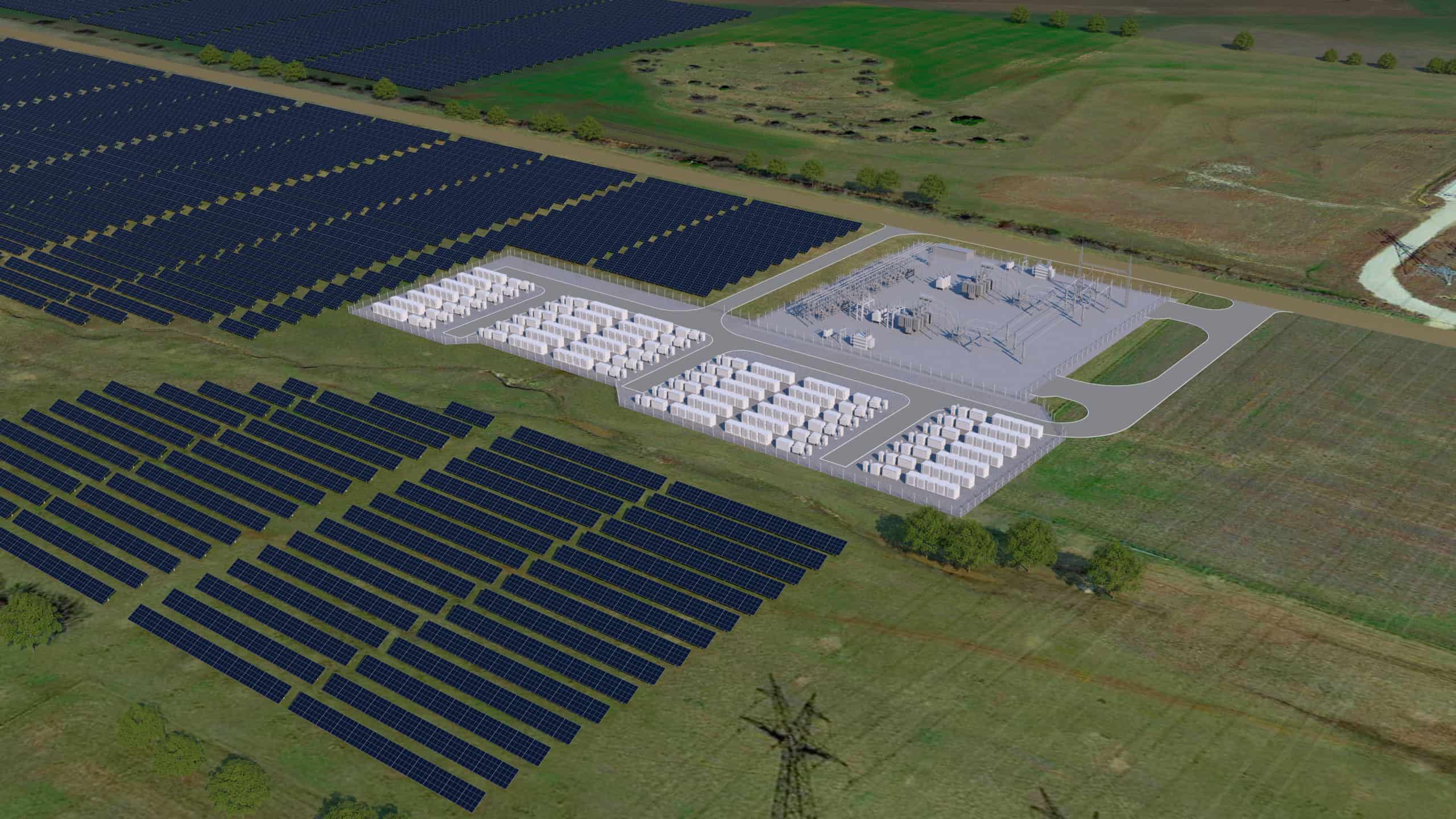
The hard truth of the matter is that these solar farms, covering acres and acres of rural land–even when they are in full operation–count as pollution, plain and simple. There is no other way to describe what these developments are doing to the countryside. The question then becomes, is the degradation of the countryside worth it? Is there a greater benefit to be gained by covering large swaths of land with concrete, metal, plastic, and glass? Do we get more in return than we lose? Have our carbon emissions been reduced? Is our electricity grid more reliable? Have our utility bills come down? Has the environment been protected? Are we reducing our reliance on foreign and hostile countries for our energy needs?
No matter what the answers to these questions are, the most important thing to come away from this article with is the recognition that there simply is no such thing as consequence-free energy production–that is the plain and undeniable science of the situation. No matter what the pundits say to the contrary, creating energy always comes with a cost. There is always some price to be paid. With solar power, one of the costs is the loss of acres and acres of countryside to glass, steel, and concrete.
In the end, it comes down to the relative magnitude of the expenses incurred. Our best bet will always be to identify and use only the energy production methods that provide the greatest benefit for the least cost–regardless of whether the price paid is monetary or environmental. It may turn out that solar power is better than the alternatives–or maybe it isn’t. We need to be sure.